Where to draw the line?

Dragster 1

The title for todays post is phrased as a question and is one that is occupying a sizable chunk of my creative brain power at the moment. Although a single question, it concerns two very distinct aspects of the drawing you see above, which is shown in nearly finished form.


The first aspect of the question arises from my decision to crop the image and leave some of the image blank. Why? Well it stems from some feedback that has come this way in recent weeks, and some older thinking from a while ago which centred around the issue of how to introduce another dimension into the monochrome ink drawings. Combining the “less is more” approach and the often mentioned ability of the eye and brain to work together to complete an image, the time seemed right for some experimentation. When soliciting comment from others about the drawings it is interesting to hear that in some cases there is almost too much information provided, that the eye, brain and imagination are left with no work to do. Everything is there in front of them and there are no gaps for them to fill in. This got me thinking about where the edges of the drawing lies and how much information is then left within the space. Hence the cropping, which I could have done simply on a completed drawing in Photoshop, but that wouldn’t be the same.


The other part of the titles question touches the same subject but lies behind my decision to leave the rider figure blank. The line that this part of the enquiry is concerned with is that which does or doesn’t depict the missing rider. Are the blank spaces amongst the bikes details exactly that, is the figure simply delineated by a simple outline or is his form expressed in line only ie legs, head, arms etc?


It is far easier to add to a drawing than it is to subtract, particularly when working in ink. I wanted the drawing to be grounded so have only cropped on three sides and have slowly built up the image until it meets my ruled edges. Once the bike is complete I can then work toward figuring out where the line work for the rider will go, moving through my three options until I’m happy. Of course it may all end up looking a bit odd, but unless one tries these things one will never know.
 

Cafe Racer-hot off the press

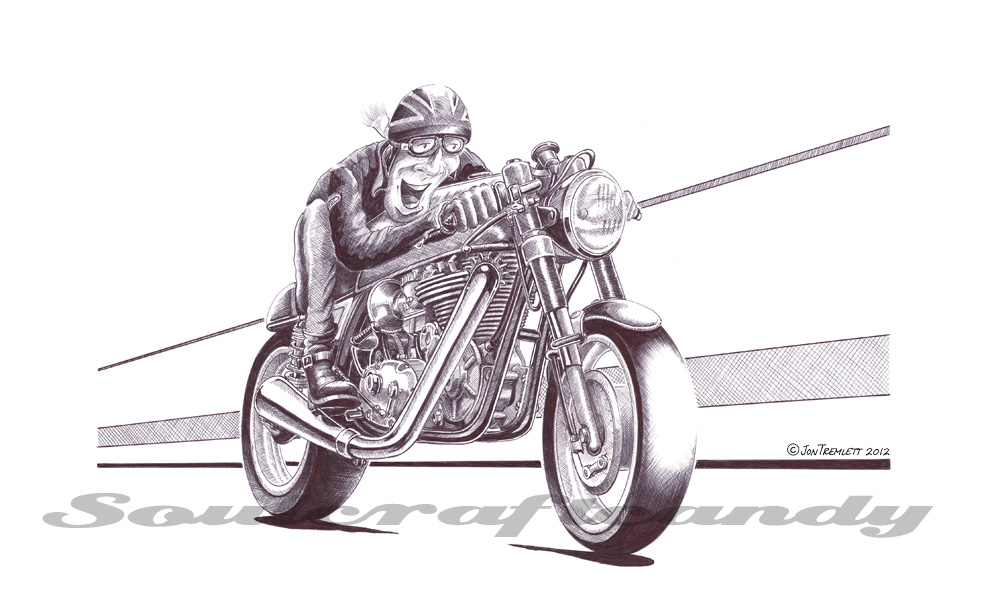
Cafe Racer 1

Hot off the press comes the first finished drawing from the Cafe racer series.


Having made the decision to work on a series of drawings, all connected by a core theme, there is a kind of flow starting to emerge during the process which has not necessarily been present before. Previously the completion of any drawing was quickly followed by the question of which sketch to pick up next and move forward. Despite working on several drawings concurrently it was always there in the background and served as a persistent distraction.


With a number of preparatory sketches clinging to the wall of the studio room an order is establishing itself as to what’s coming up next and this leaves the mind free of constantly needing to think of new ideas all the time. Focusing on concentrated idea generation sessions and then working through a series feels quite liberating in a way. It’s a much more methodical way of working as opposed to the rather scatter gun approach of before.


It is an inescapable truth that none of us work in the same way. Part of the journey that this blog hopes to chart is that bit which concerns finding the way of working, the methodology if you like, that best suits what I’m doing. It goes beyond being systematic purely for systematic’s sake. The world is ridden with systems and creative activities are no exception. If you ask any other creative person what the best way of working is, they will invariably enlighten you to their preferred ways of working. This is not a bad thing in itself but in most cases it’s the way that works best for them. The key is listening to their comments and adjusting your own approach incorporating those points you want to include. What you decide upon is never set in stone, and in fact should be able to evolve as you and your skills do. It should be all part of the fun, so if it’s not working, change it.


Finally, why cafe racers? In brief there are a couple of reasons that stand out from the field. The first is that to me they represent a very elemental form of machine. Simple, uncluttered and encompassing a purity of purpose which appeals to my sense of form and function being in balance. The second is perhaps a bit more romantic in nature. These machines in a way signal the birth of personal customisation in its purest form. English cafe racers and american bobbers could be said to be the first street specials of the post war era and as such are now the bedrock of all subsequent modifying styles from diggers to streetfighters, and choppers to street trackers. It’s a style that has endured and continues to do so. This is my way of celebrating that. The fact that I live only about three miles from the original Ace Cafe might have something to do with it too.


A short foot note. This drawing is going to be submitted for a public art show here in Ealing at the end of March. It may even be for sale, in which case it could be a first if it finds a happy owner. Fingers crossed.


Background noise.

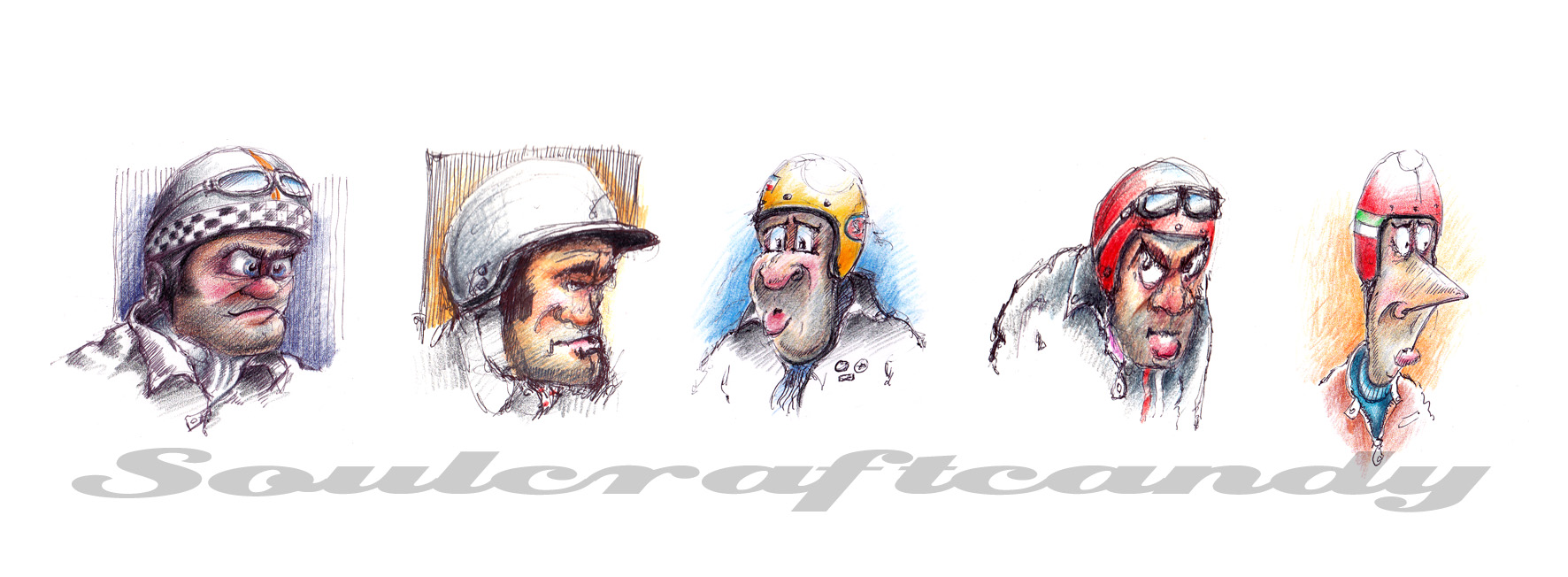
As mentioned before on the blog there are always things going on in the background while work on the larger finished drawings is progressing. Sometimes this takes the form of working sketches which will form the basis of larger works, at other times they are small drawings that are used to practice techniques or develop an idea.

Above are a small group of what are known here as bikeheads. Invariably the larger drawings contain a character or two and it is often a challenge to get them looking right for the given context that they find themselves in. Finding the correct pose and body shape is never simple and the same goes for facial expression, and how this reflects the characters personality. The former are dealt with purely through sketching out varying forms but, the latter is harder, especially when you realise that even the slightest variation in line can change a facial expression completely. So as an aid to get things going I have started a kind of character bank in which to keep all the doodles of heads and faces that appear through the sketch sheets. It will then be easier to have a look through and find some inspiration when it’s needed. Adding some colour to these helps to bring out the character and keeps my colour pencil technique up to scratch too if it’s not being employed elsewhere.

Which leads me neatly onto this second group. Back in December a post contained some small groups of varying bike styles I was playing with at a reduced scale. Those had been completed in crayon and ink. These above were done purely to see what would happen if they were done using liquid inks and watercolours. To find out how intense the colours would be and how much of the detail could be held  given the very liquid nature of the medium and the coarser paper used. Very fine Rotring pen has been applied too, to firm up[ the outlines and add extra black where desired. The paper was fine for the paints but proved to be a bit too “wooly” for the finer stuff subsequently done with the pen. Next up will be a test on harder paper.

Some say you can’t learn to draw from a book. This may be so, or not, but a couple of really useful books I refer to regularly are Action Cartooning by Ben Caldwell, here, and Cartooning The Head & Figure by Jack Hamm, here. Both are invariably out on the desk when character sketching. Neither will teach you a style but, both will inform whatever your personal style may be. Great books.