It’s very green.

103_Nail_It©JonTremlett2014

Just a brief post this time as there is still much to do at the end of this Bank Holiday weekend and we are all back at school tomorrow.

So here above is the finished picture that was shown in a part done state a couple of weeks ago. Safe to say it’s very bright and colourful and has turned out pretty much exactly as I planned. I love using a bright orange on the bike tanks and so it seemed only logical to offset that with a blazing green for the background block. And because the bike’s standing pretty much on its nose, then angling the coloured area around it seemed like a good way of emphasising the the dynamic of the image.

This one’s done on a much smoother water colour paper than the usual fare and it makes a real difference to how the inking goes down and the control that one can exercise in the coloured areas. I hope you like it as much as I do. Gotta dash.

Creative decisions that are right for you.

Taking my time to find the right position.

Taking my time to find the right position.

Time to take a look at cutting and fitting the new rear mudguard. There is much talk in bike building circles about getting the stance of your bike right as a prerequisite for coming up with anything good looking. There is a school of thought that is very prevalent currently to have the line of the bike very flat. That’s to say, the visual line from the back of the seat running through the base of the tank to the front suspension should be pretty much parallel to the ground. Hence you see lots of bikes that are all starting to look the same and share the almost totally flat seat which is almost ubiquitous in its manifestation. This is all well and good if you’ve got the time, money and the need to go down this route. Personally I haven’t. As I’ve mentioned before, without resorting to large amounts of frame modification  (read expensive welding bills and jiggery) and spending a whole pile of cash on different suspension equipment, there’s not much one can do beyond a certain point. The creative challenge is therefore to move away from the standard look enough to create difference and come up with something that works with the proportions one is presented with. This can be a lot harder than you think, but it is possible on a very limited budget and is generally a case of taking ones time in positioning, cutting and mounting components. Once you’ve cut metal there’s very little you can do to rescue things, so it pays to exercise patience and adopt a methodical approach no matter how quickly you want the project to be completed.

Position set, holes drilled, just the light to mount.

Position set, holes drilled, just the light to mount.

Of course, what “looks right” is a purely subjective conclusion. Because these kinds of projects are pretty personal in their nature, the result must first be right for you, in your own eyes. That’s the most important thing really. Decisions you make in a build are always contextualised by a whole host of factors and compromises that one has had to deal with on the journey to the final outcome. Others may not like your final iteration but then invariably they have little knowledge of this context. As a maker, of anything, one has the luxury of knowing that you could change or modify things in future if the urge takes you, but it’s an option that you can reserve to exercise if you so choose.

When I first built this bike I made a pile of decisions about how it would look based how I felt about the life it would lead, about practical issues like comfort and durability as much as aesthetic considerations. I reserved the right to change things if I wanted to but generally didn’t feel the need to do much other than periodic tweaking. Now, some time later, it is time to make some changes  based on living with it and riding it for a few years. There are still certain things about the stance I can do little about, but these are not a problem. The bike started life as a factory custom and so caries with it some small legacies of that life which I’m happy to live with, like the long forks and the steep rake of the tank.

A rather blurry shot courtesy of my iPad, but you get the idea.

A rather blurry shot courtesy of my iPad, but you get the idea.

So here are some shots showing the process of getting the new rear mudguard (fender) sitting in the right place, at the right angle in the right way. Once I’d cut the bare rolled section I’d bought to roughly the correct length I spent ages with bits of foam, tape and cups of tea trying it in different positions to get the look I was after. Once I was happy I marked the mounting holes for drilling and returned to the shed for some hole making. The critical factor was getting enough section over the wheel without it looking overly long but still having enough curve available to support the light/plate assembly at the right angle. I didn’t think things had changed much until I held up the new piece next to the old one to see that I’d actually reduced the length by about 150mm, very satisfying.

The final shot shows the guard in place with the light mounted and everything else ready to go. The final piece of this refresh is painting the petrol tank, which I’m currently working on a design for and I’ll be posting about that very soon.

Advice and opinion, don’t confuse the two.

Instruments: before, big and busy. After, uncluttered and simple.

Instruments: before, big and busy. After, uncluttered and simple.

There is a big difference between advice and opinion. One serves to guide and promote discourse, and the other invariably confuses things and promotes argument. I learned the difference between the two a long time ago and am constantly reminded of that lesson. When seeking advice we are generally hoping to tap into the accumulated knowledge and experience of others whose judgement we trust. Opinion on the other hand is generally something that follows acting upon advice and is subjective, unless of course, the other person has misconstrued your original query, in which case you get a whole load of one when you wanted the other. When I’m engaged in making stuff I ask for advice, when I need it, from other makers I know, and I might canvas their opinion when I’ve finished what I’m doing, but not before.

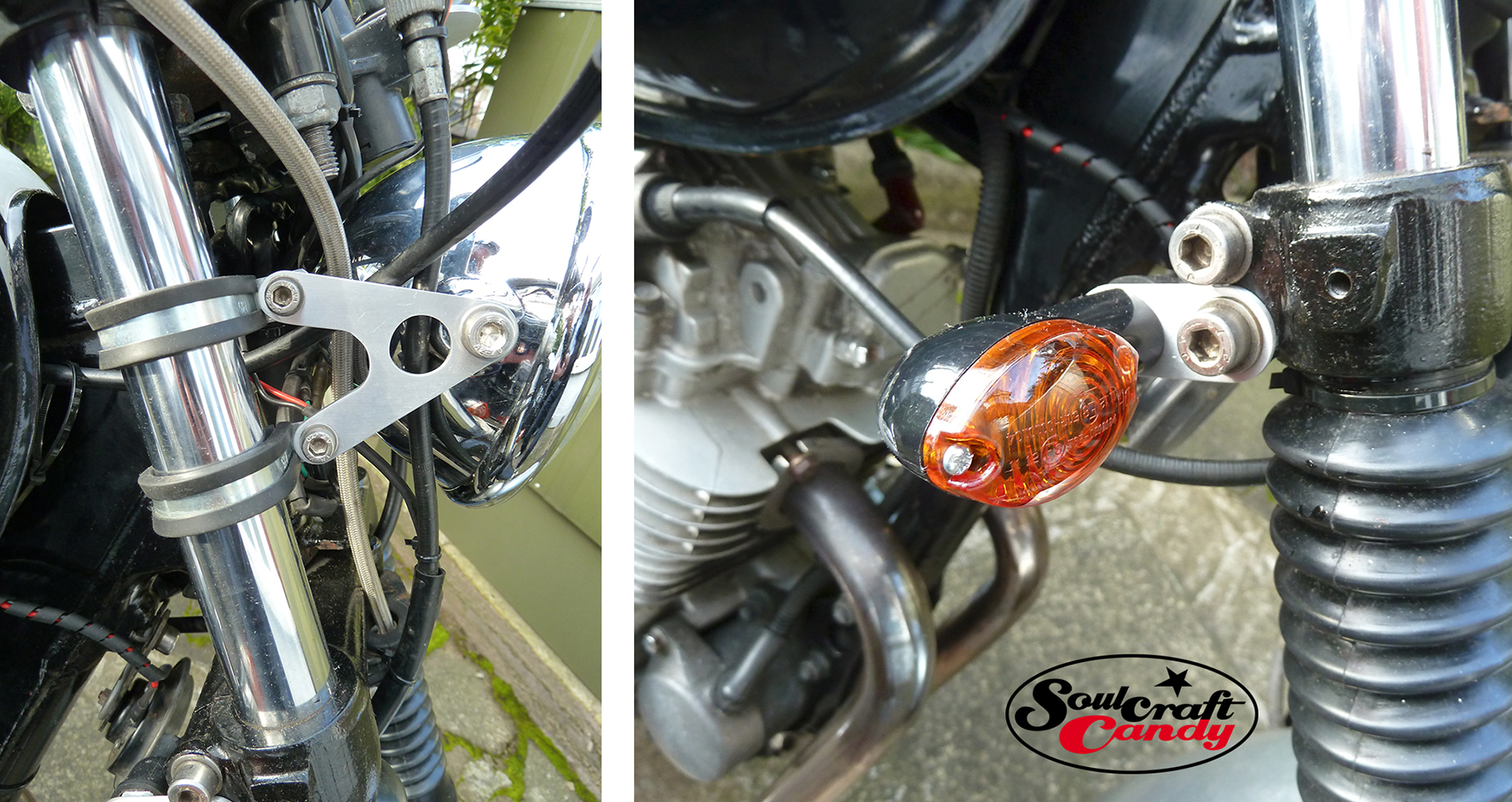
New headlight brackets and new front indicator light mounts.

New headlight brackets and new front indicator light mounts.

If I’d followed all of the unsolicited “advice” I’d been given about how my bike should be, then I would have wasted a great deal of money and time on what is essentially a cheap form of transport. Working within an admittedly self imposed tight budget, and with time pressure to match, the solutions that interest me are those which are simple, relatively easy to execute and fit for purpose. It is with this in mind that I approach everything I do on this build and it helps to steer things clear of needless expense and wasted effort. One day I might build something more special but, for now I’ll work with what I’ve got. Sorting out the instrument area and the headlight would have been “better” if I’d totally stripped the bike of all electrics, cable drives and other bits, but that doesn’t clear the deck, it just opens up a whole new avenue of expensive solutions to a new set of problems. Working with what’s there meant splitting the clocks to allow cable drives to flex more freely and shorter light mounts to keep things close in and fairly tidy. The bundle of wiring needed to keep things working would stay, although shortened and repackaged. I’d bought some ‘P’ clips some time ago thinking they’d do for mounting the light on the forks and so put them to use. they work well enough for now though I may make replacements with a tighter fit later on. I drew up some side brackets on some graph paper (brilliant for laying out simple parts to scale) and transferred the design onto some aluminium alloy for cutting out. I made a new speedo mount based on what had been there before, but with a 20 degree offset and modified the mounting that came with the tachometer when I bought it, to bring it closer to the handlebar. All this allowed me to raise the light and split the clocks, and try to keep things as low as possible. By tilting the bars back further I was getting near to where I wanted the front to be. It looks a lot more sparse than before, but I’ll get used to it. And the natty little fly screen has gone.

I was very fond of it, but it had to go. A quick word about making those side brackets. Because I’d drawn them out on graph paper, it was easy to draw them again on alloy sheet, you remember all the numbers. I cut them out using a jigsaw, slowly, with a blade for metals at slow speed. I finished them off with hand files and drilled the holes with a hand drill. It takes time but not as long as you’d think and the result is pretty tidy once they’ve had a rub down with 600 grade wet and dry paper.

Here’s a canny bit of advice given to me by my father just before I started this: when filing soft metals, rub chalk along your files, it stops them from clogging. He was right, it did too. You can’t beat good advice. His opinion? Well, he didn’t have one, he’s waiting until I’ve finished to give me that.