The 3D Pantograph Club, Part 1- Ed’s Machine.

Ed Barton Pantograph on Soulcraftcandy.

Ed and his 3D Scaling Pantograph.

It is an inescapable truth of freelance working for creative companies that you are rarely in a position to show or talk about the work you are engaged in, or have just completed. Issues of client confidentiality, and the fact that much of the work is usually a long way from entering the public domain mean you can’t show anyone what you’ve been making for quite a long time after the event. Hence the lack of “making” content on the blog for a long while.

Prompted by a recent visit to the studio of a sculptor friend, this is about to change however, as it has nudged me into digging a project out of the archive in readiness to post about it.

I first met Ed up at the Ace Cafe, a favoured north London haunt of motorcyclists, where I got talking to him about his fabulous Moto Guzzi. When we discovered what each of us did for a living, and dug a little deeper, it became clear we had more in common that purely an appreciation of personally customised motorbikes. Ed mentioned that he was interested in building a 3D Pantograph, and I had completed the construction of such a device not that long previously. Needless to say he was interested in understanding what my project had revealed regarding these rather esoteric bits of equipment and a good many knowledge sharing conversations ensued.

Before going any further though, it is probably best to try explain what a 3D pantograph is exactly. I will try and be brief. A pantograph is essentially a scaling machine that allows the operator to enlarge, and in some cases reduce, the size of an image or object. They are more commonly found in the 2-dimensional realm where they are used to trace lettering or pictures for engraving and such like. Being utterly analogue in their function they have now been generally superseded in most applications by digital technology, so they are rare things to come across. Working from a fixed pivot point, two pointers, connected by a series of pivoting arms allow the operator to follow an image with one pointer whilst the other creates a replica of that image on another surface at a greater scale, like 2:1 say. In 3 dimensions the principle is the same though in this case the first pointer follows the surface of an object, positioned on a turntable, while the second allows the operator to create a scaled up or reduced version of that point in space on a second turntable nearby. If this doesn’t make sense, then I hope that seeing some images and a short film will help to make things clearer.

The pantograph pivot and counterweight assembly.

The pantograph pivot and counterweight assembly.

Last weeks visit to Ed’s studio in Camberwell, South London was to finally see the pantograph he had built. It was impressive. Through our earlier discussions we had figured out that these machines could take many forms, it is the core geometry which provides the link between different designs. So not surprisingly Ed’s machine is a very different looking beast to the one I built, and amply demonstrates how a different “brief”, ie what you want to make with it,  effects the final design and layout of the machine. Here’s a link to the studio website where you will find a great stop frame film of the guys building their machine and then using it to cut complex forms out of large blocks of expanded polystyrene with a hot wire, and other images. When I visited the studio last week the hot wire had been replaced by a high speed cutting head which the guys had used to carve even more complex forms from similar blocks. You will also see that the machine consists of the two main elements required for the pantograph to work, a pivoting arm that holds the “pointers” and a pair of connected turntables supporting the final piece and the model from which it is being traced.

Ed Barton pantograph at Soulcraftcandy

The business end, a high speed cutting head.

In the next post I’ll reveal the details of the machine I put together for an artist, and expand a bit more on how these things work.

No wasted time.

Caferacer_1

Aahh, back to the blog, at last. It seems to be a never ending consequence of working freelance that just when you’re getting into the flow of something, another job comes along and completely consumes you and all of your creative energy. This time it was the construction of some very large card models in what’s known as poly-board, a foam cored board with thin card faces. In this case 10mm thick, they were really big models with large curving surfaces, which requires a very particular approach to construction and problem solving. I won’t go into any more detail here but, I’m of a mind to expand on the subject further in future posts. Needless to say the time scales for these kinds of work are short, the working days long and brain fatigue a constant companion. But it’s done now, until the next one.

Chopper_1

So, while the above has served to get some income in, it has prevented me from getting on with a stack of drawing stuff that was all lined up. But this down time is never wasted. My trusty sketchbook, currently an A5 Moleskine with lovely creamy paper, comes with me to work every day and allows me the chance to have a scribble during my lunchbreaks. Armed with a couple of the ideas that were waiting to be developed further, these snatched chunks of time enable some thinking to occur and help to satisfy the daily drawing need.

Dirt_rider

These three little doodles are about trying to find a progression on the ideas I’ve been having lately about cropping and framing the images to create little story snapshots whilst still maintaining some dynamism to the pictures. At the moment they seem like glimpses, captured in a moment and an attempt to try and say more through showing less, if that makes sense. Currently they are all pretty small so working them up a bit at a larger size will help to give them a bit more purpose. With the Christmas break upon us one can never be too sure how much free time can be given to some quality drawing time but here’s hoping we can steam into the new year with a bunch of fresh and exciting ideas on the go.


Finally, it just remains for me to wish all of my followers and readers a very Happy Christmas and thank you to you all for staying with Soulcraftcandy over the past year.


One task, lots of tools to play with.

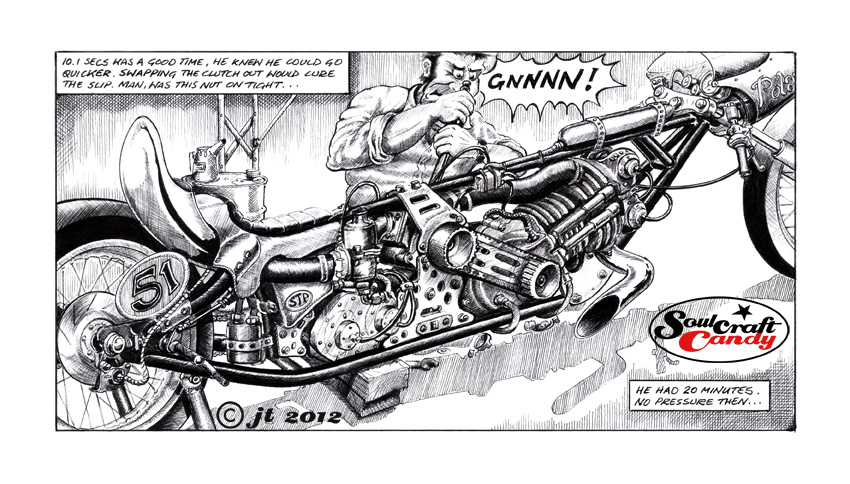
Fix your dragster.

Well, here’s the final finished version of the first foray into the world of capturing the story behind an image. I’m quietly pleased with it even though it probably represents the simplest approach to all of the story stuff I have been posting about these last couple of times. It works, and that is the most important thing. Yes, there is much room for improvement but as a first stab it’s encouraging to feel that the framing and words add to the image rather than take anything away.


What is interesting is how looking at it now sparks an immediate desire to improve things, to create more. That’s not to say that what happens next is merely an extended exercise in  duplication across any number of pictures, more a wish to really get stuck in, and learn properly how to make best use of all the different devices at ones disposal, and perhaps invent some new ones too, specific to these drawings.


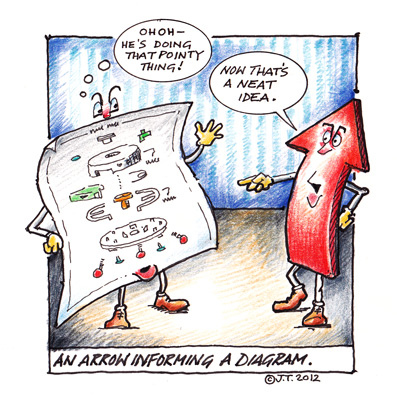
Opening any book about creating comics and graphic novels invariably floods you in established conventions for framing, speech and thought balloon use, caption box positions, view angles, perspectives and all manner of inking and texturing techniques. All of it is there for us to learn from. It can be a bit intimidating. The best bit though is realising that none of it is compulsory, and that all of these things are there to be played with. Their task is to inform the image being created, rather like an arrow or two might inform a diagram, so there’s no need to use all of them all of the time. Much more fun to find the things that work for you and the types of image you create, than feeling the need (and pressure) to become a master of all before venturing to the paper to make your first mark. There will be lots of experiments and invariably lots of trial and error involved but, without learning through doing, things won’t move forward, or worse get stuck in a repetitive rut. And we can’t have that.

And finally…….