Go easy with that colour.

CB based CR, first sketch.

The water colour paints that I have been experimenting with in my recent forays into the world of colour fall into three easily discernible groups. First there are those which come in small block form in a handy painting box. These are what you might call “classic” watercolours and although offering apparently quite vibrant yellows and reds, they are generally rather earthy in nature. The box I have here contains eighteen blocks, quite enough for most things. The second group are in liquid form, like toothpaste, and come in small tubes. My small collection of these covers some Payne’s Greys and some tinting greys of various hues. The third group are those Radiant Liquid Water Colours that look more like inks and come in small bottles with a pipette in the top.


The first and second groups are reasonably easy to get along with although there are moments when certain paints do weird things when applied to certain papers. I’m yet to get to the bottom of that one. The third group, those radiant fellows, are where all the danger lies and one must approach them with some caution. Through their vibrancy they tempt you to get a bit over excited with their application. One finds oneself forever walking a fine line between creating an image with a lovely glow to it, and utterly overdoing it, ending up with a riot of colour that could almost make your eyes bleed.


The “sketch” above, to me anyway, is one such moment when I stepped over that line. Thinking I’d go for a simple vegetative backdrop I piled on the colour like there was no tomorrow. Once I’d started I found I couldn’t stop myself. What was meant to be a rather subdued background ended up being furnished with nuclear powered bushes. The scan almost doesn’t do them justice and I had to go and do something else for a while rather than attempt a sky. It remains without said sky, the white mimicking the grey overcast look of a typical english day. It is stuck to the studio wall now, where it serves as a reminder to take it easy.


I do like the way the bike turned out though, which is what the sketch was all about in the first place. I traced this drawing off on the light box a couple of times so that I could monitor more what I was doing through working on the same picture a number of times. Version 2 will feature in the next post.


Finally, if you are reading this Larry, you can see that I’m using the pictures of your bike to inspire some images. The Honda CB750 is a handsome beast and serves as a great starting point for some future images. There is still work to be done but the process has started and you will be able to follow my progress here on the blog.

 

Work in progress.

First Dragster drawing

A couple of days in and the V-twin learning exercise is progressing well. It has not been easy balancing ones need to learn a configuration whilst at the same time not getting sucked into rendering hefty amounts of accurate detail which only serves to slow down the whole process and make it less fluid. In a way this is a process which repeats each time a new project is started, though it does vary greatly in its effect and is something one has to be constantly mindful of. There is a time for detail and a time for covering as much ground as possible. The secret is to learn and train oneself so that the jump between the two becomes instinctual, it’s not the easiest skill to learn and I struggle with it all the time.


Todays images are selected from the Dragster project inspired by my recent visit to a drag race meet. The one at the top of the post is a snap shot of a work in progress depicting a machine being pushed through the paddock on its way to the staging area. It’s kind of working as a drawing but needs a lot more work to reach completion, though it’s great to get to grips with all of the bits and pieces, the plumbing and components, that all fit together to make the whole.

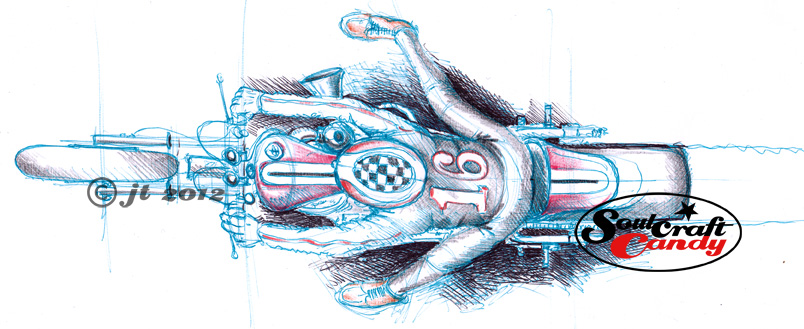
This one and the sketch below are from one of the larger sketch pads where the small scamps from the sketchbook get a work out.  What’s different about these two is that there is hardly any bike on show. There is enough to give you the impression whilst your attention is drawn mainly to the riders and their attire, and I like that.  There is a wonderful element to this racing scene which is both graphically bold and very colourful, strangely evocative of a bygone era almost. Wonderful serif fonts used in names and numbers and a healthy usage of glitter paint, retro and modern styles all coming together in a riot of colour. It would be great to capture some of that in the final drawings, which means reaching for the colour paints and inks, can’t wait. The overhead view in particular should allow a picture of a very different aspect ratio which will be interesting to create.


For completely illogical reasons that now escape me, I’ve been using this particular light blue pen for all the sketches done this week. It’s not a very sophisticated device being from a set of three I bought for a pound some time ago, pink and purple were the other colours, but there is something in the ink and the way the pen releases it that works really well with the sketch paper. I have no idea if I’ll be able to find any more when it finally runs dry. For now it does its thing well and constantly reminds me how often great results can come from using the most basic tools.


V-twins, learning to draw them.

Bobber, side elevation

Here are a couple of different sketches today which are inspired by some shots I took at the drag meet of some great custom street bikes that were on display there. I have been meaning to try and have a crack at some V-twin powered creations for absolutely ages.


You could be forgiven for thinking that this engine configuration is utterly ubiquitous given that it seems to lie at the heart of so many custom motorcycles the world over. You only have to open the pages of any custom bike magazine and they are everywhere, such is their popularity. But for some reason I have persistently shied away from them. At first it was very much a case of their apparent simplicity being incredibly difficult to capture in perspective views and, secondly it was just a case of never being able to get the proportions right, no matter how hard I tried. In fact the harder I tried, the worse it became. Anyway, as you can see, some progress is being made. Like lots of these things you have to force yourself to start but, once that initial hurdle of confidence is overcome the path to familiarity is more open and you can get on with the task of learning what you need to create the image you desire. It’s that old embedded knowledge process again and that apparent ubiquity plays into my hands here as there is never any shortage of reference material to help me out when I can’t quite get it right.


Starting with some Bobber type street bikes, I have a soft spot for these, the sketch at the top is mostly about getting to know some proportional stuff in elevation, which is really the starting point for being able to distort and exaggerate details in future drawings. The lower drawing is a first stab at pumping up the engine proportions in a simple perspective view. Again, it’s early days but satisfying none the less to be finally adding this format to the engine room.

v-twin front 3/4 view