V-twins, learning to draw them.

Bobber, side elevation

Here are a couple of different sketches today which are inspired by some shots I took at the drag meet of some great custom street bikes that were on display there. I have been meaning to try and have a crack at some V-twin powered creations for absolutely ages.


You could be forgiven for thinking that this engine configuration is utterly ubiquitous given that it seems to lie at the heart of so many custom motorcycles the world over. You only have to open the pages of any custom bike magazine and they are everywhere, such is their popularity. But for some reason I have persistently shied away from them. At first it was very much a case of their apparent simplicity being incredibly difficult to capture in perspective views and, secondly it was just a case of never being able to get the proportions right, no matter how hard I tried. In fact the harder I tried, the worse it became. Anyway, as you can see, some progress is being made. Like lots of these things you have to force yourself to start but, once that initial hurdle of confidence is overcome the path to familiarity is more open and you can get on with the task of learning what you need to create the image you desire. It’s that old embedded knowledge process again and that apparent ubiquity plays into my hands here as there is never any shortage of reference material to help me out when I can’t quite get it right.


Starting with some Bobber type street bikes, I have a soft spot for these, the sketch at the top is mostly about getting to know some proportional stuff in elevation, which is really the starting point for being able to distort and exaggerate details in future drawings. The lower drawing is a first stab at pumping up the engine proportions in a simple perspective view. Again, it’s early days but satisfying none the less to be finally adding this format to the engine room.

v-twin front 3/4 view


Sketching, lots of sketching.

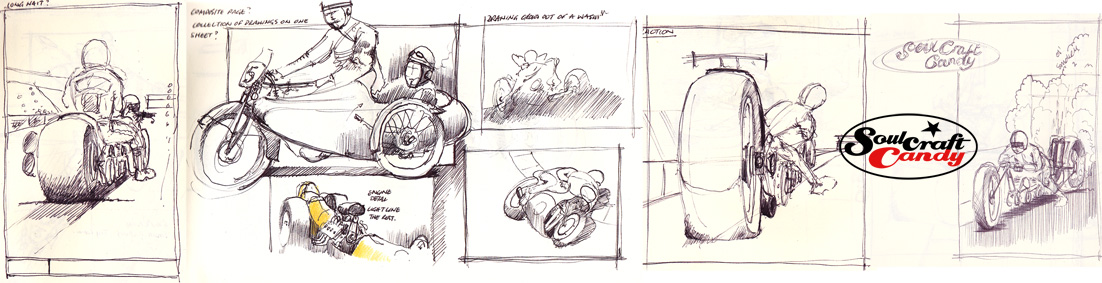
Dragster ideas.

With the print store now active, some space in the old brain is now free again to concentrate on filtering through influences and inspirations, sketching out ideas and hopefully generating some new images. Getting back into the swing of things as it were. It has also provided a moment to reflect on where things are going and how to try and incorporate various ongoing media experiments into the work flow.


The recent visit to the Dragstalgia meet at Santa Pod raceway has gone some way to rekindle interest in the whole dragster thing and this has started to filter through into the pages of the sketch book in preparation for launch into some more finished pieces. Like so many aspects of this motorcycling interest it serves up so much visual inspiration it seems often difficult to decide which bits to tackle first. There is a kind of blindness that descends upon you when venturing into an enormous retail store sometimes, there is so much stuff in front of you that you have no idea where to look first. It’s the same with some of these biking subjects, particularly if one finds oneself staring at the panorama of images downloaded from the camera into your photo library. The feeling can be that you are looking at everything and nothing at the same time. I find I can only get round this by switching it off and doing something else for a while. The subconscious is then somehow released to do what it does best and filter through the information before popping a mail into your mental in-box to let you know some form of direction has been chosen.


This is the time to sketch.

Dragster ideas 2.


Lovely imperfect paper.

The picture above is the latest of my attempts at finding some different and interesting compositions around the sidecar outfit theme. This is very much a sketch rather than a thinly veiled shot at a finished piece. The density of the line work has ended up covering a tangled nest of construction and guide lines and the wonder of modern technology has enabled me to virtually obliterate the swathes of Tippex correction fluid useed in the early stages. This more loose approach to a drawing is really working its way into my system to the point where they hold as much enjoyment as the more tight and precise drawings I have previously shown you. This one is again done on heavy weight lining paper, a habit that is proving hard to break for want of finding a good substitute.


Some time ago a friend pointed out, quite rightly, that this paper is not acid free. This has its upsides as well as its downsides. Not being acid free means, as far as I know, that the paper will age badly, yellowing and discolouring over time, and finally disintegrating into a pile of dust after a decade or three. Not good if you want your work to survive many years of ownership and admiration. If you’re worried about preserving the image rather than an original work, then I suppose it could be scanned and printed out using the Giclee process or similar, to provide with something that will last in perpetuity.


The upsides to using this paper, at least as far as I’m concerned right now, are twofold. Firstly, as I’ve said before, it possesses a surface unlike anything else. It has a course almost gritty nature to it which takes ink from the pen in a subtle way. One can employ a lightness of touch so that the pen is almost skating over the surface to leave very light, whispy lines, and then one can really build up the image by working the surface quite hard. It seems to be able to take no end of punishment from the tip of a ball point. A bonus feature is that you can apply light washes to loose sheets without suffering too much warp and distortion.


The second reason I like this paper is perhaps a bit more idiosyncratic and concerns the idea of patina. For as long as I can remember I have found the idea of objects gaining patina through their use a very appealing one. During years spent designing products the notion of how ones ownership effects the physical nature of a product over time always interested me. I found it fascinating, particularly from the point of view of someone living in what is essentially a disposable age. The way that a paint finish would rub off the corners, how once bright metals would dull through repeated handling, and how the accumulation of myriad tiny scratches and dents imbued a product with a kind of documented history. All lovely stuff. Yes, there is a mild sentimentality running through all this but, it does not purely account for my appreciation of a well used tool or favourite pair of old motorcycling gloves. So the idea that this paper will age disgracefully, take on unforeseen hues because of sunlight or pollutants in the air, and get visibly old is very appealing. Why can’t a picture show its age?

The image above shows the drawing at an early stage. Over time it kind of faded into view. I quite like the idea that it could fade out of view too.