One task, lots of tools to play with.

Fix your dragster.

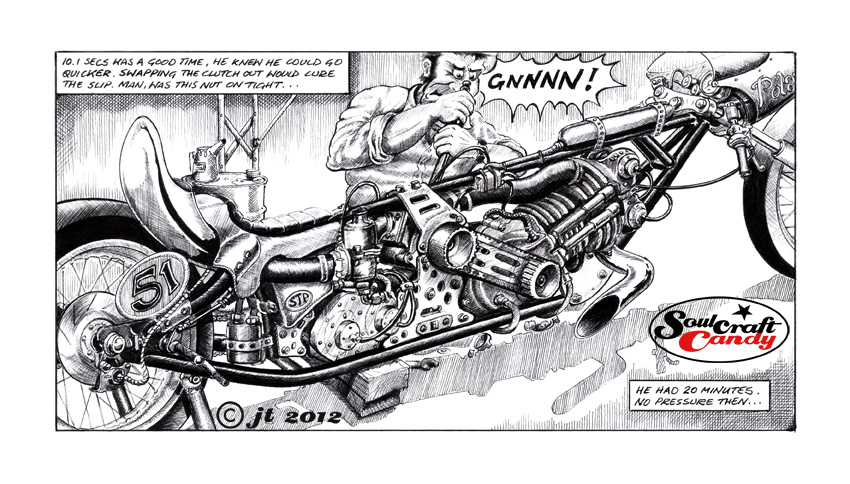
Well, here’s the final finished version of the first foray into the world of capturing the story behind an image. I’m quietly pleased with it even though it probably represents the simplest approach to all of the story stuff I have been posting about these last couple of times. It works, and that is the most important thing. Yes, there is much room for improvement but as a first stab it’s encouraging to feel that the framing and words add to the image rather than take anything away.


What is interesting is how looking at it now sparks an immediate desire to improve things, to create more. That’s not to say that what happens next is merely an extended exercise in  duplication across any number of pictures, more a wish to really get stuck in, and learn properly how to make best use of all the different devices at ones disposal, and perhaps invent some new ones too, specific to these drawings.


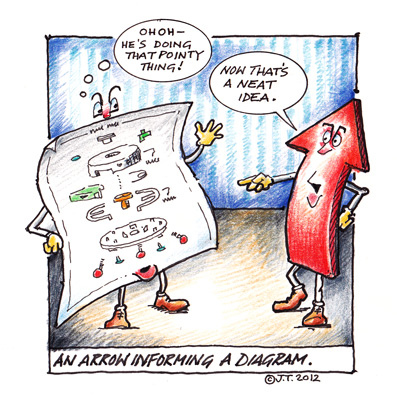
Opening any book about creating comics and graphic novels invariably floods you in established conventions for framing, speech and thought balloon use, caption box positions, view angles, perspectives and all manner of inking and texturing techniques. All of it is there for us to learn from. It can be a bit intimidating. The best bit though is realising that none of it is compulsory, and that all of these things are there to be played with. Their task is to inform the image being created, rather like an arrow or two might inform a diagram, so there’s no need to use all of them all of the time. Much more fun to find the things that work for you and the types of image you create, than feeling the need (and pressure) to become a master of all before venturing to the paper to make your first mark. There will be lots of experiments and invariably lots of trial and error involved but, without learning through doing, things won’t move forward, or worse get stuck in a repetitive rut. And we can’t have that.

And finally…….
 

Where to draw the line?

Dragster 1

The title for todays post is phrased as a question and is one that is occupying a sizable chunk of my creative brain power at the moment. Although a single question, it concerns two very distinct aspects of the drawing you see above, which is shown in nearly finished form.


The first aspect of the question arises from my decision to crop the image and leave some of the image blank. Why? Well it stems from some feedback that has come this way in recent weeks, and some older thinking from a while ago which centred around the issue of how to introduce another dimension into the monochrome ink drawings. Combining the “less is more” approach and the often mentioned ability of the eye and brain to work together to complete an image, the time seemed right for some experimentation. When soliciting comment from others about the drawings it is interesting to hear that in some cases there is almost too much information provided, that the eye, brain and imagination are left with no work to do. Everything is there in front of them and there are no gaps for them to fill in. This got me thinking about where the edges of the drawing lies and how much information is then left within the space. Hence the cropping, which I could have done simply on a completed drawing in Photoshop, but that wouldn’t be the same.


The other part of the titles question touches the same subject but lies behind my decision to leave the rider figure blank. The line that this part of the enquiry is concerned with is that which does or doesn’t depict the missing rider. Are the blank spaces amongst the bikes details exactly that, is the figure simply delineated by a simple outline or is his form expressed in line only ie legs, head, arms etc?


It is far easier to add to a drawing than it is to subtract, particularly when working in ink. I wanted the drawing to be grounded so have only cropped on three sides and have slowly built up the image until it meets my ruled edges. Once the bike is complete I can then work toward figuring out where the line work for the rider will go, moving through my three options until I’m happy. Of course it may all end up looking a bit odd, but unless one tries these things one will never know.


Engines, old and new.

Before getting on to the main purpose of todays post, an update on another of the biro drawings, there is just enough time to show you one more of the Cyclomotor drawings unearthed the other day. As you can see this is a colour one and as far as I can remember it was quite a big one, something like A1. What does remain firmly in the memory is how it was done. My tutor at the time insisted we make some of our drawings in colour and as this was a drawing project brushes were out. I had had a small tin of these oil pastels kicking around at home for a few years but had never used them, so this was a perfect opportunity to give them a try. They are called Neocolour by Caran D’Ache and are quite hard in their consistency. They are not at all appropriate for any kind of detail work but for big jobs they rule. They go down quite evenly for a pastel and what is really nice is that you can smudge them in a very controlled way with your finger and blend the colours into each other with some control. I’m wondering if I can use them for some of these bike drawings if I can get the scale up big enough, could be fun.


Looking at this old drawing today gives me real pleasure. It represents something that I work constantly to rediscover these days, a kind of naive confidence in the way the drawing is made that lies beyond the bounds of the years of formal training that followed this period of my experience. The errors in perspective and construction seem easily carried by the sheer boldness of the enterprise. I still have some of those pastels somewhere, perhaps it’s time to dig them out.

Drag bike half done

On to the main thrust of the post, oddly a much shorter paragraph, and this is a kind of progress snap shot of the second drag racing picture being worked up in biro. This one is taking a little time as I’m kind of learning as I go. In a break from usual practice this one’s being done on a different paper than usual, Fabriano Drawing Paper, whiter than cartridge with a slightly different texture. It’s a learning exercise as the pen engages with the surface in a softer way which means needing to be much more delicate with any pressure. It also tends to be much harder to hold a crisp line, though having said that it does give shaded areas a looser feel than that achieved with Bristol Board. The big test will be to see how it deals with larger areas of black and the fine feathering used on wheels etc. It is probably better suited to larger drawings where a softer medium can be used like pencil or crayon. I’ll persist though and see how it turns out.