Creative energy spreads.

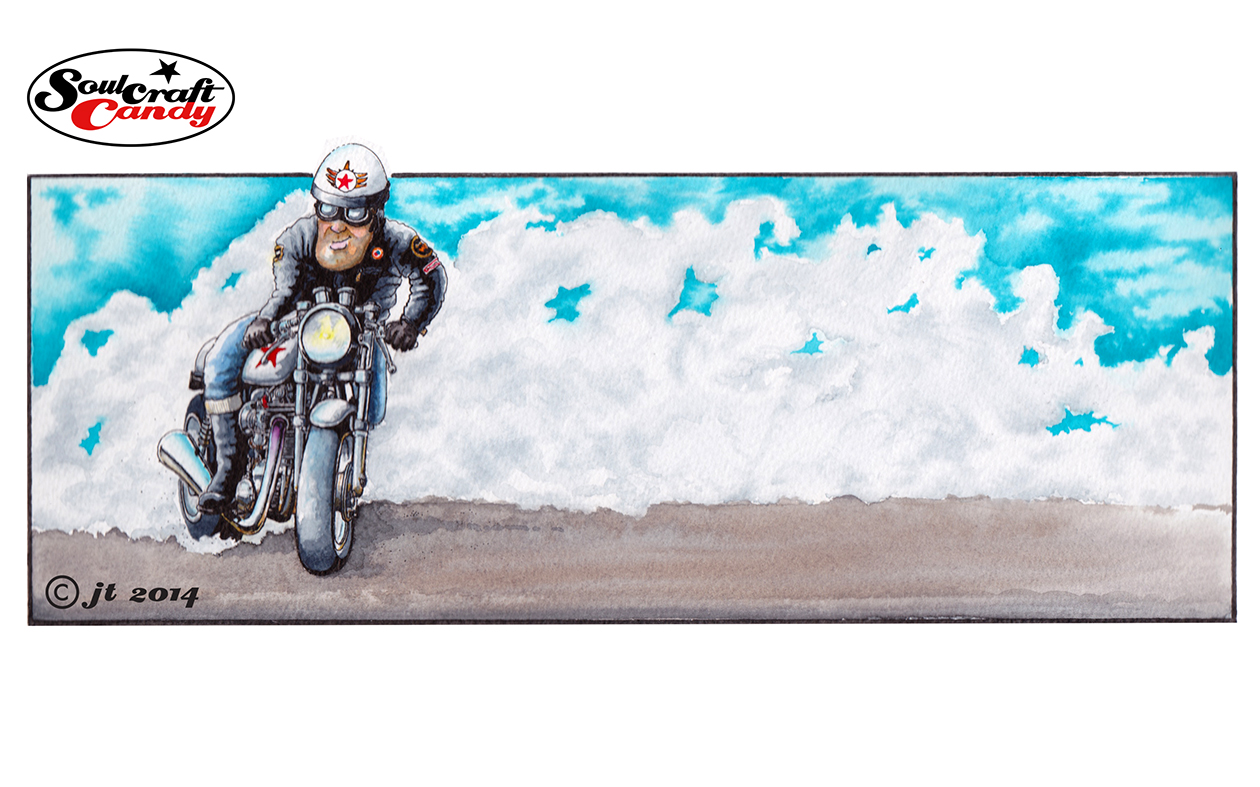
102_Cafe_smoke©JonTremlett2014

With all of the making happening in the back garden and in the makeshift workshop that is the garden shed, it would have been so easy just to forget about the artworks for a few days. But these things never sleep, whatever’s on the drawing table in the studio lets you know it’s there every time you walk in the room. The hope was that some making activity would bring a fresh spur to the drawing work and so it proved. By splitting my creative time in this way, both fed off the energy that was now available seeing as I wasn’t going to be working for a few days.

This picture above was started a while back but was taking ages to finish. Procrastination had set in as a reaction to my being a little daunted by pushing it along. I wanted to see how I’d get on with some heavier textured water colour paper, and whether I could hold the detail given the rougher surface. It was also a challenge to figure out the best way of rendering all of that smoke, something I’d not had much success at in the past.

In the end the detail concerns were pretty unfounded, the technical pen worked out ok on the paper once it was fully dry, though I would say that it does tend to get a bit “hairy” if you labour the pen too much. The smoke bit on the other hand was a tad more tricky. I had kind of promised myself that I’d have a go at being a bit more free with my brush work a while ago and saw this as a perfect way to get some practice. Smoke being of a very “wafty” nature I thought it would suit a more loose approach. What I didn’t reckon on was actually how hard it was to do. I take my hat off to all those whose water colour style is more conventional than my own, the impressionistic feel they give to brush work is a hard won prize indeed. Initially I was far too deliberate, the cloudiness needed just wasn’t there and no amount of blending the marks I’d made seemed to work. In the end I plumped for just loading up a No.4 brush and smearing, can’t think of a better word for it, wash all over the required area and trying to blur it all with more water whilst still wet. It kind of worked but I failed to achieve any consistency across the whole area. Not wanting to overdo it I left it at that, though I will be having another few tries at getting the looseness I’m after on some other pieces which are coming along behind this one.

Can I draw like a designer?

CB750 sketch by Jon Tremlett for Soulcraftcandy

When I got up this morning I knew I needed to write a blog post today. It’s been a while since the last one and my guilt is starting to gnaw at my conscience. My only problem was that I didn’t know what I was going to write about, and then the phone rang.


It was a good friend calling to ask for some advice on behalf of a colleague of his. In a nut shell the colleague was asking how she, an engineer, could learn to draw like a product designer and did I know of any courses that might teach such a thing? During the conversation my brain split into two parts, the first attempting to answer the question, the second thinking “ what a good subject for a post”. Here’s what the two parts came up with, given that the question can be answered in two ways, the simple answer and the slightly more complicated one.


Firstly I don’t know of any courses that will teach you how to draw like this in isolation. A design course might, but it’s not guaranteed and, let’s face it, if you only want to draw like a designer then a full blown design course is a very long winded way of going about it. However, if you have a modicum of drawing ability, then there are various books available which do a very good job of illustrating (sic) the various techniques that designers use to communicate their ideas in drawing form. Here’s a link to one I find very useful. The double sided key to this approach is knowing what it is you’re looking at on the page, and then putting in the hours and hours of practice that will embed the techniques into your canon of visualising skills. Although this is the simple answer to the question it is far more than a mental and creative cut and paste job. Only practice makes prefect, don’t forget, and you’ve got to have some drawing ability to start with.


The more complicated answer involves taking a closer look behind the question itself. The question, “ how do I draw like a product designer?”, provokes the immediate response, “well, how do you think product designers draw?”. Is the answer very quickly, or with a pen, or with one eye shut, or with magic ink? The answer is both none and all of the above, and this is where it gets complex. Essentially all designers who draw use it as a way of communicating their thinking, their ideas. Yes, we can all use words to back up what we are on about, but most of us draw our ideas because they are required to explain themselves when we are not there to represent them. Drawings are used to communicate everything from general concepts and aesthetics, to mechanical solutions and fine details. They are a core mechanism of the discipline which transcends language and helps others to understand the idea. Without some visual representation design is a pretty worthless exercise. Conversations between designers are often both visual and verbal.


The complexity arises when we realise that designers, even those working in a similar field, all draw differently, and the reason is because we have all spent a long time finding the techniques which we personally are most comfortable with, the ones we like the most, and are happiest exploiting. So, we are all the same but different. The other complicated bit is that drawing is a direct output from a thought process, which involves several elements like imagination, mechanical considerations, technical parameters and materials knowledge etc etc. So you can see that when designers draw, they are actually doing a lot more than purely making an image. Does this therefore mean that in order to be able to draw like a designer, you essentially have to be one? If you’re happy adopting a style or technique then perhaps not, but remember that whilst most designers can draw, not everyone who draws is a designer. I hope this makes sense as it’s taken me a while to boil it down to this brief explanation.


Here’s a lovely quote I read the other day about drawing, and is another great reason why all designers should consider the benefits of developing drawing skills.


“I prefer drawing to talking. Drawing is faster, and leaves no room for lies”. Le Corbusier.

Before I go, the sketch above is one of the projects on the go at the moment. A lovely chap called Larry sent me some info about his bike some time ago, we were discussing a possible commission. Sadly that didn’t happen, but I haven’t forgotten about it, and have finally got around to starting a drawing based on the bike, a Honda CB750. So Larry, if you’re reading this, I’ll be in touch soon.


Overcoming Bull-headedness.

Bike sketch in brown ink by Jon Tremlett ©2013

For those of you who have been following the saga of the large biro drawing, known around here as “The Bull”, you will note that todays offering is not it, it’s something else, something a little different. Why? Well to be honest with all of you, I’m having a bit of a battle with it, and as a consequence it remains unfinished. I’m beginning to wonder who the bull really is. It is truly the drawing or perhaps it’s me, as I find myself repeatedly charging full pelt at a gate which is refusing to give way. A concerted effort last week to resolve the impasse bore nothing but a large pile of scrunched up tracing paper, wasteful certainly, and enough to provide bedding for a hamster for about a year. I have since decided to leave it alone for a while.


Having got utterly steamed up about it, backing off and calming down has led me to realise that this conflict is nothing new. It is one of the uncomfortable truths that surround any creative process. It is certainly not unusual to find oneself completely bereft of ideas during a concept design phase in the studio. Having “brain dumped” for several hours in a morning it is not a surprise to find out that your mind is totally empty and your imagination has gone walkabout. The energy previously expended in generating new ideas gets refocused into frustration and before you know it you’ve got a nice little vicious circle going.  Backing away, doing something else for a while unblocks the pipes and lets things flow again. So for now the drawing is sat on the other side of the room, the recipient of the occasional glance but nothing more. It will come to me when it’s ready, but probably not before.


So what’s with this brown thing? Well, it’s a sketch I made a while back, always good to have a back up plan for a post if things go awry, whilst playing with the idea of drawing in other colours. Being a sucker for a cheap pen I’d purchased a tasteful set of biro pens in assorted colours and was intrigued by what they might bring to the party. Initial scribbling revealed that some of the colours, yellow in particular, might not be strong enough, but the brown showed immediate promise. You may remember the cartoon of the authentic biker a while back, that was done with this pen. The basic pen itself gives the drawing a lovely aged feel but it’s a bit limp when it comes to creating good contrast. As luck would have it I’d also found a brown gel rollerball pen, which when used with the biro gives a degree of heft to the dark bits and lends the whole thing a much needed punchiness. This is very much a learning exercise but one that worked out well. Now to get my hands on some cream coloured paper and find out where I can get brown biro refils without the need to buy a whole set when it runs out, which it will, soon.