Cafe Racer No.4.

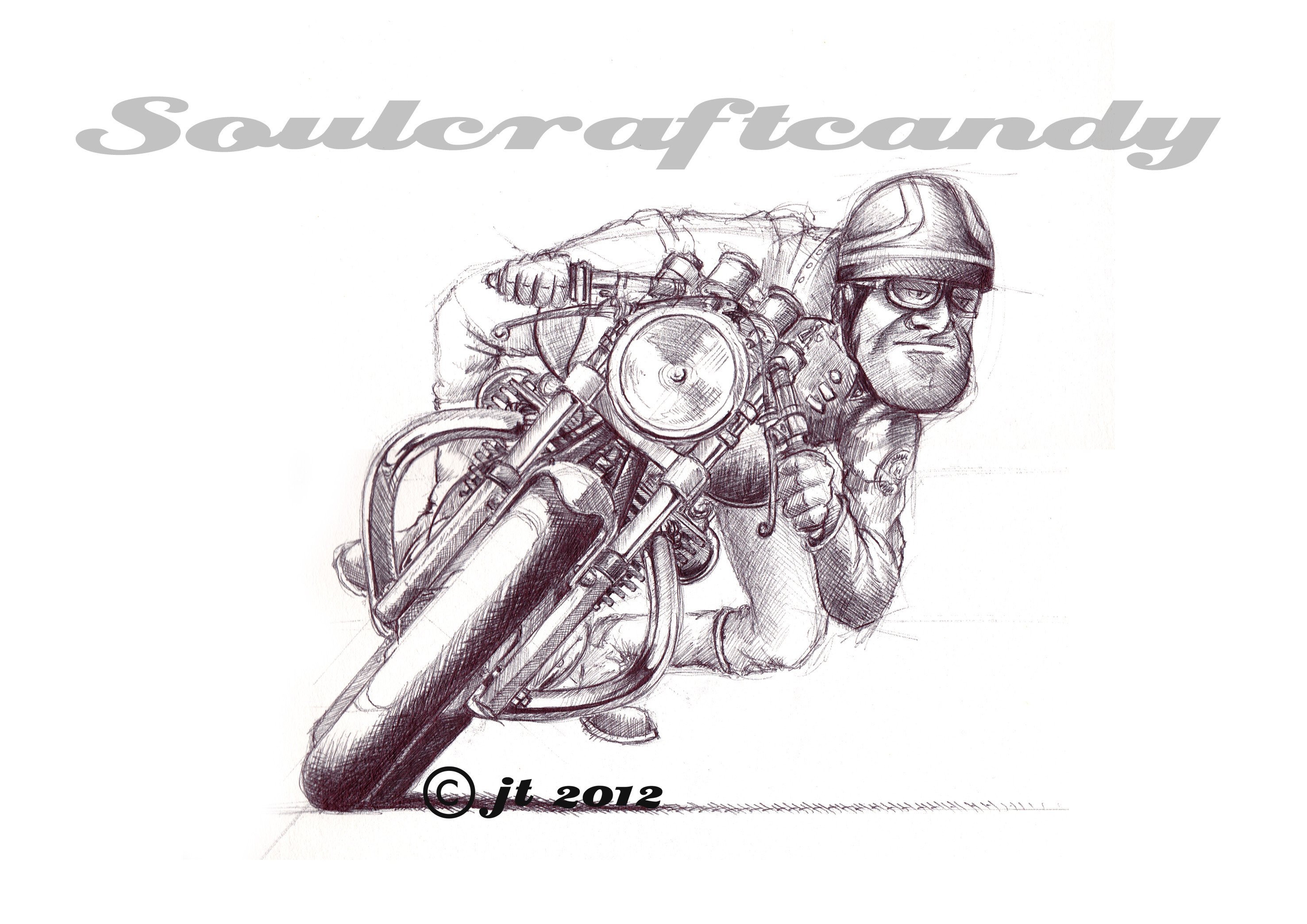
So here we are, presented for your delectation today is the fourth finished drawing in the Cafe Racer series. Like the previous drawing it treads the line between caricature and reality, leaning in one direction or the other depending on which bit you’re looking at. I’m not one to shout loudly about my work but I have to admit here that I’m very happy with it, all things considered. What was mentioned in Post No. 63, “Cafe Racer 3, finally” about how ‘static’ and ‘moving images dictate the background in very different ways rings true here. The original idea of a stylised chevron barrier, you know, the big black and white things that alert you to a bend in the road, just didn’t work, so a far simpler approach was taken.


The perennial problem that faces you when you’ve got parallel or converging lines to cross-hatch between is staying inside the lines. If you have an occasionally wobbly hand as I do, then it can be a real ordeal. Each stroke of the pen is a potential mess maker waiting to happen. My solution, and it’s obvious when you think about it, is to mask off the area. Normal masking tape’s no good though, particularly if you want to preserve the surface of your paper. Every roll tried just seems too sticky. Back in my designer days, some guys I was working with at Philips’ studio used a lovely low-tac masking tape when making their marker renderings. It was brilliant stuff but I’ve no idea what it was called or where I could get any. If you know, please let me know. My solution currently is Scotch Removable clear tape which is similarly low-tac. It doesn’t bend as much as masking tape does, so it has its limitations but for these purposes it’s fine, and not so thick that it makes the pen jump on the edge. Pretty good and a neat way to get those edges really crisp.


The next two drawings are already laid out in pencil so I’ll be posting updates on their progress when there’s something to show.
 

Lining paper, a surprisingly good drawing medium.

This is a sketch for one of the remaining drawings that are left to do. This was done as a kind of experiment. It’s at least 60% bigger than any of the others for a start, which allowed me to be a little less precise with everything, and seeing what an increase in scale would look like proved a useful exercise. Sometime in the future it would be great to create some much bigger drawings and my first tentative steps in this direction are being taken now. As mentioned above it’s not significantly larger than any of the others but, creating it starts to give me a feel for what changes when you go up in size. How you deal with proportion, detail and tonal variation across the drawing. One also has to consider the implication on ones preferred medium. I’m not sure that working in biro across an A1 sheet or larger is going to be a fruitful or spirit crushing experience. Only one way to find out I suppose.


It’s drawn directly, no pencil rough out, on to heavy duty (1400 weight) lining paper, the stuff you stick on your walls at home to even out a wall surface before painting. It’s not good quality paper for sure but, it does have this kind of hard textured surface which works really well with a medium point biro, almost making it feel like using a pencil such is the subtlety of shading one can achieve. Being quite thick allows you to work into the paper a good deal to achieve the thick black areas but, the pay off is not the usual warping and distortion you get with other, albeit finer, papers.


Yes, it can be a bit scratchy and coarse but it’s great stuff, cheap as chips and comes on a roll, so you can cut sheets to any size. I would mention though that at first it was a challenge to get it to lie flat, at all. Leaving it under a pile of books for a couple of days didn’t work, so I ended up ironing it with a hot but dry iron and then left it in a pile under a couple of pads. Much better. This weeks top tip for ploughing through sketches without worrying about using up your expensive art shop bought sketch pads. I’m going to have a look at lighter weights of lining paper to see if the texture is different and check out how they perform. An update will hit the blog soon.


Cafe Racer 3, finally.

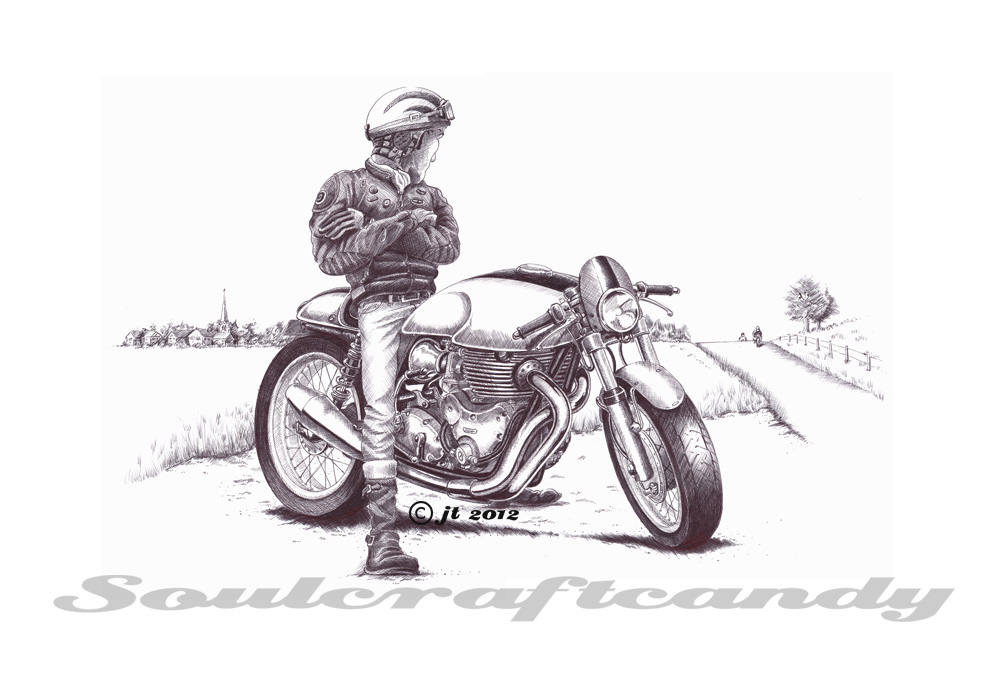
Finally, finally, finally the wind has been in the right direction and the third of the Cafe Racer series is now done. Boy, did this one suffer an awkward and time consuming birth! After all of the misgivings expressed in the previous post about teetering along the line between reality and caricature, it took a bit of effort to apply the finishing touches. There was no way that I was going to be able to drag it back towards cartoon humour, so the best thing to do was just focus on what would suit the central image and concentrate on that. Needless to say, I think it’s turned out not too badly considering the hand wringing of the last few days.


When the central characters and bikes are stationary in a drawing it’s interesting to note that my mind’s eye considers and composes completely different approaches to the contextual background, or what goes in to help place the image on the page. This is almost a subconscious act. When things are in motion, my imagination automatically starts thinking very graphically, with lines and blocks as a way of emphasising that motion. When things are stationary quite the opposite occurs, with visions of horizons and landscapes being the main focus. Not a bad situation to be in, a fertile imagination is a great thing but, it does lead to quite different feeling final outcomes. Somewhere along the line it would probably be worth trying to swap these two traits around to see what comes out but, for the purposes of not wanting to create too many distractions before this series is finished I’ll leave that for now.


Look out for Cafe Racer No.4, coming very soon.