Trying something new.

Stoppie©JonTremlett2014

Most of the fabrication work on the bike refresh is now complete and, as I mentioned before, the last big bit of the jigsaw puzzle is coming up with a new paint scheme for the fuel tank and spraying it up. I’ve got something I’m pretty keen on and it’s sitting in the “mulling” section of my brain right now while I have a final think about the colours.

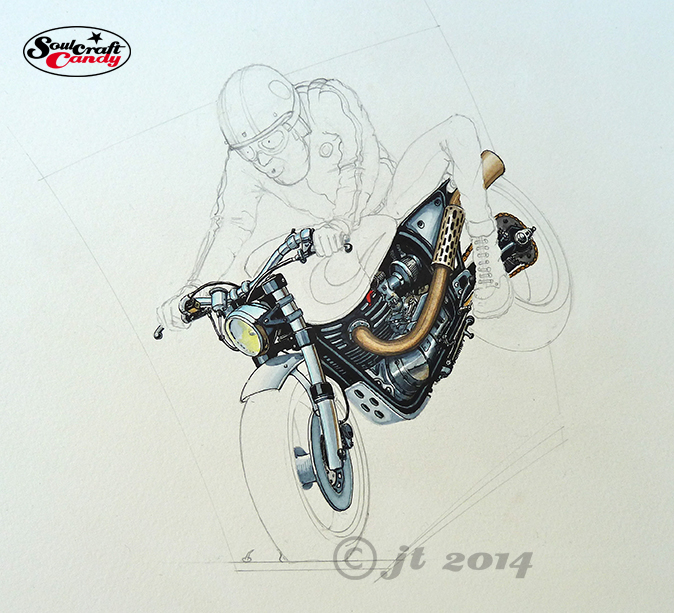
In the meantime here are some pictures in way of an update of what else is happening in the creative microcosm that is Soulcraftcandy. The first is a little sketch I knocked out a while back which immediately demanded a finished version. I’m unsure as to why it sent such a strong signal but I think it’s got something to do with putting the pink bits into the drawing as well as the stance and angle of the whole thing.
Stoppie_prog_1©JonTremlett2014

Needless to say the pink hasn’t survived the move to a more finished image but the idea of using bright colour has, and I’m hoping for quite a punchy little picture when it’s done.

Soulcarftcandy art by Jon Tremlett

These two progress shots show working up the main part of the bike, painting and inking as I go. I find this a good way to work as it enables me to keep an eye on what I’m doing and keep things in control. I find that bringing focus to the picture as it moves along helps me see what I want to do with the next bit, rather than leaving it all rough and inking in everything at the very end. From here I’ll move on to doing the rider figure and then finally the background. Excuse the odd hue of the pictures, it seems to be a consequence of photographing these things in daylight as I can’t fit the backing board onto the scanning bed.
Soulcraftcandy art by Jon Tremlett

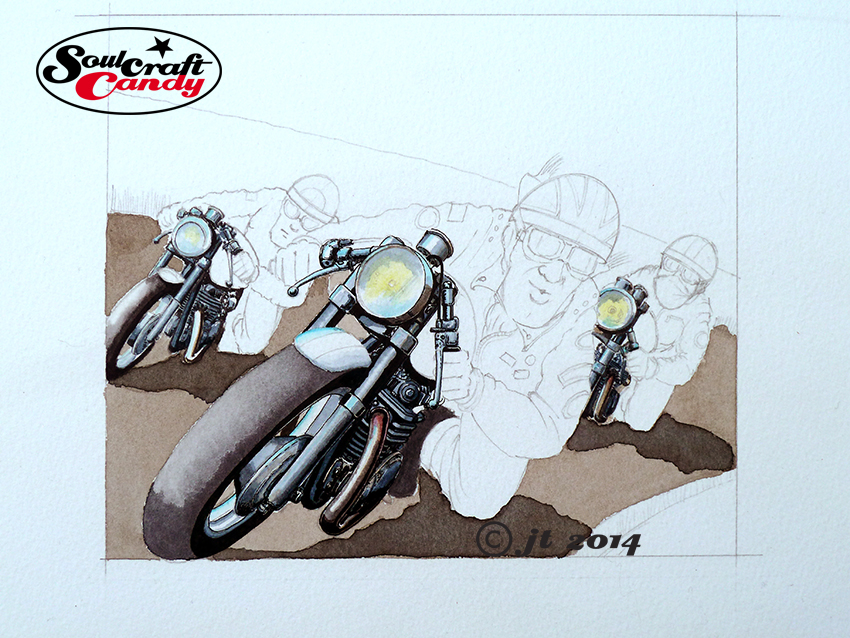
This last one is a slightly different animal, an image on which I’m trying to do something new (for me anyway). Firstly I’m trying to paint much more of a complete scene and this is forcing me to think harder about background, middle ground and foreground and the focal relationships between them. In all honesty I’m finding it quite difficult, but it’s rewarding to try and rise to the challenge. My difficulty probably stems from all those years of design drawing where one is not expected to create any sense of depth of field, presentation visuals being very two dimensional in nature, and so it all feels a bit alien and intimidating. So in order to help myself as much as possible I’ve divided the image into three planes, big bike at the front in focus, two smaller bikes on the second level and then the landscape on the third, mainly. The desire to try a bit of freer brush work, which I’ve mentioned before, now gets a chance to play on the background levels and will hopefully minimise my chances of making a muck of it all from the outset and build some much needed confidence in being a bit more loose with how I apply paint to the paper. I’ll keep you posted on progress.

Creative decisions that are right for you.

Taking my time to find the right position.

Taking my time to find the right position.

Time to take a look at cutting and fitting the new rear mudguard. There is much talk in bike building circles about getting the stance of your bike right as a prerequisite for coming up with anything good looking. There is a school of thought that is very prevalent currently to have the line of the bike very flat. That’s to say, the visual line from the back of the seat running through the base of the tank to the front suspension should be pretty much parallel to the ground. Hence you see lots of bikes that are all starting to look the same and share the almost totally flat seat which is almost ubiquitous in its manifestation. This is all well and good if you’ve got the time, money and the need to go down this route. Personally I haven’t. As I’ve mentioned before, without resorting to large amounts of frame modification  (read expensive welding bills and jiggery) and spending a whole pile of cash on different suspension equipment, there’s not much one can do beyond a certain point. The creative challenge is therefore to move away from the standard look enough to create difference and come up with something that works with the proportions one is presented with. This can be a lot harder than you think, but it is possible on a very limited budget and is generally a case of taking ones time in positioning, cutting and mounting components. Once you’ve cut metal there’s very little you can do to rescue things, so it pays to exercise patience and adopt a methodical approach no matter how quickly you want the project to be completed.

Position set, holes drilled, just the light to mount.

Position set, holes drilled, just the light to mount.

Of course, what “looks right” is a purely subjective conclusion. Because these kinds of projects are pretty personal in their nature, the result must first be right for you, in your own eyes. That’s the most important thing really. Decisions you make in a build are always contextualised by a whole host of factors and compromises that one has had to deal with on the journey to the final outcome. Others may not like your final iteration but then invariably they have little knowledge of this context. As a maker, of anything, one has the luxury of knowing that you could change or modify things in future if the urge takes you, but it’s an option that you can reserve to exercise if you so choose.

When I first built this bike I made a pile of decisions about how it would look based how I felt about the life it would lead, about practical issues like comfort and durability as much as aesthetic considerations. I reserved the right to change things if I wanted to but generally didn’t feel the need to do much other than periodic tweaking. Now, some time later, it is time to make some changes  based on living with it and riding it for a few years. There are still certain things about the stance I can do little about, but these are not a problem. The bike started life as a factory custom and so caries with it some small legacies of that life which I’m happy to live with, like the long forks and the steep rake of the tank.

A rather blurry shot courtesy of my iPad, but you get the idea.

A rather blurry shot courtesy of my iPad, but you get the idea.

So here are some shots showing the process of getting the new rear mudguard (fender) sitting in the right place, at the right angle in the right way. Once I’d cut the bare rolled section I’d bought to roughly the correct length I spent ages with bits of foam, tape and cups of tea trying it in different positions to get the look I was after. Once I was happy I marked the mounting holes for drilling and returned to the shed for some hole making. The critical factor was getting enough section over the wheel without it looking overly long but still having enough curve available to support the light/plate assembly at the right angle. I didn’t think things had changed much until I held up the new piece next to the old one to see that I’d actually reduced the length by about 150mm, very satisfying.

The final shot shows the guard in place with the light mounted and everything else ready to go. The final piece of this refresh is painting the petrol tank, which I’m currently working on a design for and I’ll be posting about that very soon.

Celebrate unexpected outcomes.

The finished thing, blobs and all.

The finished thing, blobs and all.

Those of you who’ve followed the blog for some time will know that I have a thing for a ball point pen. I have my favourites obviously, just like painters tend to have a favourite brush or colour, but generally speaking it doesn’t really matter what brand it is or how cheap. In fact some of the best for drawing are amongst the cheapest you can buy. Although I tend to use black mainly, there’s nothing wrong with other colours, they bring a certain something to an image. But I digress.

This drawing you see here must be one of the messiest I have done for quite some time. I have no problem with this, in fact it was a joy to make, really, and it was made using a ball point pen. Well, I’ll call it a pen for now, but in fact it’s more of a marker and actually I used two different types to make the picture. You may remember some time ago I posted that I’d had a sketch of one of the original Cafe Racer drawings printed out at life size. The resultant print, taken from a scan of a loose biro sketch, revealed all of the feathering and broken line work that were not really visible on the original. It looked great, one could really see where the pen had travelled and what marks it had left behind. On the back of this experiment I wanted to investigate whether I could create a giant ball point pen to try and replicate this character and do some massive drawings at life size. Scaling things up I needed to find a pen with a ball of roughly 3.0mm in diameter. My searches unfortunately proved that no such thing existed but something very similar did. What I found were ball point paint markers which are used in the construction and engineering fields for marking parts and assemblies. Finding a convenient supplier in Royston, Hertfordshire I duly bought a couple to try. In black.

Detail showing paint build up.

Detail showing paint build up.

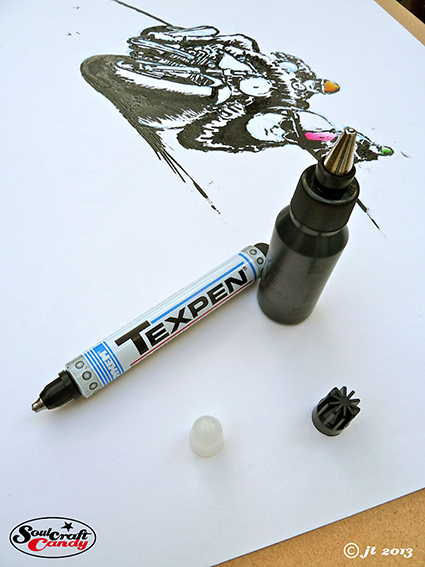
Both of the markers are shown in the bottom picture. The first, a thing called a Texpen made by Dykem, is a fairly conventional looking marker and quite easy to hold and manipulate. The other is a more heavy duty one from a company called Suremark. As you can see it’s essentially a bottle of paint with a ball point cap screwed onto the top. Lasts longer but not so easy to handle, and is refillable.

Before venturing into huge scale and wrecking large pieces of paper I thought I’d try something smaller to start with, to see if my suspicions were correct or not. The picture you see here is on a piece of A2 cartridge paper. I roughed out a sketch in blue biro first and then hit it with the paint markers. After half an hour of struggling I had to get up and have a cup of tea whilst I coped with my disappointment. After sweet tea and swearing I sat down and tried again, and this time really enjoyed myself.

These things are not like ball point pens at all, no sir. Firstly the paint is thick, gooey and doesn’t really flow. Secondly, the balls in the nibs are spring loaded so you have to press down to release the paint, so describing a line in a sweep is virtually impossible. Once I’d got my head around mark making though, I found I could squidge and blob my way to creating an image without too much trouble, the key bit was realising that detail and line consistency were never going to come to this party. It was a great lesson in learning how to approach getting the best out of an unfamiliar tool. The paint takes a short while to dry so avoiding putting your drawing hand in it is quite difficult, hence various blobs scattered about. The bottle option proved best for filling in solid areas while the pen option was easier to “draw” with. You can see from the detail shot, I hope, that paint tends to build up quite a bit on the blackest areas.

Paint_sketch3©JonTremlett2013

I stopped at a point beyond which I thought I might spoil it, and let it dry. When I returned I wanted to give it something extra so grabbed some cheap coloured biros I have here and put some colour on the riders helmets to lift the whole thing a little.


I hope you like it. This isn’t the end of my experiments with these markers, there are different papers to try in the search for different results and different types of drawings to try too. All very exciting, I’ll let you know how I get on.