It’s good to sketch.

Lots of folk who say they can’t draw actually can, and time and again one finds out after some very elementary enquiry that the reason they’ve got to thinking this is that they never take any time to practice, and so, when they do pick up a pencil or pen it always leads to disappointment. For those of us who draw a lot, this kind of existential dilemma is a less formidable obstacle to overcome. That doesn’t mean though that things are necessarily easier for us. We still need to practice, just as much as someone who plays a musical instrument does, it’s the way we keep our skills sharp and develop ourselves.

The greatest practice is sketching and the best thing about it is that you can do it anywhere and at any time pretty much. It doesn’t have to be from life, though keeping ones observational skills up to scratch pretty much necessitates it. With a whole world out there to look at there is plenty of subject matter to choose from and nothing to be intimidated by. I have always subscribed to the view that it’s ok to visit a zoo, for example, and simply draw a building or a tree. You sketch what catches your eye, what you naturally gravitate toward. if you don’t like drawing people then don’t draw them unless you actually want to improve this skill. Sketching can be so easily turned into a stick with which we beat ourselves with, and this removes the fun from the exercise.Sketching is a drawers play time, the serious stuff comes later, so enjoy it. I’m sure lots of us reckon we don’t do it enough, but no one is counting the hours. The important thing is to do it when you can.

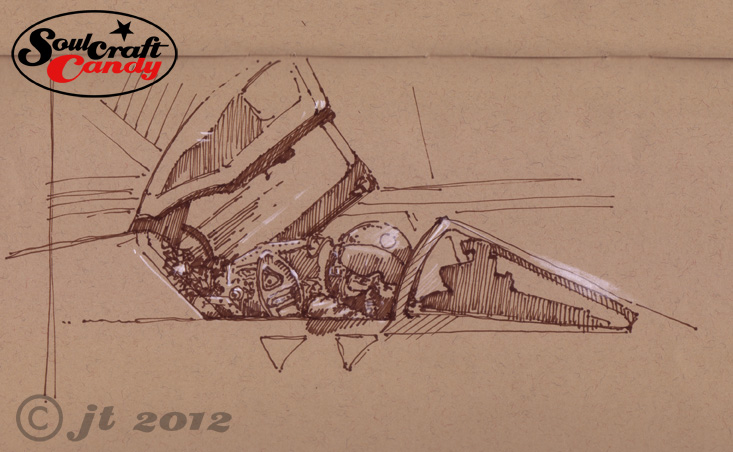
Here are a couple of sketches done the other day on a visit to the RAF museum at Hendon in North London. I tend to go with my old chum Ben, who’s pretty handy with a pen, and this lends an extra dimension to the day as we are able to meet up after sessions and discuss our sketches and the views, angles and processes we’re engaging with. It makes it much more interesting. I took a brown paper sketchbook I bought recently and after a couple of roughs in soft pencil I thought I’d have a go with a brown ink pen, which works well with the paper, and splodge some highlights around with a thin white chalk. The first one is looking up into an open cockpit of a Lightning fighter with a dummy pilot sat inside. The second a cylinder head from the radial engine on the front of a Bristol Bulldog biplane. There is so much to look at at the museum that one is never short of a subject, the collection is huge and it’s free to visitors too. What more do you need?

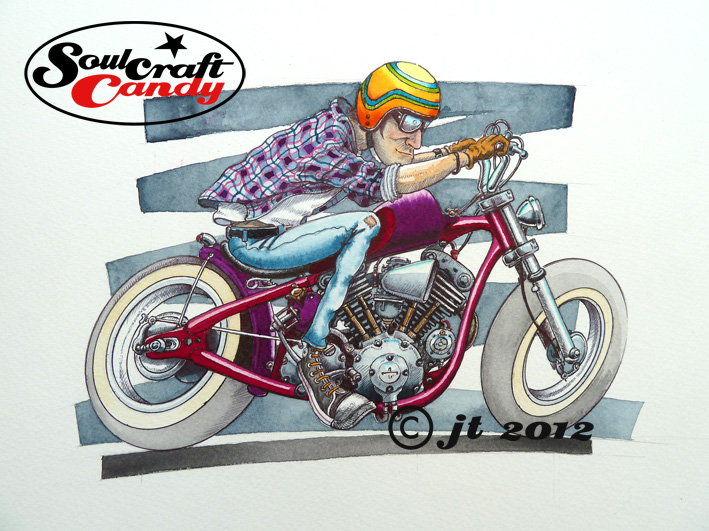
Finally here’s an update of the cherry red bobber I’ve been working away on of late. For a background I’ve decided to mimic the kind of bold swipes designers sometimes use to back up their marker drawings. More about this in the next post when it should be finished.
Making it different.

TT racer sketch

Apart from the story conveyed by an image to the viewer, a picture also contains another story, that which lies behind its creation. This is not the narrative expressed by the image but the tale of how the image was made. Whenever I look at an image the “maker” in me can not resist trying to work out how it was made. It is this questioning which drives my desire to try and share, whenever possible, the processes which lie behind the images I create. The techniques I use are not complex and I don’t use any cunningly developed or unique ways to create them, so why not let others see how these things come into being.


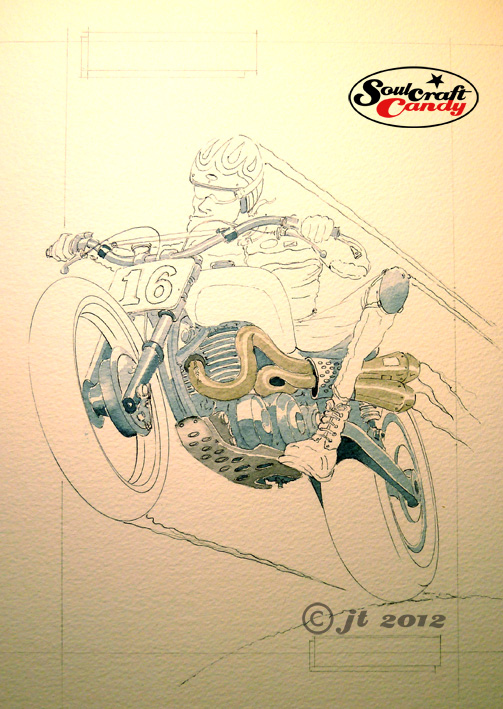
Above is the first sketch for a picture I am now working on. It comes from a series of sketches done for the V-twins project. The inspiration for it is american dirt track TT racing where oval tracks are supplemented with right hand turns and jumps. I find the idea of flinging a big heavy 750 around this kind of circuit attractively bonkers and so, worthy of a picture. It’s done simply in plain blue biro pen on some of the cheapest and low quality sketching paper I own. Believe me, it’s a good deal messier than the scan shows thanks to the wonders of playing with the levels in Photoshop in readiness for posting. Those shaded areas cover a multitude of hidden lines and you can see the engine has received some attention from the Tippex pen too.


Using my trusty little lightbox the image was transferred onto some water colour paper, firstly in pencil which was then overdrawn with fine black biro pen. I wanted to try having another go at introducing some colour to the images so thought I’d start on familiar ground with some water colour paints and inks. Normally one would stretch paper before making even an outline drawing, but that would not allow lightbox use so I stretched it after copying the drawing across. It’s a great way to do it and the image doesn’t seem to suffer any distortion at all.


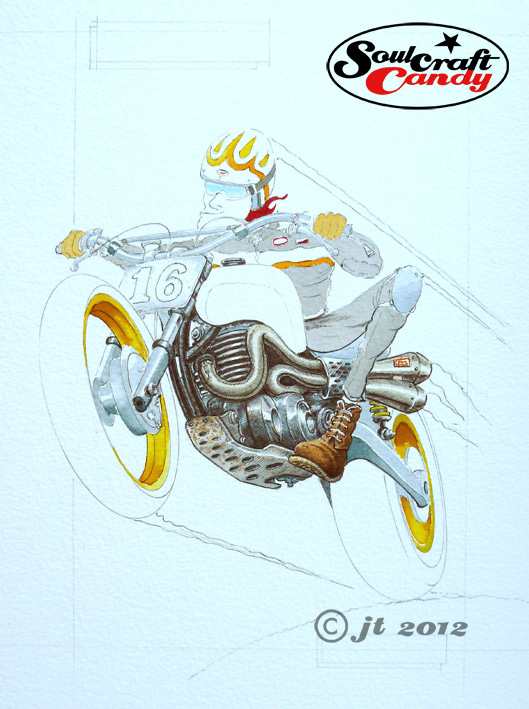
The following images are my progress updates. The first is laying on some light washes to give the image its base colour. The second shows you what I’m aiming towards. By applying my usual biro pen technique over the washed areas I can achieve the impact I want but with a degree of colour behind it, and thus a nice bit of punch too. I suppose it’s very like how you ink in a comic strip but here I’m aiming for some variation in the tones and not such a contrasty finish. The third one just shows how far I’ve got. In reality I should have applied all the washes before picking up the pen but wanted to show what’s building as much as see for myself whether I was on the right track or not. Looking good, though forgive the odd colouration, my camera does odd things with daylight.


We are all story tellers, Part 1.

Old sketch, new life.

In the previous post I alluded to my attempts to find new directions in which to take some, or all, of the drawings that pop out of the studio here. For a long time now there has been a persistent challenge in completing the ink drawings in particular, which has somehow not diminished or been overcome no matter the approach taken. It is that old thorny issue of context. Whether the inability to get this nailed is the result of never being formally trained in illustrative techniques, or some weird hangover from years drawing objects as a product designer I’m not sure. The more I think about it, the more I’m persuaded it’s a combination of things, some of which go right back to when we learn to draw in the first place and how we look at the world we are trying to capture.


The connection between ones minds eye and the imagination is a fascinating one and is undoubtedly different in all of us. How we imagine things, scenes, objects and the like also varies within us from moment to moment. When drawing from life one is saved from creating context because, in a way, it’s right there in front of us, and we are able to use some visual editing to eliminate that which we feel is surplus to our requirements. In imaginative drawing this is almost reversed, we must “fill in” first before editing down.


What’s this got to do with stories you might ask? Well, part of the success or failure of an imaginative image, I believe, lies in providing enough information to not only hold the eye of the viewer, but also to captivate their imagination in the hope that we allow them to extract as much as possible from the image. In a way we try to tell a story, or at least provide enough to start a story off, to allow the imagination to take us somewhere. Although a fairly simple sounding premise it has taken me some time to work this out in my own mind, which I’d much rather do than read it in some book or other. Because I’m a person who sees objects more than scenes in the minds eye, providing this context is always a struggle. Previous attempts have had mixed success. Shaded geometric shapes have helped to place the image on the page, but no more. Inserting scenes such as horizon lines inhabited with trees and buildings have helped too but run the risk of pulling the central image back towards reality and becoming repetitive. What I wanted to find was a format that would give more flexibility whilst being very much in tune with the language of the images.


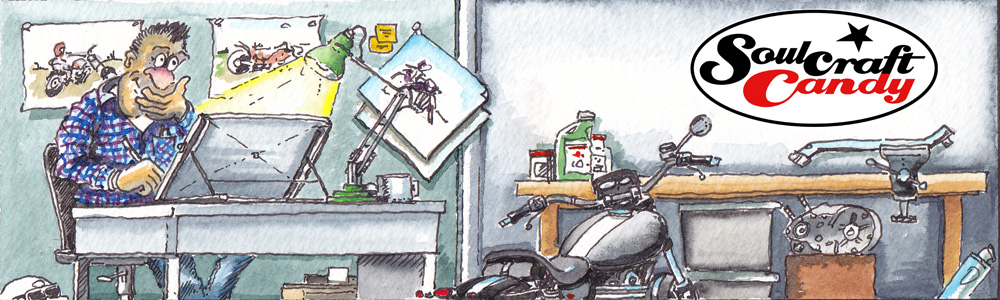
The little drawing above might give you a fairly clear idea as to where this is going.