It’s enough to make you dotty. A dragster in monochrome.

Dragster cartoon©JonTremlett2013 at Soulcraftcandy

Maintaining momentum, and keeping the creative juices flowing, is always one of the challenges one has to overcome when engaging in an artistic pursuit which has to fit in around the everyday goings on of ones life. It’s easy to loose the flow, and returning to an unfinished image rarely results in picking up the thread exactly where you left it. I suppose that one of the key disciplines of any artist is to develop techniques which enable you to do this as seamlessly as possible. I don’t have any hard and fast routines that I follow in order to make this easier but one thing I do do is always try and have a number of little projects on the go at any one time, all at different stages. This means that when I’m deep in thought about how to solve a problem on one picture, there is always another close by which I can engage with, one where the work is at a stage where I don’t have to overcome any issues in the execution. So dipping in and out of things keeps the creative ball rolling rather than running to a dead stop as endless time is wasted staring at a problem until the answer comes. In fact this act of “dotting about” helps me to uncover the answers that I’m looking for.


So whilst pondering what to do about the background for the picture featured in the last post, I had a good look through the “pending ideas you should really finish” pile and pulled one out to serve as the “other” project. I had a dabble last year with some sketches following a visit to a drag race meeting, made a couple of drawings, and then promptly left it there. I’m not sure why. This drawing above was all ready for some treatment having been carefully pencilled out onto a nice bit of drawing paper, I just hadn’t thought much about how to take it further. I’m not sure what inspired my choice of technique, it could have been my recent visit to Tate Modern to see the Roy Lichtenstein show or something else entirely. Doing something different really appealed though and so out came the trusty old technical pens and I set to work.


Although the dot shading is a madly labour intensive way to do things, this drawing proved to be very enjoyable to do and a pleasant alternative to the paint and ink technique I’ve been doing a lot of recently. You have to take a break every now and then though as all the little specks of black make your eyes go a bit funny after a while. It’s a lovely way to gradually build up tone though and really plays to the cartoon nature of the drawing. I’ve called it “The Slugger” after a certain baseball bat, a blunt though effective instrument that gets the job done. I hope you like it.
 

One task, lots of tools to play with.

Fix your dragster.

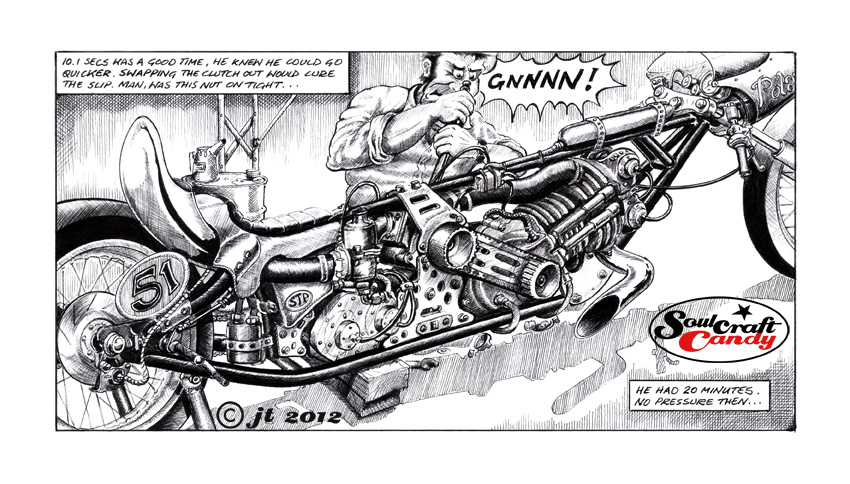
Well, here’s the final finished version of the first foray into the world of capturing the story behind an image. I’m quietly pleased with it even though it probably represents the simplest approach to all of the story stuff I have been posting about these last couple of times. It works, and that is the most important thing. Yes, there is much room for improvement but as a first stab it’s encouraging to feel that the framing and words add to the image rather than take anything away.


What is interesting is how looking at it now sparks an immediate desire to improve things, to create more. That’s not to say that what happens next is merely an extended exercise in  duplication across any number of pictures, more a wish to really get stuck in, and learn properly how to make best use of all the different devices at ones disposal, and perhaps invent some new ones too, specific to these drawings.


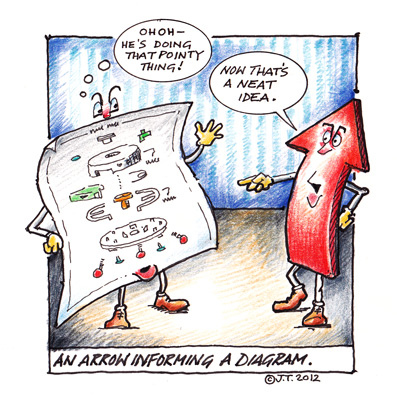
Opening any book about creating comics and graphic novels invariably floods you in established conventions for framing, speech and thought balloon use, caption box positions, view angles, perspectives and all manner of inking and texturing techniques. All of it is there for us to learn from. It can be a bit intimidating. The best bit though is realising that none of it is compulsory, and that all of these things are there to be played with. Their task is to inform the image being created, rather like an arrow or two might inform a diagram, so there’s no need to use all of them all of the time. Much more fun to find the things that work for you and the types of image you create, than feeling the need (and pressure) to become a master of all before venturing to the paper to make your first mark. There will be lots of experiments and invariably lots of trial and error involved but, without learning through doing, things won’t move forward, or worse get stuck in a repetitive rut. And we can’t have that.

And finally…….


Telling stories, the second bit.

Dragster cartoon nearly finished.

So the search has been on to find how to start thinking about stories behind the images and how best to communicate them. In a way a potential solution was staring me in the face, though I’d failed to recognise it. A very strong instance of not being able to see the wood for the trees. The “tipping point” was completing the cut down dragster drawing featured in The Line Is Drawn post. By cropping the image I had essentially put a box around it, the story in the image was contained mainly within this box, though it broke out to imply the story being much bigger than this constraint. The issue with previous drawings had been the open nature of the final image, with nothing to hold the image it was left to sit adrift in a space that then just flowed out to the edge of the paper. Sometimes paintings and drawings only start to make sense once we have framed them for hanging, and it was this sentiment that I was trying to capture. Rather than rely purely on the edge of the paper to provide the boundary of the contextual space, I realised that what may best serve these kinds of drawings is to create this boundary myself. Create distinct frames like they do for comic books and graphic novels.


It was a kind of “aha” moment. Had I found a mechanism for completing the images and communicating the “story” better? It seemed such an obvious realisation but then what is directly in front of you can be the hardest thing to see sometimes.It is nothing new, a technique that has a long history running through the comic universe to storyboards and beyond but, such a simple approach could really compliment the images as they are essentially cartoons in themselves and might benefit hugely from such a solution.


Conveniently there was a drawing here which I have struggled with completing for quite some time. It’s another in the dragster series and is sitting in the middle of a big bit of A2 paper, you may remember it from a post back in August. I got so far with it, then kind of stopped, the more I worked on it, the more the life seemed to drain out of it. The context I’d created in my imagination just wasn’t working so it got put to one side, to await a flash of inspiration and energy. It seemed a perfect candidate for experimenting with the “crop and box” approach. Interestingly, what happened was that it made me think much harder about what’s inside the boundary I’ve drawn. As a consequence the story has changed and with it a new context is starting to emerge in the background. The drawing has a new life, one that I’m more than happy with so far and looking forward to finishing.


So as a first stab it’s kind of working, an image I was perhaps bored with has regained my interest, and that’s such an important part of this exercise. They key now is to explore how this development pans out across future images. Certainly I don’t want it to become an exercise in cutting and pasting formats and such across a host of work, each piece must remain unique in its own way. What’s good is the fact that the idea is so simple and basic that it is ripe for all manner of playing with, and that flexibility is exciting.