Advice and opinion, don’t confuse the two.

Instruments: before, big and busy. After, uncluttered and simple.

Instruments: before, big and busy. After, uncluttered and simple.

There is a big difference between advice and opinion. One serves to guide and promote discourse, and the other invariably confuses things and promotes argument. I learned the difference between the two a long time ago and am constantly reminded of that lesson. When seeking advice we are generally hoping to tap into the accumulated knowledge and experience of others whose judgement we trust. Opinion on the other hand is generally something that follows acting upon advice and is subjective, unless of course, the other person has misconstrued your original query, in which case you get a whole load of one when you wanted the other. When I’m engaged in making stuff I ask for advice, when I need it, from other makers I know, and I might canvas their opinion when I’ve finished what I’m doing, but not before.
New headlight brackets and new front indicator light mounts.

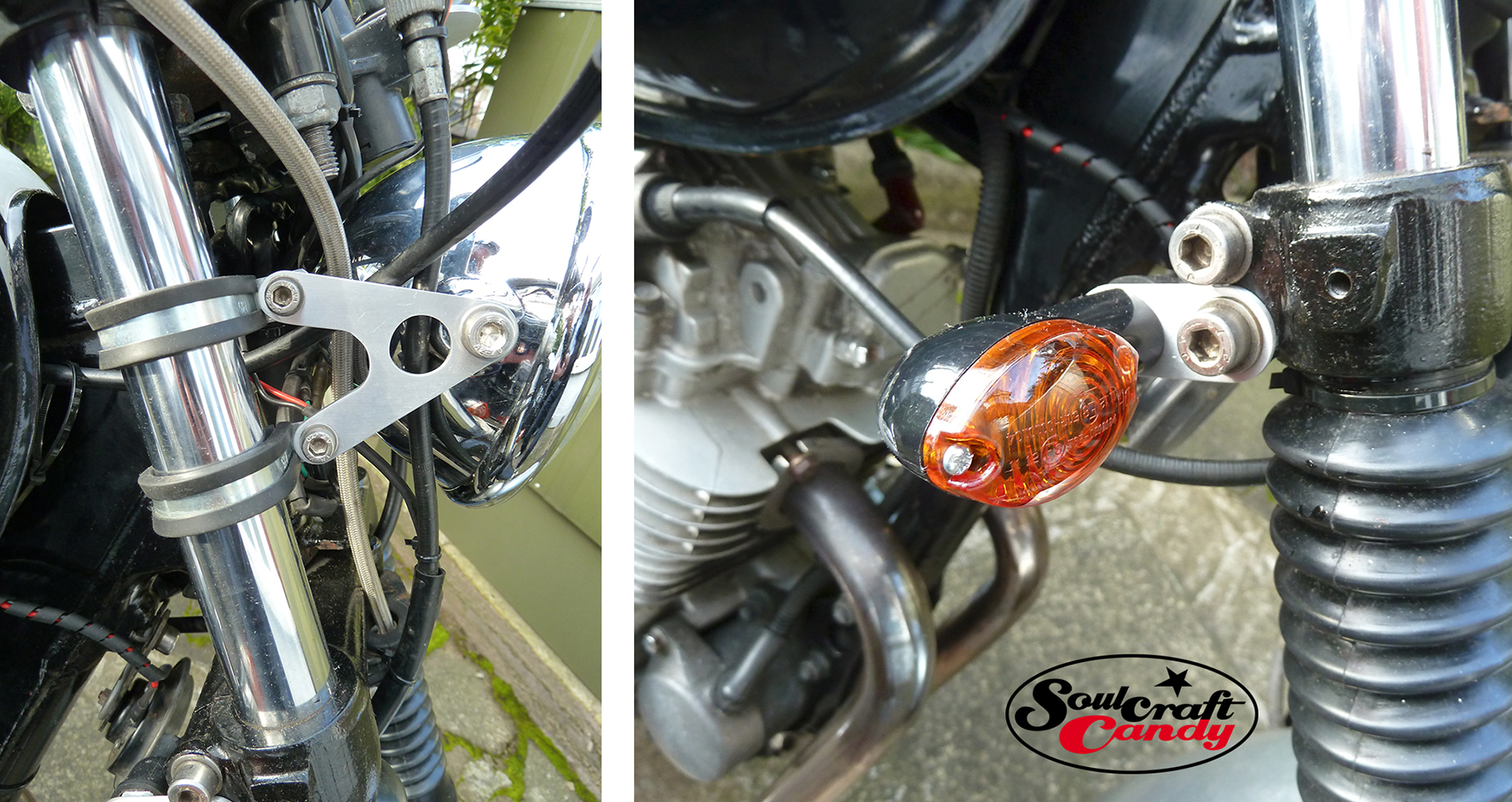
New headlight brackets and new front indicator light mounts.

If I’d followed all of the unsolicited “advice” I’d been given about how my bike should be, then I would have wasted a great deal of money and time on what is essentially a cheap form of transport. Working within an admittedly self imposed tight budget, and with time pressure to match, the solutions that interest me are those which are simple, relatively easy to execute and fit for purpose. It is with this in mind that I approach everything I do on this build and it helps to steer things clear of needless expense and wasted effort. One day I might build something more special but, for now I’ll work with what I’ve got. Sorting out the instrument area and the headlight would have been “better” if I’d totally stripped the bike of all electrics, cable drives and other bits, but that doesn’t clear the deck, it just opens up a whole new avenue of expensive solutions to a new set of problems. Working with what’s there meant splitting the clocks to allow cable drives to flex more freely and shorter light mounts to keep things close in and fairly tidy. The bundle of wiring needed to keep things working would stay, although shortened and repackaged. I’d bought some ‘P’ clips some time ago thinking they’d do for mounting the light on the forks and so put them to use. they work well enough for now though I may make replacements with a tighter fit later on. I drew up some side brackets on some graph paper (brilliant for laying out simple parts to scale) and transferred the design onto some aluminium alloy for cutting out. I made a new speedo mount based on what had been there before, but with a 20 degree offset and modified the mounting that came with the tachometer when I bought it, to bring it closer to the handlebar. All this allowed me to raise the light and split the clocks, and try to keep things as low as possible. By tilting the bars back further I was getting near to where I wanted the front to be. It looks a lot more sparse than before, but I’ll get used to it. And the natty little fly screen has gone.

I was very fond of it, but it had to go. A quick word about making those side brackets. Because I’d drawn them out on graph paper, it was easy to draw them again on alloy sheet, you remember all the numbers. I cut them out using a jigsaw, slowly, with a blade for metals at slow speed. I finished them off with hand files and drilled the holes with a hand drill. It takes time but not as long as you’d think and the result is pretty tidy once they’ve had a rub down with 600 grade wet and dry paper.

Here’s a canny bit of advice given to me by my father just before I started this: when filing soft metals, rub chalk along your files, it stops them from clogging. He was right, it did too. You can’t beat good advice. His opinion? Well, he didn’t have one, he’s waiting until I’ve finished to give me that.

Seize the moment.

Stripped and ready for action.

Stripped and ready for action.

The decision to get cracking on the bike coincided with two pieces of good fortune. First, work called just before I started on it to ask if I’d mind staying at home that week as there wasn’t enough work going through the studio to keep me busy. Regret that I wouldn’t earn any money that week was countered by the prospect of getting a fair crack of the whip on my bike build, so a reasonable result. Then, to my utter surprise, the weather turned unseasonably warm and sunny for about a week, perfect for fettling bits of metal out in the shed and garden. Having wrestled the bike into the back garden, no easy task given a very narrow access alley out back and the need to fit some much reduced width handlebars, the strip down was quick. Originally I’d built it in a way that would enable me to take it apart if I ever needed to and so was grateful for having made that decision. The work plan was front mudguard first, then the clocks and headlight area and finally the rear mudguard. After a quick once over and a clean it was time to get started.

Not bad, considering.

Not bad, considering.

I’d sketched out several solutions for mounting the front guard but, in the end opted for the simplest one which used two straps or hoops connecting the mounting holes on the fork legs with the guard mounted on top. Ok, not that elegant, but essentially all you need and adhering nicely to one of my general philosophies when approaching making anything, which is the KISS principal (Keep It Simple, Stupid). Due to the front forks having a leading axle arrangement, the mounting holes are off-set to the wheel centre so the straps needed to be of different lengths, and so I slotted the holes on the rear one to enable some positional adjustment when finally mounting the guard. Trimming the guard from the longer piece of rolled section I had was relatively easy, the tricky bit is joining it all together. For this you need to find the centreline of the guard, awkward on a thing that curves in two planes. My simple solution was to lie the piece on its side and establish the centreline as a height rather than a width, using a pen taped to an adjustable square. That done, it’s much easier to define the hole positions for your fixing screws or rivets to attach the mounting straps. Nothing worse than drilling holes only to find they’re in the wrong place. With the holes drilled I screwed the whole thing together using some M4 button headed screws and thread lock compound. Doing it this way allowed me to tighten things up just so, and minimise the risk of pulling the surface down onto the straps too much and dishing the top surface. The rolled mudguard blanks came with a polished finish but this is a nightmare to maintain, so the final thing was “brushed” with Scotchbrite before a treatment of anti-corrosion spray. Ok so far. Next up, the clocks and front light area.

It’s bright, I’m happy and it’s shipped.

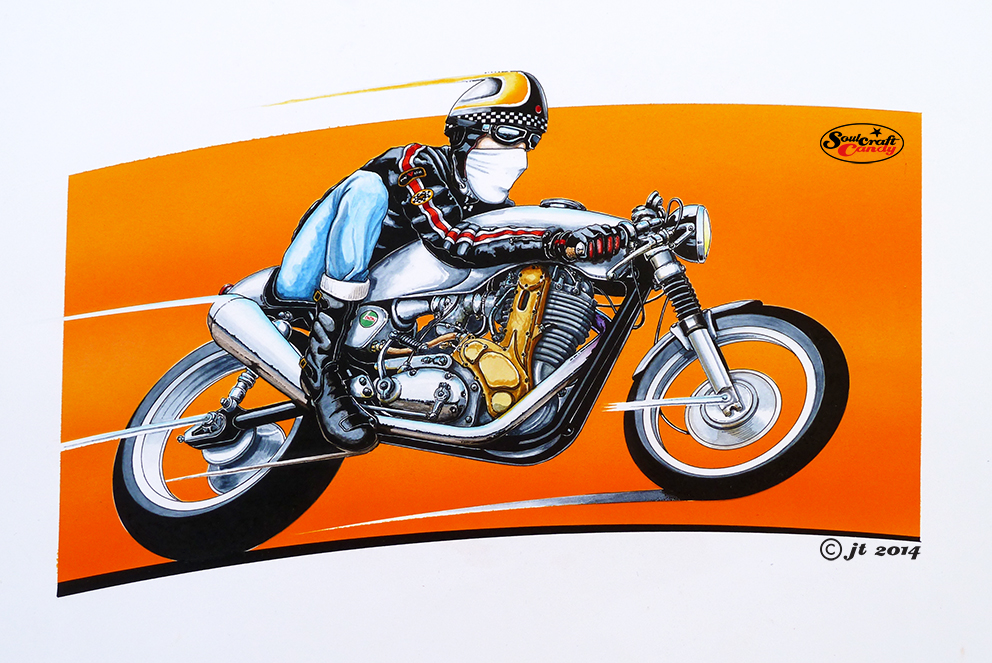
The Thumper © Jon Tremlett for Soulcraftcandy 2014

Those little thieves, that like to pinch bits of your time when you’re not looking are still hovering around the studio, turning hours into minutes. I’m experimenting with various strategies to combat their fiddling, the most effective so far being to shut down the email at certain times and turn the phone to silent mode. It’s working but it’s not a long term solution.


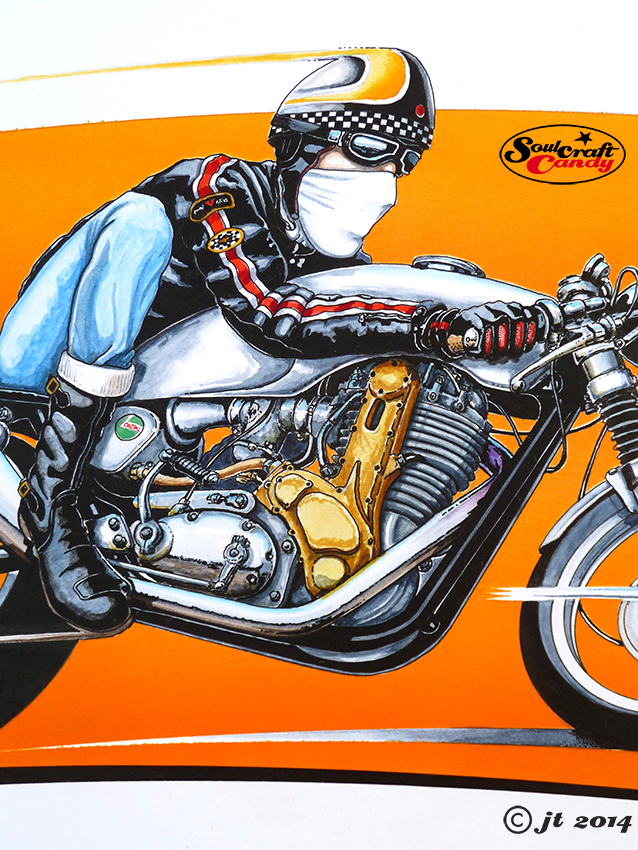
Despite these distractions I have finally managed to finish the picture featured in the last post, and it would be fair to say that I’m pretty pleased with how it turned out. For a long time I wondered if the speed streaks would work, and was tempted on many an occasion to just leave them out. I’m glad I didn’t, they add a bit of direction and dynamism to the image which wouldn’t be there otherwise. It’s a detail I need to work on to get absolutely right but for a first attempt it’s none too shabby. I’m also very happy with the balance, between cartoon and reality, I have managed to strike. It is such an overwhelming temptation sometimes to get utterly carried away in the painting and start working too much realism into the colouring.


As for that background, well it just needed something massive and punchy to lift it off the paper and grab the eyeballs. I did it in Dr. Martin’s liquid water colour with an airbrush, using two variations on orange. First a layer of orange and then some tangerine layed over the top. I always find using the airbrush completely nerve wracking. Laying down the masking film is enough to give me the jitters on its own, and then cutting out the mask with a scalpel and removing the pieces turns me into a shaking wreck! Spraying seems to be the easy bit. The ink takes ages to dry properly and in the end I had to remove it from the surface of the film with a carefully placed piece of blotting paper and a roller. Only then is it safe to remove the mask, very, very slowly.

Detail of the Thumper by © Jon Tremlett 2014

As I mentioned before, I think I’ll leave this level of detail painting for a while and have a go at being a bit looser with things. I’ve been sketching out some other pieces in good old fashioned pencil this week and I want to take one of those onto a suitable paper and play with washes. I’m hoping it will be a bit experimental and free up the brain a bit, loosen the creative muscle as it were. I’ll let you know how I get on.