No going back.

The inescapable fact of the matter when you’re making drawings like these is that ink can be a mightily unforgivable medium. Once you’ve made that mark on the paper there is invariably no going back. You can’t erase it. I remember there being such a thing as an erasable biro pen many years ago but, I also remember that it wasn’t really so and always left some kind of witness behind it and the eraser used scuffed up the surface of the paper. Not that great really when you’re after a perfect image. But I digress. There are advantages however to putting oneself in the situation where you can’t really afford to make any mistakes. I’ve always found that it tends to focus ones concentration on the drawing and where the marks and lines go. Over time this also builds a confidence in oneself which allows you to be much more relaxed during the creative process. There is a joy to be had in “knowing” what you’re doing and why you’re doing it. It makes it all feel very natural and in some way takes you closer to that point of flow that I’ve mentioned before.

There are many agonising moments during the making of a drawing, but the most can often be the point where you’re just about to make the very first marks on the page. I know I’m not alone in suffering that dreadful emptiness when faced with a blank sheet of paper. As a kid sat in art class the blank page presented you with so much possibility that you almost froze in the face of its intimidating emptiness. As you mature creatively this diminishes for sure but it can pop up occasionally to test you. Thankfully with a pencilled outline already on the page I don’t suffer this fate at present but I do take one last long stare at the bare image before that first biro contact. One is still faced with many choices one has to make even at this point but to combat any unsureity I employ a couple of simple strategies to get me by.
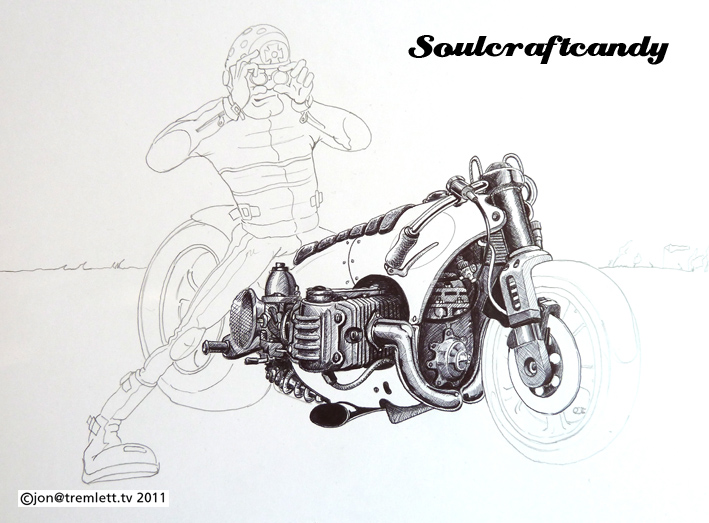
The sketches in this post demonstrate my simplest approach. I start in the middle of the drawing and work outwards. There is a practical reason behind this as much as anything. By starting in the centre I can move around the piece I’m working on very easily without running the risk of picking up “wet” ink on my hand and then promptly smearing it all around the page. I always use a loose sheet of paper to lean on to avoid this but it is so easy to forget to move it as you go and make a mess. As the drawing progresses I then divide it up into areas and attack those one at a time. So for example I’ll do the engine, then the surrounding bodywork etc. Wheels are always done as a pair and I leave the rendering of the figure until after I’ve competed the bike. the final step is any shadow and ground detail and then finally the horizon or background, if there is one.

These two drawings have taken shape in parallel. Again it’s another strategy I use to help me along, working on more than one thing at a time. Despite the obvious advantage of giving you two finished drawings at the same time what this really does is help we out when I get stuck. It keeps the flow going when I run into a set of details I’m perhaps not sure about, and rather than sit idly there letting my mind and focus wander I can reach for the other drawing and keep going while my subconscious mulls over how I’m going to deal with the problem. A happy consequence can also be that something done on one drawing provides a solution for the other. A kind of win win thing.

These two will be finished very soon.

Inspirations part one.

Whatever it is that forms the output from your creative noodlings everyone gets asked at one point or another where their inspiration comes from. Those tiny little seeds of ideas, they must come from somewhere right? Whilst the answer to this question is often an easy one for most creative people, sometimes it’s difficult to be specific. I find that both cases apply to my own ideas. The former seem to be the direct result of consciously absorbing influences, looking at photographs, taking pictures myself, books, looking at blog sites etc. Others feel like they come from somewhere else, some far fetched corner of my subconscious that has been busy reviewing stuff without my really knowing about it.

What’s often interesting is that what I think will influence me actually doesn’t. For example, I can spend hours browsing images on-line across a whole raft of sites, collect a few, and then promptly forget all of them by the next day. If I take pictures myself and go through the whole process of loading them into i-photo and editing some of them, then they work their way into my memory bank more. It’s something to do with interacting with an image or other material that seems to be the key. I’m still working out why all this is so as I’d like to get to the point where I know inherently how to feed the engine of my imagination prior to a big ideas session. That sounds all too controlling but at present it’s worth thinking about.

The sketch at the top of the post was strongly influenced by this image above. For once I made a direct connection between seeing and idea creation. As I said, it’s not always this plain and simple. I came across this image on a blog site called Le Containeur, which is a fantastic site. You’ll find it here.

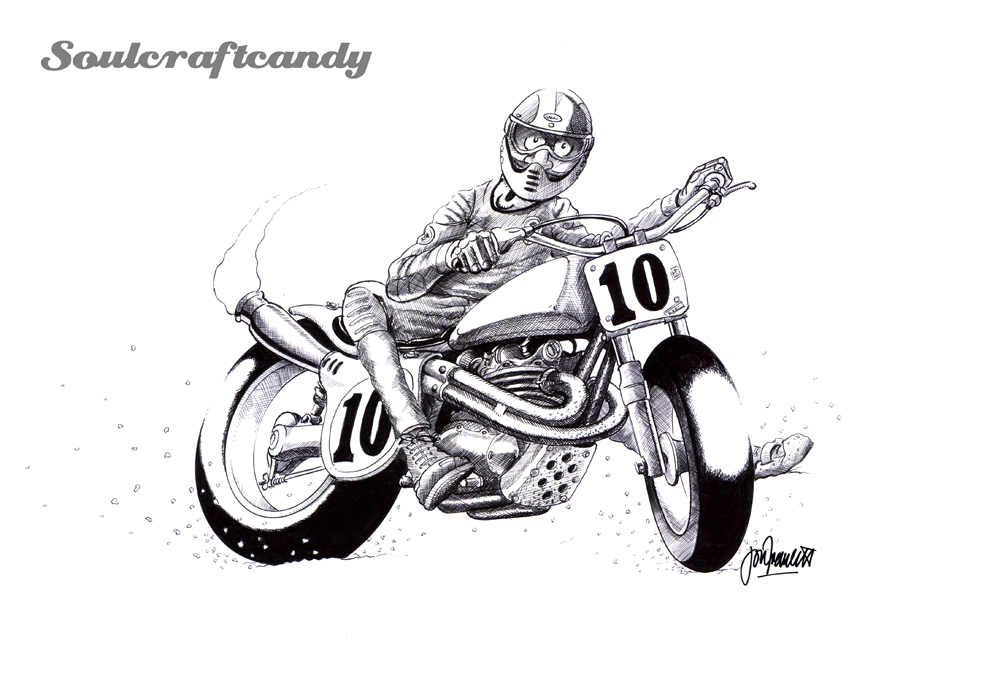
There is of course another step to all this which is when something you’ve created heavily influences another idea. This drawing of a dirt tracker is a direct result of making that first sketch. Ill try to expand on this over the next couple of days.

Pop! And it’s gone.

The bulging pile of paper sheets sitting on various shelves in my small studio room are testament to the hard learned (many years ago I might add) lesson that for every stack of ideas one might have, only a very few ever really make it out into the world in a finished form that we the creators are fully happy with. In the commercial design environment where I used to spend much of my time this is certainly the case and the reason why the search for a new industrial design for a mobile phone, for example, starts with hundreds of design sketches. Only after a protracted process of editing, refinement, lots of trips round an iterative loop and endless testing is the final design isolated.


What’s the point of the above? Well, I suppose it’s a comment on ones ability to accept that no matter what you might think there is still a very strong reason why iterative exercises and endless failures must remain a fundamental part of any personal creative undertaking. Personally, I like it when things don’t go quite right. It makes me refocus on what I’m doing and forces me to analyse why it didn’t work in an effort to learn something new and move forward.


This is what’s happening with this colour sketch above. I knew I had to put some kind of background in. I thought I’d try and keep it simple. I had a funny feeling it wasn’t working before I’d finished but, I carried on, and I think mainly to see if it would turn out as bad as I’d suspected. I think it did. I will probably find ten things wrong with it if I think long and hard about it. But I don’t feel the need to do that as the thing that hits me first is that it kills the drawing. It’s taken any and all of the “pop” away from the core image and drowned it in a sea of mid-toned dullness. ‘Pop’ is the word I use to describe in very simple terms an images ability to jump out of the page at you. The colour drawing in the previous post has it and many of the black and white drawings have it too. For me it’s about contrasts. Tonal contrasts across a drawing and between foreground and background. And intensities, particularly when using colour, again between foreground and background.


In theory I should know better, I’ve been making images for long enough to balance these things instinctively but, it doesn’t always work like that, so moments like this are always useful because they force me to step back from the work and consider carefully what I’m actually doing.


I’m not sure yet what I’m going to do with it. I could use it as the basis for a good fiddle in Photoshop just to play with tonal values quickly or I may take the opportunity to recolour another print and find that missing pop.