Keep it simple, stupid.

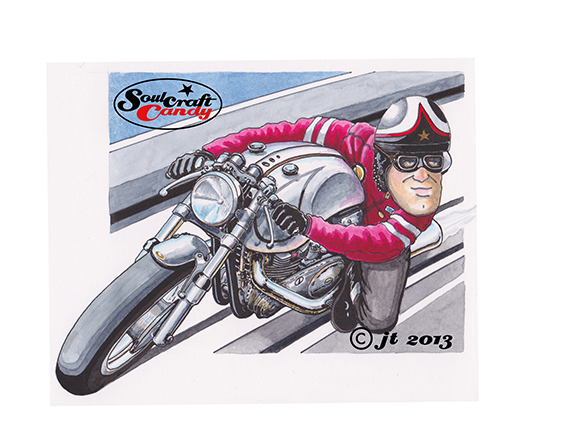
Cafe Racer cartoon from soulcraftcandy ©Jon Tremlett 2013

Ok, so I air-brushed it. Some may construe this as giving up, caving in and taking the easy way out, but I don’t see it that way. The concentric rings of colour idea was something I wanted to try, but knowing that it might not go according to plan, it was only common sense to have a solution tucked in the back pocket. Try as I might, I could not get it to work manually. The twin evils of watery paint and a shaky hand conspired to create a cringe making collection of patchy coverage and hopelessly imprecise curving lines. If it was a report card it would have had “Messy, must try harder” written large over it in red ink. I thanked myself for at least taking the trouble to try it out on a separate sheet of paper. 


I’m sure it might have been less traumatic if I’d tried it in acrylic paint, or mixed up house paints, as a good friend has since suggested. But I really didn’t want to make another trip to the art store to purchase even more stuff that I would have to find a home for in the now bulging shelves of the studio. 


The air brushing was not without its moments either. Purchased many years ago to apply even coats to a rather expensive model I was making, the airbrush has spent most of its life in its box, venturing out occasionally to be fiddled with but never wealded as a precision instrument. As far as using it to create a picture, the last time I tried that was at art school thirty years ago, and the results were pretty poor even viewed through rose tinted specs. I’ve never bought a compressor, resorting to cans of air such is the infrequency of its use. Anyway, armed with some low tac Frisk film I set about carving the concentric lines with a scalpel to create pieces of removable mask. I had completely forgotten how difficult it is to replace a curving piece of film accurately onto the page and that any overspray on the surrounding mask adheres immediately to your finger tips and goes everywhere you don’t want it. Result: another shocking mess. Finally, realising that the KISS principal (Keep It Simple Stupid) was my only option I recovered the piece in another piece of film, cut around the drawing to reveal the background space, and sprayed the whole thing in one go with blue emanating from one corner and the yellow from another. All the film was then lifted off when it was all totally dry. Et voila, finished, and despite being the result of expediency as much as desire it looks pretty good considering. The compromise may not be ideal but it saves me from looking at a finished piece with the perpetual frustration of knowing that a simpler solution would have yielded a better result.


Virtual interactions.

Soulcraftcandy cartoon cafe racer.

Two posts ago I talked about the many distractions hanging in the air these days, they are all mostly still there though my mind is slowly learning to ignore them. After all, one can only do one thing at a time and besides there are quite a few things to finish before immersing myself in a new medium, material, technique etc. Best get those done then.


Here is a more completed scan of the picture featured in that very post. The bike and rider are now done and it’s background time, again. I wanted something impactful but simple, colour but not complicated. I’d settled on a sun and sky combination and wondered about treating it as a series of concentric arcs of colour across the page. Sounds simple enough I thought, though knowing also how easy it can be to make a complete mess of a decent picture through the application of an ill considered final detail, I resolved to “sketch” it out in Photoshop first. So now we get the image shown below.

Soulcraftcandy cartoon cafe racer.

It is not looking too shabby at this stage, but I’m already wondering whether this is achievable in ink and paint given that the paper is Bristol Board, not the best thing for getting large areas of really flat colour. This is one aspect that Photoshop and other similar softwares can’t mimic. The digital space is a nigh on perfect canvas, free of the foibles of papers, boards and other physical media. Ones brushes are consistent in their behaviour, even when using a tablet as I do, and their “feel” is experienced through your gliding across the uniform surface of the tablet and the application of tiny variations in pressure. All lovely, but nothing like the real thing. So whilst I’ve got myself a scheme that seems to tick all of the boxes for me, the real challenge now will be rendering it in the mucky, unpredictable and unforgiving analogue space, where water manages to help and hinder all at the same time.


Are you ever unhappy with your work? Perhaps this is why.

Red_Jacket_Racer_by_JonTremlett2013

What do you do whilst thinking about how to finish a picture? This question is usually answered by going and doing something else for a period of time while the imagination, now freed from staring at the problem, finds a solution in its own time. In this instance though, the answer was to promptly do another picture. It’s smaller and was done a bit more quickly. When I’d finished it I was quite happy with it, the red jacket experiment worked well. The following day however, with fresh eyes. I didn’t like it at all. Something wasn’t right, and while I wondered what was suddenly wrong with it, I got to thinking about what it was inside me that would not allow the picture to enjoy any approval. This episode brought to mind a quote from a recent book about creativity by Seth Godin, “The Icarus Deception: How High Will You Fly”, which was shown to me by my partner a couple of weeks back. To me this quote goes some way to explain why we self appraise our work, not just that we do, and illustrates the relationship between the two agents of this internal process, ambition and taste. here it goes:


 On Good Taste.


Ira Glass understands how you feel.


“Nobody tells this to people who are beginners, I wish someone told me. All of us who do creative work, we get into it because we have good taste. But there is this gap. For the first couple of years you make stuff, it’s just not that good. It’s trying to be good, it has potential, but it’s not good. But your taste, the thing that got you into the game, is still killer. And your taste is why your work disappoints you. A lot of people never get passed this phase, they quit. Most people I know who do interesting, creative work went through years of this. We know our work doesn’t have this special thing that we want it to have…… And if you are just starting out or you are still in this phase, you gotta know it’s normal and the most important thing you can do is do a lot of work, …… It is only by going through a volume of work that you will close that gap, and your work will be as good as your ambitions”.


What I also found interesting about the above was that it explained to me something that has bugged me for ages. Have you ever allowed a friend or family member to see a piece of work? Has that viewing resulted in a spout of gushing praise that made you feel uneasy? After graciously accepting the praise, have you then struggled to explain why to you, in spite of their protestations, the piece is not very good at all and you should do better? I’m sure it’s not just me. The introduction of the ideas of taste and ambition really help to frame the argument you want to make, your only real challenge is to find the right words to use. Let’s face it, people get very upset if you tell them you’ve got better taste than they have! It’s surely about the education of that taste, and we are all responsible for our own in that regard. I must read this book.


Here’s to closing the gap.