One task, lots of tools to play with.

Fix your dragster.

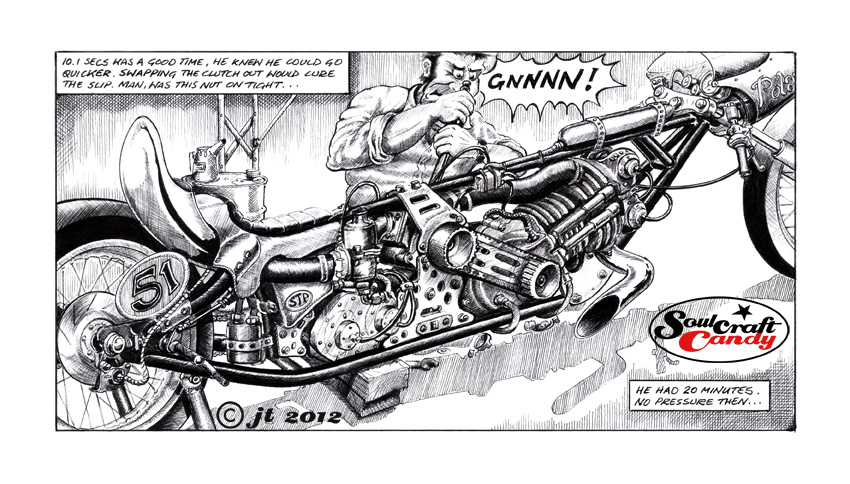
Well, here’s the final finished version of the first foray into the world of capturing the story behind an image. I’m quietly pleased with it even though it probably represents the simplest approach to all of the story stuff I have been posting about these last couple of times. It works, and that is the most important thing. Yes, there is much room for improvement but as a first stab it’s encouraging to feel that the framing and words add to the image rather than take anything away.


What is interesting is how looking at it now sparks an immediate desire to improve things, to create more. That’s not to say that what happens next is merely an extended exercise in  duplication across any number of pictures, more a wish to really get stuck in, and learn properly how to make best use of all the different devices at ones disposal, and perhaps invent some new ones too, specific to these drawings.


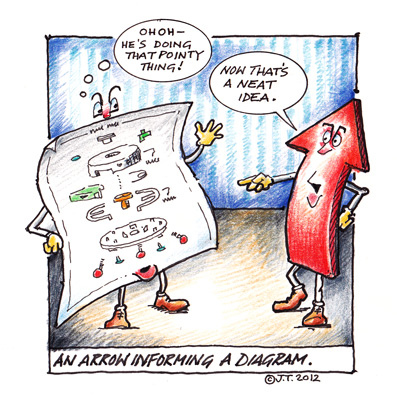
Opening any book about creating comics and graphic novels invariably floods you in established conventions for framing, speech and thought balloon use, caption box positions, view angles, perspectives and all manner of inking and texturing techniques. All of it is there for us to learn from. It can be a bit intimidating. The best bit though is realising that none of it is compulsory, and that all of these things are there to be played with. Their task is to inform the image being created, rather like an arrow or two might inform a diagram, so there’s no need to use all of them all of the time. Much more fun to find the things that work for you and the types of image you create, than feeling the need (and pressure) to become a master of all before venturing to the paper to make your first mark. There will be lots of experiments and invariably lots of trial and error involved but, without learning through doing, things won’t move forward, or worse get stuck in a repetitive rut. And we can’t have that.

And finally…….
 

We are all story tellers, Part 1.

Old sketch, new life.

In the previous post I alluded to my attempts to find new directions in which to take some, or all, of the drawings that pop out of the studio here. For a long time now there has been a persistent challenge in completing the ink drawings in particular, which has somehow not diminished or been overcome no matter the approach taken. It is that old thorny issue of context. Whether the inability to get this nailed is the result of never being formally trained in illustrative techniques, or some weird hangover from years drawing objects as a product designer I’m not sure. The more I think about it, the more I’m persuaded it’s a combination of things, some of which go right back to when we learn to draw in the first place and how we look at the world we are trying to capture.


The connection between ones minds eye and the imagination is a fascinating one and is undoubtedly different in all of us. How we imagine things, scenes, objects and the like also varies within us from moment to moment. When drawing from life one is saved from creating context because, in a way, it’s right there in front of us, and we are able to use some visual editing to eliminate that which we feel is surplus to our requirements. In imaginative drawing this is almost reversed, we must “fill in” first before editing down.


What’s this got to do with stories you might ask? Well, part of the success or failure of an imaginative image, I believe, lies in providing enough information to not only hold the eye of the viewer, but also to captivate their imagination in the hope that we allow them to extract as much as possible from the image. In a way we try to tell a story, or at least provide enough to start a story off, to allow the imagination to take us somewhere. Although a fairly simple sounding premise it has taken me some time to work this out in my own mind, which I’d much rather do than read it in some book or other. Because I’m a person who sees objects more than scenes in the minds eye, providing this context is always a struggle. Previous attempts have had mixed success. Shaded geometric shapes have helped to place the image on the page, but no more. Inserting scenes such as horizon lines inhabited with trees and buildings have helped too but run the risk of pulling the central image back towards reality and becoming repetitive. What I wanted to find was a format that would give more flexibility whilst being very much in tune with the language of the images.


The little drawing above might give you a fairly clear idea as to where this is going.


The first V-twin drawing, nearly done.

First V-twin drawing.

Firstly, a big thanks to everyone who sent me a “like” following the last post about the Dragster drawing and its blank rider. As ever, it’s always so encouraging to receive positive responses from viewers. If I haven’t yet, I will be visiting your sites too, to check out all of the creativity happening on WordPress and elsewhere and hopefully reciprocating in the spread of good karma.


You will see from the drawing above that not everything is going down the “leave bits blank” route, and so currently this one is much more like many that have come before. But it isn’t finished yet. What you see today is more of a progress update than a finished drawing. I whizzed off a quick scan for the blog without cleaning any of it up so it’s riddled with pencil lines and various other bits and pieces. Although the differences are sometimes subtle, this one is done on Fabriano drawing paper (200 gsm) rather than my preferred Bristol Board. The surface of the paper is much softer than the board and so the fine biro pen interacts with it differently. It is much harder to achieve the very fine line work for delicate tones on the one hand but, creates a kind of broken texture in the cross-hatching on the other hand. You do get a bit more ink build up on the nib of the pen so it’s a good idea to always have a tissue handy for keeping the pen as clean as you can. Overall the result is good though, so the paper has passed this part of the test. The next bit will be to see how it deals with direct sketching in pen. If there is a downside, it is the fact that this paper is only available in A4 and A3 sizes, so getting into some larger drawings will require  me to find a different paper. I’m on to that already.


What’s going to happen in order to finish it? Well, there are a couple of new ideas that I’m trying out now which I hope will provide the answer to that question. It will be a new direction that’s for sure and I’ll post about it very soon.

Lastly today, here for your amusement, is the second cartoon I bashed out the other day over a cappuccino whilst contemplating our inability to read things properly, take things seriously and exercise our sense of humour.