Awash with colour.

TT racer washes.

Building a finished image is a really exciting part of the picture making process. As each area of colour goes down and every line gets drawn, ones original vision is slowly realised and brought to life. It’s at times like this that one realises that the making part of creativity is as enjoyable, and sometimes more so, than the spawning of ideas.


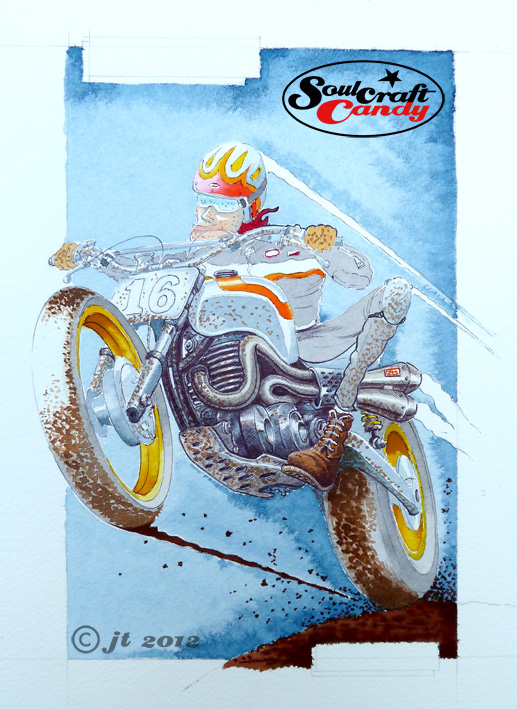
So the TT racer image now has its full compliment of colour washes and is now ready for the remainder of the line work. It has gone pretty well so far though I have to admit to a small mistake, over on the right hand side, where the two white streaks exit the frame. You’ll see that I let the wash run over the line on the top one a bit, which has let a bit of blue in. I will have a try at removing some of the colour with a damp flat brush once it’s fully dry. It may not work but it’s really not a problem, errors occur every now and then, and it is much better to learn to work with and around them rather than beating yourself up about it. This is as much an experimental drawing as anything else so mentally I’m ready for small things not being perfect. There’s nothing wrong with a bit of white gouache at the end if it proves stubborn.


Putting the washes down, particularly the large areas of blue proved a bit nerve wracking as you never really know what it’s going to turn out like. Not being too proficient a water-colourist there is always a degree of unpredictability in laying in larger areas. But then again this provides a nice contrast to the precision of the following pen work. I have left two small blank boxes top and bottom, one for the story title and the other for any final thoughts or signature, we’ll see. Should have this done in a couple of days. Here’s a close up for you.
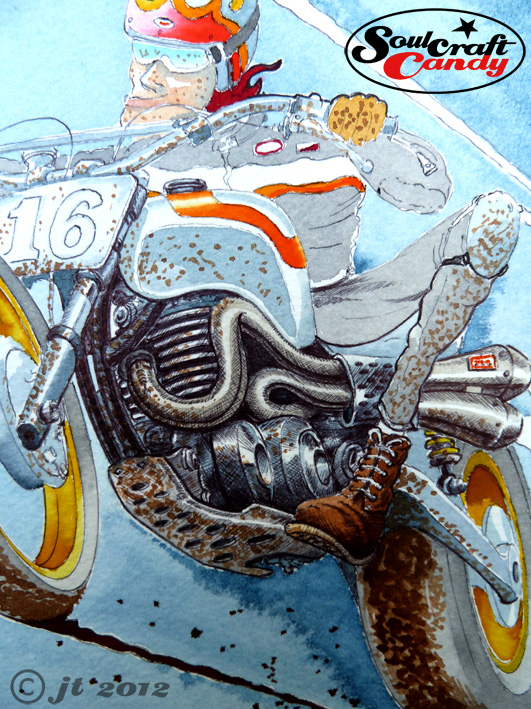
TT racer close up.


Making it different.

TT racer sketch

Apart from the story conveyed by an image to the viewer, a picture also contains another story, that which lies behind its creation. This is not the narrative expressed by the image but the tale of how the image was made. Whenever I look at an image the “maker” in me can not resist trying to work out how it was made. It is this questioning which drives my desire to try and share, whenever possible, the processes which lie behind the images I create. The techniques I use are not complex and I don’t use any cunningly developed or unique ways to create them, so why not let others see how these things come into being.


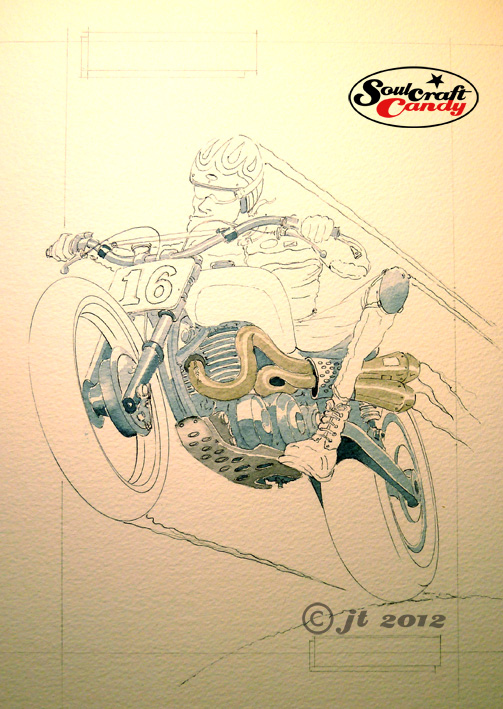
Above is the first sketch for a picture I am now working on. It comes from a series of sketches done for the V-twins project. The inspiration for it is american dirt track TT racing where oval tracks are supplemented with right hand turns and jumps. I find the idea of flinging a big heavy 750 around this kind of circuit attractively bonkers and so, worthy of a picture. It’s done simply in plain blue biro pen on some of the cheapest and low quality sketching paper I own. Believe me, it’s a good deal messier than the scan shows thanks to the wonders of playing with the levels in Photoshop in readiness for posting. Those shaded areas cover a multitude of hidden lines and you can see the engine has received some attention from the Tippex pen too.


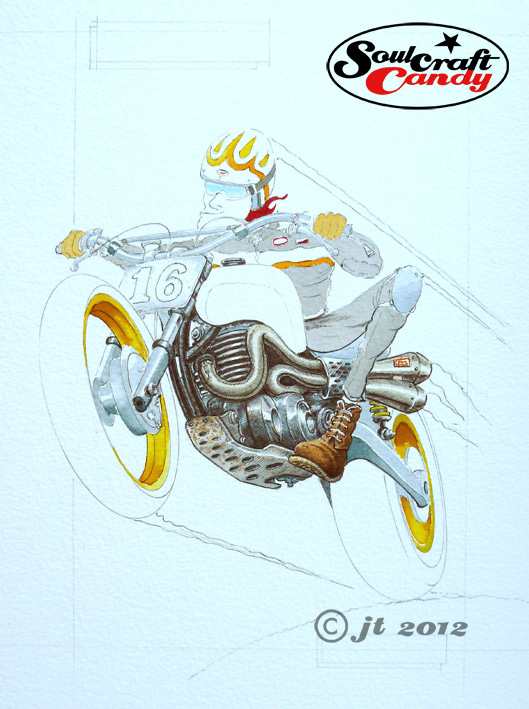
Using my trusty little lightbox the image was transferred onto some water colour paper, firstly in pencil which was then overdrawn with fine black biro pen. I wanted to try having another go at introducing some colour to the images so thought I’d start on familiar ground with some water colour paints and inks. Normally one would stretch paper before making even an outline drawing, but that would not allow lightbox use so I stretched it after copying the drawing across. It’s a great way to do it and the image doesn’t seem to suffer any distortion at all.


The following images are my progress updates. The first is laying on some light washes to give the image its base colour. The second shows you what I’m aiming towards. By applying my usual biro pen technique over the washed areas I can achieve the impact I want but with a degree of colour behind it, and thus a nice bit of punch too. I suppose it’s very like how you ink in a comic strip but here I’m aiming for some variation in the tones and not such a contrasty finish. The third one just shows how far I’ve got. In reality I should have applied all the washes before picking up the pen but wanted to show what’s building as much as see for myself whether I was on the right track or not. Looking good, though forgive the odd colouration, my camera does odd things with daylight.


Version 3, did it work?

The third version of this sketch is now complete as far as the main subject of the image is concerned. So as not to reduce the exercise to one of exact and complete copying I elected to change a couple of features about the central picture in an effort to try rendering certain details differently as much as to maintain my interest in it. So you’ll see that this time the main body of the engine is made to look black, the bike has taken on a two tone colour scheme and the rider figure has taken to wearing a check shirt amongst other small changes.


Third time around this was still a fun picture to create and the inclusion of a bit more detail in these small areas, such as the shirt material make it much more interesting to look at. It is often said that both God and the Devil live in the details and this is utterly true, ones treatment of detail can make or break a drawing or design, so a cautious approach is always a watch word when trying things like this. Is it successful? I’m not sure that success is the right word to describe it, though I would say that working at a larger scale, this drawing is only six inches wide, would help in depicting the finer points and relieve the need to try achieve things with a very small brush which is still too big.


This buff background arises from necessity as much as choice. I wanted to post the image before departing for a long weekend away so time is short. Some careful trimming of the scanned image and a block fill, with a little shadow, was the solution to time pressures. Judging ones own work is always tricky but in this instance I’d say it works quite well. The colours are suitably contrasty to give the drawing some “pop” and help it stand out. What really ticks the box though is the contrast offered between the very hand made nature of the painted image and the utterly smooth, flat nature of the machine made background. It would be interesting to see how this looks in printed form, something I’ll experiment with later perhaps, and equally, it would be interesting to see what happens when this flat colour is applied by hand using Gouache or Acrylic paints.


There is some black and white pen work which desperately needs attention lavishing on it so messing about with colour may have to take a back seat for a time. The challenge is whether this exercise has committed enough to memory for it all to move forward again the next time I pick up the brush.