From blank sheet to finished picture – part 3.

Norton_wash3

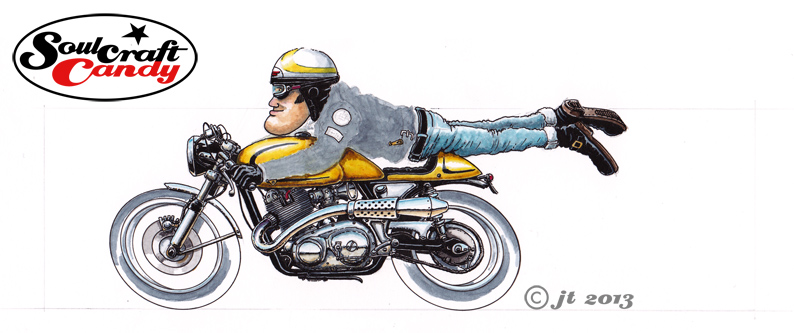
The next stage in the application of colours to the picture is probably the most nerve wracking and delicate, though it is hugely rewarding when completed to ones satisfaction. Although in your minds eye you feel you can “see” exactly how you want things to to turn out, the reality is that one is merely aiming at achieving that vision, as actually it’s not at all clear until you’ve put paint to paper, and sometimes by then it is too late to make a change. You have to kind of feel your way towards your goal. I’d decided the bike should be a golden yellow colour. The first stage is to put some shadow tones onto the areas that require them like lower edges and vertical faces. With these you have to think what colour the yellow would be in shadow as these things are invariably never a case of simply adding black or grey to your base colour. In this case doing that would make everything a dirty green colour, not good. So using small quantities of darker ochres and browns these areas are touched in and left to dry. Having decided on highlight size and position it’s time for the yellow, applied in a thinned wash to start with and then built with some less diluted colour as the from appears. Knowing when to stop is as much judgement as experience, so slowly, slowly, catchy monkey as they say. The yellow on the helmet follows and then finally the base layer for the leather jacket making sure I leave clear all the small details I want to stand out in the finished picture.
Norton_ink3

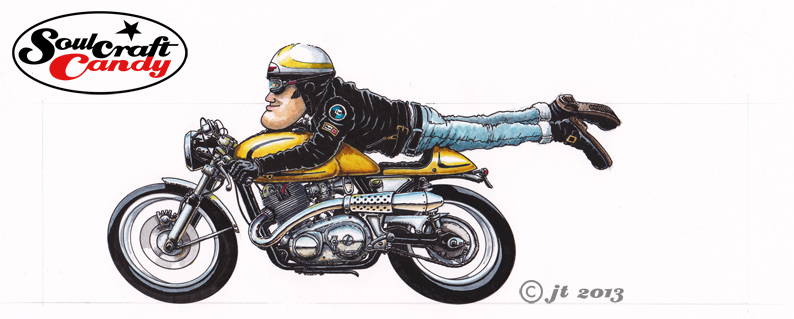
When all the above is fully dry it’s time for the last of the inking stages. Using a fatter pen than usual, a 0.5 point, the tyres are done first, leaving hard edged areas for the highlights rather than a more messy looking feathered edge. Back to a fine pen and the jacket comes next where it’s very much a case of working slowly down or across the shape, again leaving small slivers of grey to denote highlight areas where the leather wrinkles. You could argue that areas like the jacket should be more gradated and “realistic”, but if you do that then the rest of the picture doesn’t “fit” and you end up having to apply the same approach to everything. All that’s left to do now is add any small colour touches into any helmet and jacket badges, the spark plug cap and small reflections of the yellow that appear on metal parts facing the coloured area. A final tickling process takes some time, constantly scanning the image for little white gaps and spots where a bit more colour or black is needed, but it serves to lift small parts of the picture that you perhaps didn’t see before.


The picture is now nearly done, all that remains is to choose the right colour for the background block, one that gives enough contrast with the bike colour but doesn’t drown the image in the process. That’s all in the next post, see you then.


Take your imagination for a walk.

83_Wheelie_2

There aren’t many drawings here in my collection that are based fairly and squarely on actual, real machines. The bike in the picture today is probably as close as I’ve got in some time to depicting an actual bike. On the one hand this is down to the fact that I find “copying” from reference material a rather dull activity, and on the other it has a lot to do with keeping my imagination fed, watered and happy. Those of us who enjoy documenting the wonderful world around us through image making most likely occupy an area similar to that found between the two intersecting circles of a Venn diagram, where the real and imaginary overlap, and each image is a result of varying percentage combinations of the contents of those two circles. For me the ratio feels very much tipped in favour of imagination but, sometimes I wonder whether this is actually the case. What is my imagination up to during the process of making an image such as this one above? Is it actually creating anything or is it busy bending a set of reality based frameworks, and blending those with a healthy dose of embedded knowledge to create something which my  eye is happy with? I’m not sure, but it’s an interesting question all the same.


Generally speaking, an active imagination is a happy one, and though we all know that this isn’t always the case, learning to feed it with good stuff is an important life lesson. The pleasure though, in this activity, is that it seemingly has no problem propelling itself along at a fair old clip when it’s found something to get its teeth into, and for me this is where reality plays it’s biggest role, in influencing the choices my imagination makes and providing the fuel for the journey. This is one of the key reasons why these pictures come out the way they do. My imagination needs not only to bear creative fruit but also has to have something to distort, to have fun with in order to function properly. It’s a strong urge and one I’m almost powerless to resist, so most of the time I don’t try to. But there is some control involved somewhere as it doesn’t just run wild all the time. Perhaps it is like a kind of dog, look after it, feed it properly and give it regular exercise and it stays a loyal and rewarding companion.


Bending the rules, just a little.

82_Wheelie_1

Todays stunt, the Wheelie. As much as they are displays of machine control and skill, they are also a perfect expression of the utterly boyish exuberance and confidence that infects us when we’re out on our bikes. It’s a lot of fun to depict them in images, though capturing that moment, like a camera snapshot, presents its own challenges. If you drew up some kind of list of all the variables one could consider before putting pen to paper, you would probably never start. For me the essence lies in capturing that sense of fun and confidence such a display gives off. It is after all, nothing more than showing off to an audience, so trying to get that into the picture is important. It would be far simpler to draw the whole thing as a straight elevational view but that would be too easy. Like a camera lens your eye can be a pretty wide angle device, and so creating a sense of depth and perspective is the main challenge. Which part of the image is almost flat to the viewer, and at what angle does one see the rest of the subject are aspects that present an interesting challenge when drawing from imagination. Too little and things look rather flat, too much and you get a kind of fish eye effect that turns the subject into a kind of banana. In perspective terms these are not perfect depictions but I hope they do enough to convey the idea. Cartoons invariably bend the rules a bit, but I think you can get away with it when you admit that that is exactly what you’re creating.


This one is Wheelie 1, and yes, that means there is another one coming along shortly. I hope you enjoyed it.