Pop! And it’s gone.

The bulging pile of paper sheets sitting on various shelves in my small studio room are testament to the hard learned (many years ago I might add) lesson that for every stack of ideas one might have, only a very few ever really make it out into the world in a finished form that we the creators are fully happy with. In the commercial design environment where I used to spend much of my time this is certainly the case and the reason why the search for a new industrial design for a mobile phone, for example, starts with hundreds of design sketches. Only after a protracted process of editing, refinement, lots of trips round an iterative loop and endless testing is the final design isolated.


What’s the point of the above? Well, I suppose it’s a comment on ones ability to accept that no matter what you might think there is still a very strong reason why iterative exercises and endless failures must remain a fundamental part of any personal creative undertaking. Personally, I like it when things don’t go quite right. It makes me refocus on what I’m doing and forces me to analyse why it didn’t work in an effort to learn something new and move forward.


This is what’s happening with this colour sketch above. I knew I had to put some kind of background in. I thought I’d try and keep it simple. I had a funny feeling it wasn’t working before I’d finished but, I carried on, and I think mainly to see if it would turn out as bad as I’d suspected. I think it did. I will probably find ten things wrong with it if I think long and hard about it. But I don’t feel the need to do that as the thing that hits me first is that it kills the drawing. It’s taken any and all of the “pop” away from the core image and drowned it in a sea of mid-toned dullness. ‘Pop’ is the word I use to describe in very simple terms an images ability to jump out of the page at you. The colour drawing in the previous post has it and many of the black and white drawings have it too. For me it’s about contrasts. Tonal contrasts across a drawing and between foreground and background. And intensities, particularly when using colour, again between foreground and background.


In theory I should know better, I’ve been making images for long enough to balance these things instinctively but, it doesn’t always work like that, so moments like this are always useful because they force me to step back from the work and consider carefully what I’m actually doing.


I’m not sure yet what I’m going to do with it. I could use it as the basis for a good fiddle in Photoshop just to play with tonal values quickly or I may take the opportunity to recolour another print and find that missing pop.
 

Going with the flow.

Some years ago I was engaged in a process of attempting to understand creative acts and my own creativity in particular. This was brought about by a need to find out more about what made me tick. Like many creative people I’m sure, I’ve often found myself wondering what exactly it was that I was good at why being unsure about it was making working life quite confusing and unrewarding. Coincidentally my partner was beginning to investigate the meaning of creativity around about the same time and through her own investigations introduced to me the concept of flow.

I had never come across this idea before but, very quickly I understood that it was something I’d encountered many times in both my professional and private life. Like many of these kinds of things it’s a very simple idea but people manage to write whole books about it. In simple terms the best way I can describe it is that it is primarily a state of mind.


Have you ever engaged in an activity and lost all track of time? Have you ever been so engrossed in something that you’ve not heard the telephone ring, or suddenly looked up from a task and wondered where the day went? Have you ever been so into making something that all problems encountered are easily solved and progress seems to just come naturally? Well, if any of these has happened to you then most likely you have been in flow.


Understanding this concept has helped me hugely in recognising what I like doing most in work and play. It has enabled me to make much more informed choices about what work to take on and why sometimes I feel like I’m flogging a dead horse.


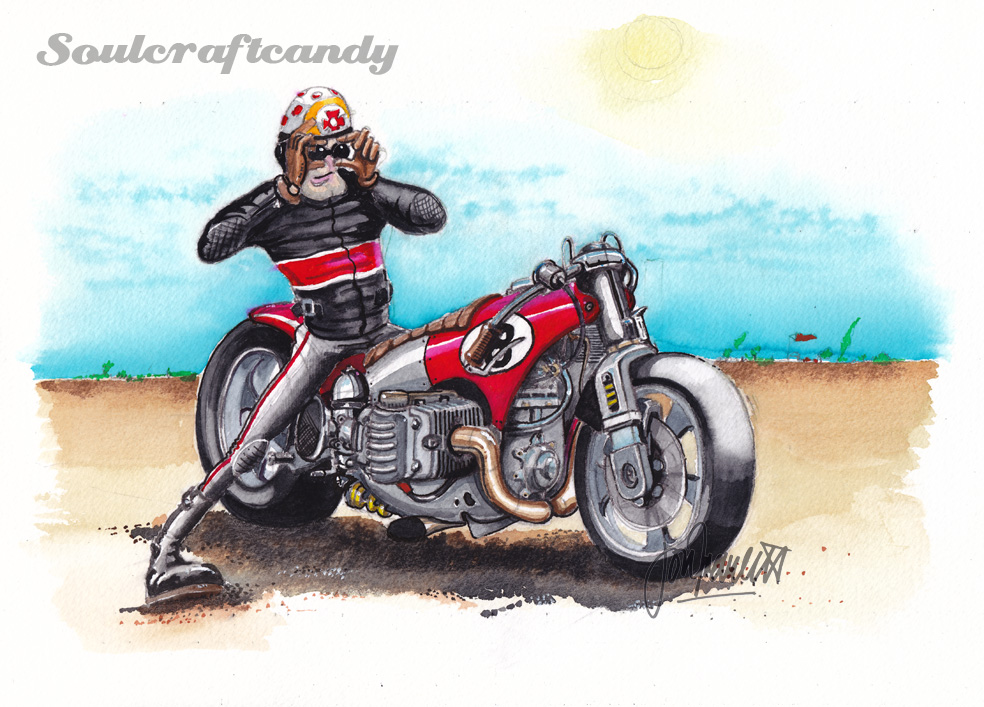
This finished colour representation of the second of my printed out sketches onto watercolour paper emerged from a concentrated afternoon spent mostly in flow. I have no idea how long it really took, not that it matters, and I got so engrossed in it that the day just vanished in a blur of paints, brushes and water. Not having really done a full colour drawing like this for some time I threw myself into rediscovering how to get the paints to move around the painting and what happens when you put paint on a wetted surface and a dry surface. It sounds simple but I’ve found it’s easy to forget all of the little tricks one develops for oneself to get things looking how you want them. There are a couple of things not quite right with it, like needing more variance in my greys. But there are also some great things about it too. I’d forgotten how vibrant the liquid watercolours I use for some parts can be (Dr. Ph. Martin’s Radiant concentrated water colours, hopefully available at all good art shops worth their salt). The red for the tank really helps the image to jump off the page which is such a satisfying outcome, for me anyway. I’m attending the 50th birthday party for a very old friend this weekend and I’m so pleased with this image I think I’ll give it to him as a present. He’s a bit of a bike nut too, so here’s hoping he’ll like it.


The first sketch, with the mechanic behind the bike, is very nearly done too so I’ll post that up in a day or so. The bigger biro drawing of the big single cylinder cafe racer is coming along well to and will be here soon. Watch this space.


A Teaser

In my last post I mentioned that I wanted to work up those two BMW inspired sketches in ink as a next step before playing around with some colour. Well, things as ever never go according to even the simplest of plans. Not through anything going wrong, far from it, but from being led up another path by my inquisitiveness.

When I’m playing about with colour on an image I’m always fearful of making a mess of it and spoiling a perfectly good drawing through the inappropriate application of paint or crayon. The latter you can sometimes remove with an eraser but, the former is a more tricky medium to shift. It always leaves a stain at the very least. So my thinking was that to avoid such situations I could print the sketch onto another sheet and play about with that. I’ve tried this before and it’s always been onto standard cartridge or stock printer paper. It’s a habit carried over from doing coloured design renderings back in the studio many moons ago, before anyone thought an Apple mac might be useful and anyone had any idea about Photoshop. The copier was my best friend.


My problem, or what I perceived as a problem was that I wanted to use some watercolours and these do not sit well with standard printer paper. The paint goes all streaky and the paper quickly starts to look like an unpressed shirt. I’d never thought to try printing onto watercolour paper as I’d always thought it would be too thick to go through my old Epson. How wrong I was. After a couple of false starts as the paper feeder got to grips with what must have felt like someone feeding it a doormat, it chugged through and the results are pleasing enough to warrant throwing some colour at it. As you can see from the picture above it’s not too shabby a result. I’ve printed out a couple of other scanned pencil sketches in the same way and I’ll pop those up on the blog as they come together and I get to grips with re-familiarising myself with my favourite paint medium.

Here is a bit of a teaser image for you too today. It shows me (though I’m not in the shot obviously) about coming up to half way through inking in a drawing of a massively engined single cylinder cafe racer I sketched out ages ago. I’d left it languishing in the sketch pile while I got on with other drawings but, coming across it the other day I thought I’d do something about it now. Of course I’ll put the finished article up on the blog as soon as it’s done for your delectation.


Also in the shot is one of my favourite tools. It’s a book, a fabulous book by a chap called Daniel Peirce and covers the story of a photographic project he undertook called Up-N-Smoke. It is essentially 140 pages or so of beautifully photographed bike engines. All vintages, all types and all lovingly lit. For me it’s a fantastic reference for shading in all of those apparently similar coloured metal parts, how reflections get cast on surfaces and bags of engineering details to feed the imagination for future drawings. It’s published by Veloce books (ISBN 978-1-84584-174-4 ).


There is art to be found in engines, that’s for sure.