Awash with colour.

TT racer washes.

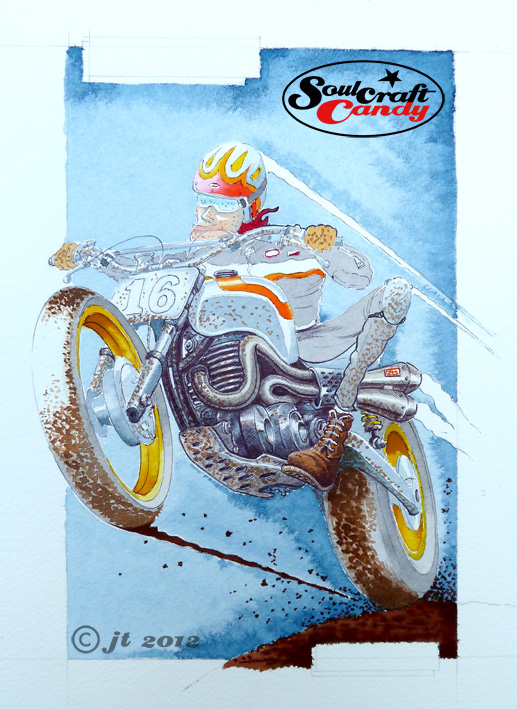
Building a finished image is a really exciting part of the picture making process. As each area of colour goes down and every line gets drawn, ones original vision is slowly realised and brought to life. It’s at times like this that one realises that the making part of creativity is as enjoyable, and sometimes more so, than the spawning of ideas.


So the TT racer image now has its full compliment of colour washes and is now ready for the remainder of the line work. It has gone pretty well so far though I have to admit to a small mistake, over on the right hand side, where the two white streaks exit the frame. You’ll see that I let the wash run over the line on the top one a bit, which has let a bit of blue in. I will have a try at removing some of the colour with a damp flat brush once it’s fully dry. It may not work but it’s really not a problem, errors occur every now and then, and it is much better to learn to work with and around them rather than beating yourself up about it. This is as much an experimental drawing as anything else so mentally I’m ready for small things not being perfect. There’s nothing wrong with a bit of white gouache at the end if it proves stubborn.


Putting the washes down, particularly the large areas of blue proved a bit nerve wracking as you never really know what it’s going to turn out like. Not being too proficient a water-colourist there is always a degree of unpredictability in laying in larger areas. But then again this provides a nice contrast to the precision of the following pen work. I have left two small blank boxes top and bottom, one for the story title and the other for any final thoughts or signature, we’ll see. Should have this done in a couple of days. Here’s a close up for you.
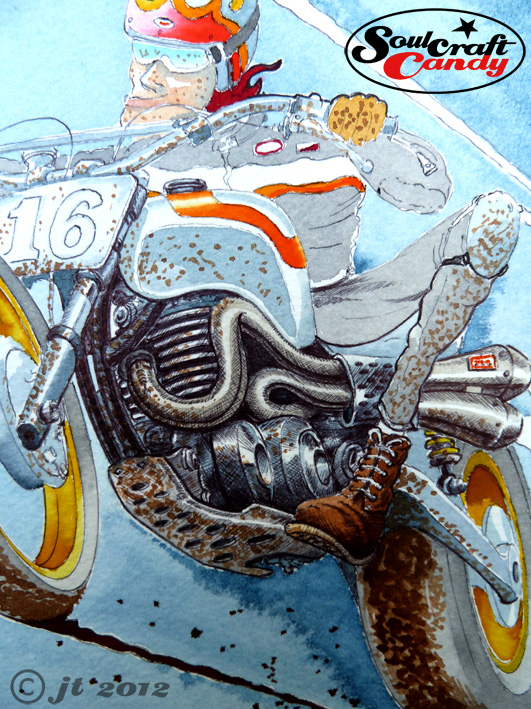
TT racer close up.


The first V-twin drawing, nearly done.

First V-twin drawing.

Firstly, a big thanks to everyone who sent me a “like” following the last post about the Dragster drawing and its blank rider. As ever, it’s always so encouraging to receive positive responses from viewers. If I haven’t yet, I will be visiting your sites too, to check out all of the creativity happening on WordPress and elsewhere and hopefully reciprocating in the spread of good karma.


You will see from the drawing above that not everything is going down the “leave bits blank” route, and so currently this one is much more like many that have come before. But it isn’t finished yet. What you see today is more of a progress update than a finished drawing. I whizzed off a quick scan for the blog without cleaning any of it up so it’s riddled with pencil lines and various other bits and pieces. Although the differences are sometimes subtle, this one is done on Fabriano drawing paper (200 gsm) rather than my preferred Bristol Board. The surface of the paper is much softer than the board and so the fine biro pen interacts with it differently. It is much harder to achieve the very fine line work for delicate tones on the one hand but, creates a kind of broken texture in the cross-hatching on the other hand. You do get a bit more ink build up on the nib of the pen so it’s a good idea to always have a tissue handy for keeping the pen as clean as you can. Overall the result is good though, so the paper has passed this part of the test. The next bit will be to see how it deals with direct sketching in pen. If there is a downside, it is the fact that this paper is only available in A4 and A3 sizes, so getting into some larger drawings will require  me to find a different paper. I’m on to that already.


What’s going to happen in order to finish it? Well, there are a couple of new ideas that I’m trying out now which I hope will provide the answer to that question. It will be a new direction that’s for sure and I’ll post about it very soon.

Lastly today, here for your amusement, is the second cartoon I bashed out the other day over a cappuccino whilst contemplating our inability to read things properly, take things seriously and exercise our sense of humour.


Where to draw the line?

Dragster 1

The title for todays post is phrased as a question and is one that is occupying a sizable chunk of my creative brain power at the moment. Although a single question, it concerns two very distinct aspects of the drawing you see above, which is shown in nearly finished form.


The first aspect of the question arises from my decision to crop the image and leave some of the image blank. Why? Well it stems from some feedback that has come this way in recent weeks, and some older thinking from a while ago which centred around the issue of how to introduce another dimension into the monochrome ink drawings. Combining the “less is more” approach and the often mentioned ability of the eye and brain to work together to complete an image, the time seemed right for some experimentation. When soliciting comment from others about the drawings it is interesting to hear that in some cases there is almost too much information provided, that the eye, brain and imagination are left with no work to do. Everything is there in front of them and there are no gaps for them to fill in. This got me thinking about where the edges of the drawing lies and how much information is then left within the space. Hence the cropping, which I could have done simply on a completed drawing in Photoshop, but that wouldn’t be the same.


The other part of the titles question touches the same subject but lies behind my decision to leave the rider figure blank. The line that this part of the enquiry is concerned with is that which does or doesn’t depict the missing rider. Are the blank spaces amongst the bikes details exactly that, is the figure simply delineated by a simple outline or is his form expressed in line only ie legs, head, arms etc?


It is far easier to add to a drawing than it is to subtract, particularly when working in ink. I wanted the drawing to be grounded so have only cropped on three sides and have slowly built up the image until it meets my ruled edges. Once the bike is complete I can then work toward figuring out where the line work for the rider will go, moving through my three options until I’m happy. Of course it may all end up looking a bit odd, but unless one tries these things one will never know.