Creative imbalance and making the most of what you’ve got.

Small, but with lots of potential.

Small, but with lots of potential.

It is the only word I’ve managed to come up with in trying to describe what’s been going on of late, imbalance. I’ve got a fair idea about where it’s come from and it has taken me a while to get to grips with it.

Rather than castigate myself for allowing it to happen, it has been much easier to recognise it for what it is and deal with it through action and a little reasoning. This imbalance stems from a shift in my working life over the last few months, and hence my creative output, which I’d not accounted for. Although my role is only part time, it has involved a lot of idea generation and thus a massive amount of drawing and sketching. Big projects, which require a lot of this kind of thing in their early stages, need sustained creative input and masses of ideas. It’s exhausting, creatively and physically. Where I went wrong is not remembering this to be the case and failing to keep any creative energy in reserve for my own stuff once I returned home. So it’s been difficult to draw, but more to the point, it’s been hard to generate ideas.

Shed_2

I’m showing you a couple of pictures of my garden shed, here in my back yard, as it has proved to be the answer to coping with this imbalance. Rather than spend any more time staring at blank sheets of paper the solution lay in getting out there and making something, turning raw materials into something else, using some tools and getting my hands dirty.


There had been a plan in the back of my mind for a while to refresh the little 250cc motorcycle that I’d modified some years ago when I started this blog. Over the years, as the miles have racked up, it has suffered the usual knocks and scrapes that these things are victim to, and overall the finish was starting to look very tired. I wanted to give it a freshen up, and make some changes to the overall design that I’d not got right first time around. So what to do for a making project was all ready and waiting, I just had to start. Before now I have relied on using workshop space owned by other people, this time around I didn’t have that option so my little shed was going to need to be the work space that I could use. As you can see it’s a small building with very limited floor area, but it does have an electricity supply, a big light on the rafters  and a work bench across one end. It houses all of my various tools, materials and other useful stuff accumulated over years of working as a prototype builder and modelmaker. Being of a sturdy design and construction it allows all manner of things to be hung from the walls, freeing up floor area and permitting at least a modicum of organisation. I don’t own any large machine tools, I’d need a bigger shed if I did, so most of the work would be done with hand and power tools with my trusty old Black and Decker Workmate acting as a secondary work bench. The only thing I can’t, and likely won’t do in there is spray paint, that will have to happen elsewhere. The shed was here in the garden when we moved into the house and I’ve always wanted to use it as a making space. now was my chance to put that thought into practice.

It just about fits in.

It just about fits in.

The third shot shows the bike pretty much in the shed. I didn’t need it completely inside, just enough to get some soldering done on the electrical loom, but it meant that I could work on it in there if the weather took a turn for the worse. By being methodical and tidying up as I went it was utterly surprising what I managed to do in this small space. Most of us work in some kind of organised chaos. Some cope well the more chaotic things are, others less, and over the years my natural inclination has veered toward the organised rather than the chaotic and this is a boon when working in a confined space. Having everything to hand helps too but, the order one maintains around oneself really is reflected in how one deals mentally with the making process.

The fruits of my labours are in the next post.


Confronting your creative comfort zone, one step at a time.

Paint and ink detail be Kon Tremnlett for Soulcraftcandy.

Welcome to the first post of the new year, a year supposedly fully fueled with fresh resolve to go beyond merely just carrying on. Actually, to be honest, I made no new resolutions regarding the blog, and this may end up being a good thing as it will keep the devil of disappointment from the door for a while. Y’see, it’s not even the end of January and the thieves of time have already raided the creative cupboard and made off with more than they usually swipe. The important thing at times like this is not to stop altogether, to keep chipping away, even if it is only a small bit at a time. This is how it goes sometimes and part time work can often morph into something with a greedy appetite for your precious time. I liken it to when we used to listen to the radio on sets that possessed a manual tuning dial. Often the signal would fade or go crackly, and in order to hear the music again you had to lean over and move the tuning control ever so slightly. Clarity would return. So currently the dial of life needs some subtle turning to get back to a more balanced feeling.


But creative work never stops and thankfully the drawing projects are still on going, just a bit more slowly than usual. The image above is a detail of what’s on the drawing board right now. Essentially it’s a larger colour version of a drawing I did over a year ago as part of the original cafe racer series in biro. I’ve been wanting to do a colour one for ages, so got the brushes out just before Christmas and have been chipping away ever since.


Like previous pictures this one is being done on Bristol Board using water colour washes and my trusty technical pens. Although progress is slow, I’m enjoying every minute of it and, taking my time has allowed me to make some considered changes to my plan and think a bit more deeply about what I’m doing.


This is all good stuff, but it’s also causing me to realise that I should perhaps be trying to do more with the paint. I’ll try and explain what I mean. At the core of it would be a feeling that I am not a natural painter, someone who’s automatically at home with the medium. For me, and this probably harks back to formative years, the application of paint to an image has always been a colouring in exercise, following some kind of predetermined outline to render a colour picture. It has never really ever been used as an expressive tool in its own right. As a result I’ve established this kind of comfort zone in which my painting exists and is quite cosy for me. So there’s a challenge in the near future to see if I can get out of that comfort zone and see if I can make more of what’s out there. People endlessly talk about thinking outside of the box these days, well this is a challenge of DOING outside of the box.Painting, whether it be in oils, acrylics or water colour is a combination of many skills and techniques and yes, it is daunting to think that one is only in possession of a small amount of skill and a couple of techniques but, it is also exciting to know that there is a world of image making still out there waiting to be tried. My professional life does not allow me the luxury of experimentation so, somehow expectedly, I’ll need to break some habits too if I’m going to improve my skills. Rather like the picture from the last post, you never know what’ll happen until you try, so flinging some paint around could reveal some interesting things. The key will be to learn, as much as create and make. Here’s to an experimental and rewarding 2014.  I’ll keep you posted.


Celebrate unexpected outcomes.

The finished thing, blobs and all.

The finished thing, blobs and all.

Those of you who’ve followed the blog for some time will know that I have a thing for a ball point pen. I have my favourites obviously, just like painters tend to have a favourite brush or colour, but generally speaking it doesn’t really matter what brand it is or how cheap. In fact some of the best for drawing are amongst the cheapest you can buy. Although I tend to use black mainly, there’s nothing wrong with other colours, they bring a certain something to an image. But I digress.

This drawing you see here must be one of the messiest I have done for quite some time. I have no problem with this, in fact it was a joy to make, really, and it was made using a ball point pen. Well, I’ll call it a pen for now, but in fact it’s more of a marker and actually I used two different types to make the picture. You may remember some time ago I posted that I’d had a sketch of one of the original Cafe Racer drawings printed out at life size. The resultant print, taken from a scan of a loose biro sketch, revealed all of the feathering and broken line work that were not really visible on the original. It looked great, one could really see where the pen had travelled and what marks it had left behind. On the back of this experiment I wanted to investigate whether I could create a giant ball point pen to try and replicate this character and do some massive drawings at life size. Scaling things up I needed to find a pen with a ball of roughly 3.0mm in diameter. My searches unfortunately proved that no such thing existed but something very similar did. What I found were ball point paint markers which are used in the construction and engineering fields for marking parts and assemblies. Finding a convenient supplier in Royston, Hertfordshire I duly bought a couple to try. In black.

Detail showing paint build up.

Detail showing paint build up.

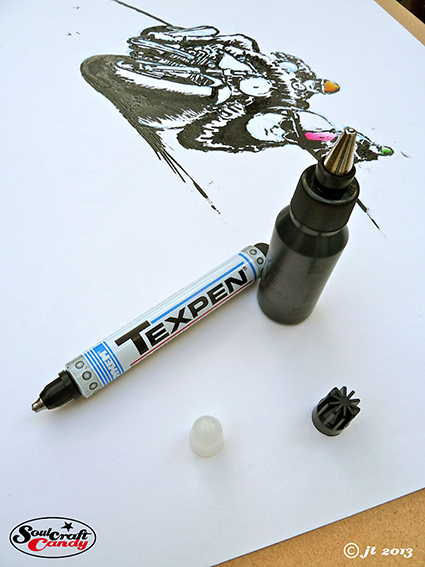
Both of the markers are shown in the bottom picture. The first, a thing called a Texpen made by Dykem, is a fairly conventional looking marker and quite easy to hold and manipulate. The other is a more heavy duty one from a company called Suremark. As you can see it’s essentially a bottle of paint with a ball point cap screwed onto the top. Lasts longer but not so easy to handle, and is refillable.

Before venturing into huge scale and wrecking large pieces of paper I thought I’d try something smaller to start with, to see if my suspicions were correct or not. The picture you see here is on a piece of A2 cartridge paper. I roughed out a sketch in blue biro first and then hit it with the paint markers. After half an hour of struggling I had to get up and have a cup of tea whilst I coped with my disappointment. After sweet tea and swearing I sat down and tried again, and this time really enjoyed myself.

These things are not like ball point pens at all, no sir. Firstly the paint is thick, gooey and doesn’t really flow. Secondly, the balls in the nibs are spring loaded so you have to press down to release the paint, so describing a line in a sweep is virtually impossible. Once I’d got my head around mark making though, I found I could squidge and blob my way to creating an image without too much trouble, the key bit was realising that detail and line consistency were never going to come to this party. It was a great lesson in learning how to approach getting the best out of an unfamiliar tool. The paint takes a short while to dry so avoiding putting your drawing hand in it is quite difficult, hence various blobs scattered about. The bottle option proved best for filling in solid areas while the pen option was easier to “draw” with. You can see from the detail shot, I hope, that paint tends to build up quite a bit on the blackest areas.

Paint_sketch3©JonTremlett2013

I stopped at a point beyond which I thought I might spoil it, and let it dry. When I returned I wanted to give it something extra so grabbed some cheap coloured biros I have here and put some colour on the riders helmets to lift the whole thing a little.


I hope you like it. This isn’t the end of my experiments with these markers, there are different papers to try in the search for different results and different types of drawings to try too. All very exciting, I’ll let you know how I get on.