In the pipeline.

As mentioned previously there is a small queue of stuff which is patiently waiting to get onto the blog. It all needs scanning and fiddling with slightly to get it into the right shape to do that. This process seems to take more time than it rightfully should but, then again it’s worth making the effort to get them all looking as good as possible, even the sketches. So here are the first couple of recipients of a bit of tinkering.

This first one, above, is a half done colour version of a biro ink drawing which was originally posted back in October. That was quite a popular post, so encouraged by that and another watercolour picture which featured in September, it seemed like a good idea to see what this one would look like if given the same treatment. The base image is a scan of the original pencil sketch printed out onto a piece of plain fine grain watercolour paper. I paint straight onto this without bothering to stretch the paper or anything fancy. Filling out the detailed areas of the drawing first, the bike is then followed by the rider and finally the background. As this one is somewhat of an experiment, a black rapidograph pen (a Rotring 0,35 remember those?) was used to emphasise some of the outline stuff at this stage to see how it would look. Most of the above is done in a combination of greys. Oddly the solid block Payne’s grey in the paintbox, and the liquid Payne’s grey that comes in a tube are completely different colours, but this provides a nice choice between one which is quite blue in hue and one which is much blacker in character. I avoid using pure black as much as possible, which goes way back to being “informed” by an old tutor once that nothing in daylight is actually ever really black. Hoping to complete this very soon.

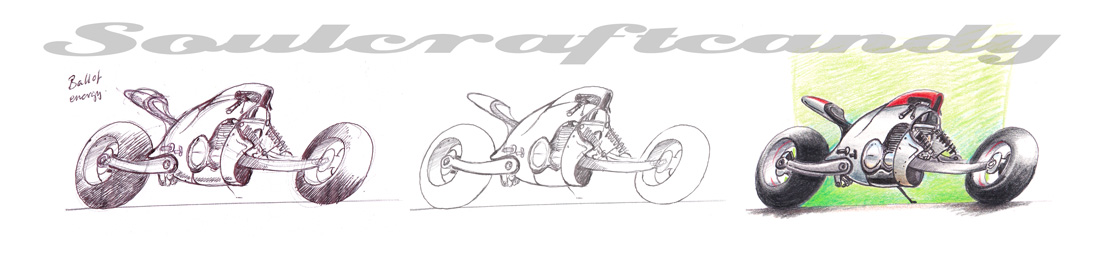
This second image is a detail of a drawing which is taking shape on the A2 Cartridge pad which spends most of its life leaning against that wall here in the micro-studio. Having talked about scribble sketching in a post before Christmas it seemed like a good idea to see if that technique could be explored a bit more and the jump up in size from A3 to A2 felt like the right thing to do. In all honesty there is a little bit of cheating going on here, there’s a very rough pencil layout underneath all the ink. Essentially though this is drawn pretty much off the cuff using my previous small sketch as a rough guide. This slightly rougher paper lends itself well to leaning the biro over almost to the point where it won’t make a mark, and scribbling away. There are some bits still to do to finish it off. Apologies if the image is a little dark around the edges but it’s too big to fit under the scanner so out came the camera. Really looking forward to finishing this one and then I can put both finished images in the gallery.

Two for One.

Welcome to 2012, it’s the new year, and here’s hoping for all of us it will turn out better than the sooth sayers suggest. The new year always brings a short period for fresh resolution and reflection. Being a serial resolution maker and breaker it helps to keep things to a minimum these days, and whilst being happier, healthier and a little wealthier are all things to work towards, it is this small blog which is the main focus for attention this year.

Viewing the newly received stats report from the guys at WordPress will be interesting but, before that’s done I know already that I want to increase my blogging output this year, be more creative and get more stuff out there. Small and obvious goals but ones which are worth noting down. Employing a slightly sideways approach to this challenge the first task at hand is to clear the decks, as it were, and bring to light some things which have been sitting here waiting for a chance to strut their stuff and be viewed. By tidying up some loose ends, particularly in respect of showing a sketch and not the subsequently finished drawing, I’m hoping to clear a bit of a backlog, physically as well as mentally. The hope is that this will free up some much needed brain space for new ideas and projects.

The drawing at the top of the post featured as an initial scribbly biro layout and then a more tidy pencil sketch waiting to be given a good inking. It follows a theme which is proving to be quite enduring, lots of healthy detail centered around the middle of the drawing, some punchy contrast areas and a kind of fish eye lens effect in the perspective. It’s one of my personal favourites and neatly treads a line between feasibility, if you drag the idea towards reality, and a cartoon if you pull it the other way towards fantasy. Again it’s done in black Bic biro on A3 Bristol paper (250 gsm) which is rapidly becoming a kind of default medium for this type of drawing.

This second drawing, completed shortly after the previous one, again has the detail and contrast areas coming through. I don’t like to comment on my drawings too much other than to discuss more technical aspects of them, preferring to leave aesthetic judgements to others. What’s important to me in looking at these is seeing whether they show any improvements in style, technique and composition, that kind of thing. How far have things come from the early days of the blog when bike related drawings were starting to be a larger part of life.

Observations, of course, tend to vary depending on mood and other variables but, today three things in particular come across. First is the quality of my sometimes wayward cross hatching. It’s getting more even, probably due to being better able to balance control and patience. Certainly the latter, as making a zillion lines can get to you after a while, and remembering to wipe the end of the pen occasionally helps too, none of those horrible little inky blobs to contend with. The second is to do with shadows and ground lines. By worrying less about crispness, and more about texture, the “hairy” and “lumpy” approaches give texture to the ground the bike is riding over through implication rather than needing to render bits of earth. A happy accident really, it wasn’t part of the original plan. The final bit is about the riders and their clobber. Folding fabrics have always been a challenge and hard to figure out no matter how many times clothes were sketched etc. All I can summise is that less is more. Fewer wrinkles and bolder shading seems to be doing the trick. All that’s needed is to repeat how it goes from one drawing to another, the habit of referencing one drawing whilst making another has yet to take root fully, but it will in time.

A change of scale.

It is most likely true that if you asked any creative person who produces stuff, if they just worked on one thing at a time, in a beautifully seamless procession of sequential order, they would likely say they did not. It seems to be in our nature to have as many things in the pipeline as we can manage, and then more. Our work spaces are doubtless littered with bits and pieces which remain unfinished, partially forgotten and “in development”. Our ability to accumulate projects is often quite astounding, and that’s before you even start talking about what’s in the brain bank, the unseen material hidden in the grey matter.

This is very much the case at Soulcraftcandy Mansions. Both the brain bank and endless pages of notebooks are filled with things that might be, one day. Sketches, doodles and diagrams all waiting patiently to be given life through some creative expression.

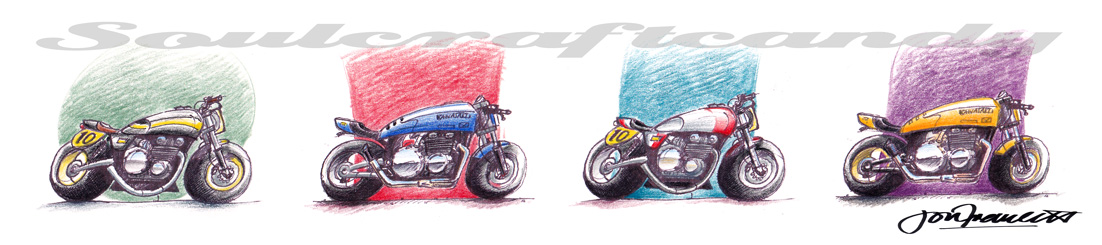
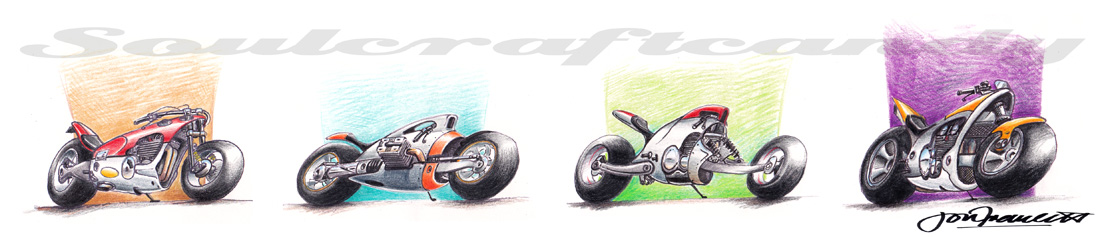
One such idea has been receiving such attention this week, small drawings in series. With the bigger drawings churning away nicely it was time to look at another idea for a while, to give my creativity a rest by way of a change of scale, pace and medium. Small drawings have always held my attention and this goes way back to when to being in a design studio and a winning idea would first appear in the corner of a page as a little thumbnail sketch. Of course the same thing happens these days but I’m now just as interested in the drawing as the idea it expresses.

The former situation would require enlarging the sketch and then investigating its potential as a design. Now the process is kind of reversed, rather than adding detail to the original sketch the process is reductive, what can be left out. The drop in scale really makes you think about what is the minimum required to get what you’re after. How do you compress all the complexity, mechanisms and complicated forms into a small space. Comic artists are consummate masters of this discipline. The hope is that it will refresh an appreciation for the details when returning to a larger format, but that might be hoping for too much.

Some might be tempted to sidestep this issue of detail by simply scaling down an already scanned drawing in Photoshop and printing it out, but that only gives you little dense balls of ink and not much else. So the idea was to draw as close to the required scale as possible to start with. Then, in the same way that we used to play with the photocopier all those years ago, it’s a question of cleaning up the image and changing the size until you’ve got something workable. Scanning, cleaning out unwanted lines, knocking back saturation levels and printing until I’m happy. Four of these images get gathered together and printed out in a 2×2 matrix on A4.

The old Epson A3 printer that’s sat here stopped doing beautiful ages ago but has a great ability for handling all manner of different kinds and weights of paper which my newer Canon is not that interested in doing.

This facility means that it’s also easy now to play with differing media on these different papers and, to play around with different colour combinations for the images. Colour crayons, inks and paints will all get a look in. So far it’s the crayons that have held my attention and the results are promising though there is certainly room for improvement. I’m using Derwent Studio crayons by Rexel Cumberland and they have a lovely soft waxiness to them, but they don’t stay sharp for long and laying on deep colour often requires you to labour them a bit. The paper too, is a bit coarse but picks up colour well so it will be a case of finding the right balance between these two attributes in order to get the desired level of intensity.

There are some liquid water colours ( Dr Ph Martin’s)sitting in a box on the shelf here. It will be interesting to see how they work on some fine surfaced water colour paper in the next experiment.