Making it different.

TT racer sketch

Apart from the story conveyed by an image to the viewer, a picture also contains another story, that which lies behind its creation. This is not the narrative expressed by the image but the tale of how the image was made. Whenever I look at an image the “maker” in me can not resist trying to work out how it was made. It is this questioning which drives my desire to try and share, whenever possible, the processes which lie behind the images I create. The techniques I use are not complex and I don’t use any cunningly developed or unique ways to create them, so why not let others see how these things come into being.


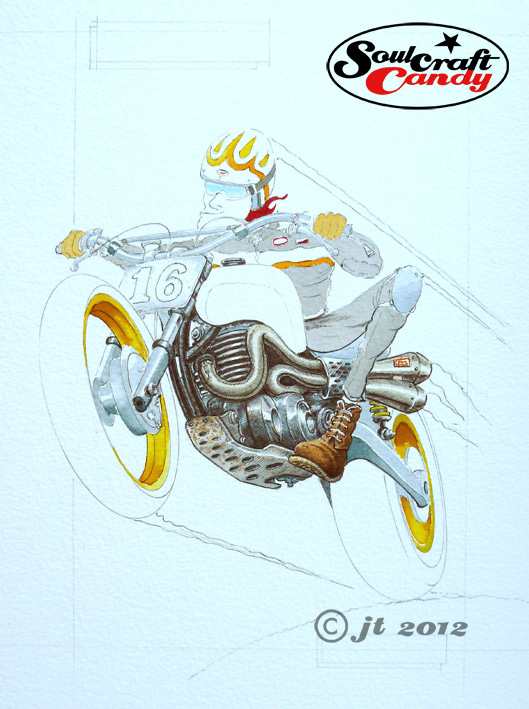
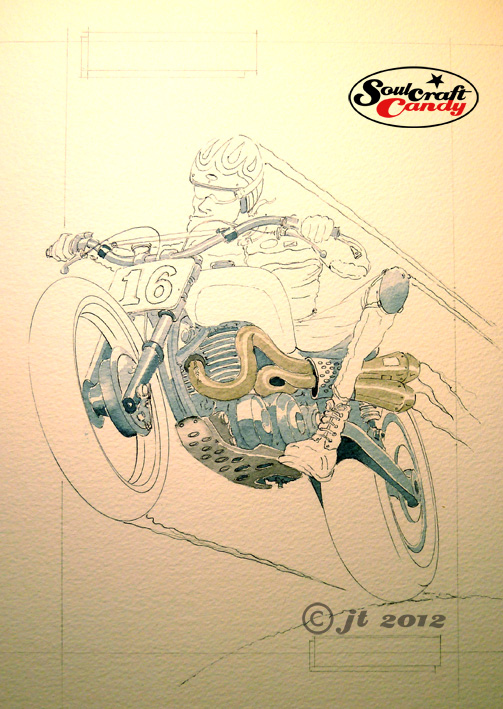
Above is the first sketch for a picture I am now working on. It comes from a series of sketches done for the V-twins project. The inspiration for it is american dirt track TT racing where oval tracks are supplemented with right hand turns and jumps. I find the idea of flinging a big heavy 750 around this kind of circuit attractively bonkers and so, worthy of a picture. It’s done simply in plain blue biro pen on some of the cheapest and low quality sketching paper I own. Believe me, it’s a good deal messier than the scan shows thanks to the wonders of playing with the levels in Photoshop in readiness for posting. Those shaded areas cover a multitude of hidden lines and you can see the engine has received some attention from the Tippex pen too.


Using my trusty little lightbox the image was transferred onto some water colour paper, firstly in pencil which was then overdrawn with fine black biro pen. I wanted to try having another go at introducing some colour to the images so thought I’d start on familiar ground with some water colour paints and inks. Normally one would stretch paper before making even an outline drawing, but that would not allow lightbox use so I stretched it after copying the drawing across. It’s a great way to do it and the image doesn’t seem to suffer any distortion at all.


The following images are my progress updates. The first is laying on some light washes to give the image its base colour. The second shows you what I’m aiming towards. By applying my usual biro pen technique over the washed areas I can achieve the impact I want but with a degree of colour behind it, and thus a nice bit of punch too. I suppose it’s very like how you ink in a comic strip but here I’m aiming for some variation in the tones and not such a contrasty finish. The third one just shows how far I’ve got. In reality I should have applied all the washes before picking up the pen but wanted to show what’s building as much as see for myself whether I was on the right track or not. Looking good, though forgive the odd colouration, my camera does odd things with daylight.


One task, lots of tools to play with.

Fix your dragster.

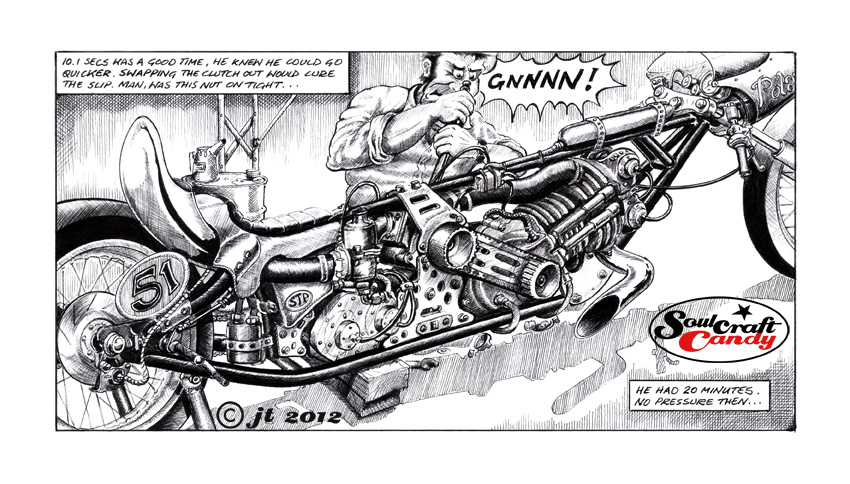
Well, here’s the final finished version of the first foray into the world of capturing the story behind an image. I’m quietly pleased with it even though it probably represents the simplest approach to all of the story stuff I have been posting about these last couple of times. It works, and that is the most important thing. Yes, there is much room for improvement but as a first stab it’s encouraging to feel that the framing and words add to the image rather than take anything away.


What is interesting is how looking at it now sparks an immediate desire to improve things, to create more. That’s not to say that what happens next is merely an extended exercise in  duplication across any number of pictures, more a wish to really get stuck in, and learn properly how to make best use of all the different devices at ones disposal, and perhaps invent some new ones too, specific to these drawings.


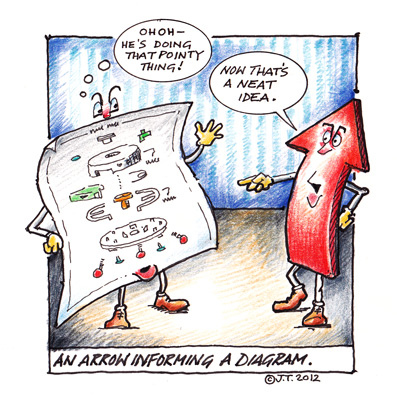
Opening any book about creating comics and graphic novels invariably floods you in established conventions for framing, speech and thought balloon use, caption box positions, view angles, perspectives and all manner of inking and texturing techniques. All of it is there for us to learn from. It can be a bit intimidating. The best bit though is realising that none of it is compulsory, and that all of these things are there to be played with. Their task is to inform the image being created, rather like an arrow or two might inform a diagram, so there’s no need to use all of them all of the time. Much more fun to find the things that work for you and the types of image you create, than feeling the need (and pressure) to become a master of all before venturing to the paper to make your first mark. There will be lots of experiments and invariably lots of trial and error involved but, without learning through doing, things won’t move forward, or worse get stuck in a repetitive rut. And we can’t have that.

And finally…….


Telling stories, the second bit.

Dragster cartoon nearly finished.

So the search has been on to find how to start thinking about stories behind the images and how best to communicate them. In a way a potential solution was staring me in the face, though I’d failed to recognise it. A very strong instance of not being able to see the wood for the trees. The “tipping point” was completing the cut down dragster drawing featured in The Line Is Drawn post. By cropping the image I had essentially put a box around it, the story in the image was contained mainly within this box, though it broke out to imply the story being much bigger than this constraint. The issue with previous drawings had been the open nature of the final image, with nothing to hold the image it was left to sit adrift in a space that then just flowed out to the edge of the paper. Sometimes paintings and drawings only start to make sense once we have framed them for hanging, and it was this sentiment that I was trying to capture. Rather than rely purely on the edge of the paper to provide the boundary of the contextual space, I realised that what may best serve these kinds of drawings is to create this boundary myself. Create distinct frames like they do for comic books and graphic novels.


It was a kind of “aha” moment. Had I found a mechanism for completing the images and communicating the “story” better? It seemed such an obvious realisation but then what is directly in front of you can be the hardest thing to see sometimes.It is nothing new, a technique that has a long history running through the comic universe to storyboards and beyond but, such a simple approach could really compliment the images as they are essentially cartoons in themselves and might benefit hugely from such a solution.


Conveniently there was a drawing here which I have struggled with completing for quite some time. It’s another in the dragster series and is sitting in the middle of a big bit of A2 paper, you may remember it from a post back in August. I got so far with it, then kind of stopped, the more I worked on it, the more the life seemed to drain out of it. The context I’d created in my imagination just wasn’t working so it got put to one side, to await a flash of inspiration and energy. It seemed a perfect candidate for experimenting with the “crop and box” approach. Interestingly, what happened was that it made me think much harder about what’s inside the boundary I’ve drawn. As a consequence the story has changed and with it a new context is starting to emerge in the background. The drawing has a new life, one that I’m more than happy with so far and looking forward to finishing.


So as a first stab it’s kind of working, an image I was perhaps bored with has regained my interest, and that’s such an important part of this exercise. They key now is to explore how this development pans out across future images. Certainly I don’t want it to become an exercise in cutting and pasting formats and such across a host of work, each piece must remain unique in its own way. What’s good is the fact that the idea is so simple and basic that it is ripe for all manner of playing with, and that flexibility is exciting.