Blasts from the past.

Pencil drawing of old Cyclomotor circa 1981

The long weekend away turned into a longer period away from the drawing board thanks to another chunk of freelance work, a mad dash to the line in time for a client meeting abroad for my client and a hefty chunk of mechanism making. It worked out fine so here’s hoping more work from them soon.


Anyone who has a home workshop full of stuff, or a home studio full of the products of ones creativity will know that it is an oft occurring feature of life that whilst rummaging through things in order to find a particular item, one often uncovers another item long buried under a pile, or secreted at the bottom of a rarely opened box. It happens on our computers too. How many of us have hard drives stuffed with old files we barely know we still have? So it was a nice surprise to unearth some very old drawings from my first year as an art student. You’ll see that my interest in engines was already in plain view.


As some of you will know, and others perhaps not, ones journey toward a creative life in the UK often starts after you’ve spent eighteen or so years filling your head with maths, history, geography, languages and all manner of fact based academic luggage. Many of us don’t really know what creative career we would like to pursue and so a year on a Foundation course helps to point you in the right direction. It’s a fantastic period full of experimentation and exploration as you feel your way through a vast gamut of disciplines. After thirty years as a professional I really feel like doing another one it’s such an expansive experience.


So these two drawings are from that time, products of one of the many observational drawing assignments undertaken where the emphasis was on producing lots of images rather than how one made them. The one above is done in soft pencil on cartridge paper and is complete with smears, fingerprints and the lovely grubbiness one gets from the heel of your hand moving about the paper. I’m not sure, but I think the lower one is done in some kind of oil pastel, again on cartridge paper, and is vastly oversized. You can see from both that my interpretation and understanding of forms, and the ability to distinguish surfaces through light and dark areas is starting to assert itself but is very much a work in progress. I’m particularly amused by my rendering of various ellipses, a geometric shape that haunts many an interpretation of man made objects. I still struggle with them even now.

Cyclomotor carburettor.

What is this object? It is a small engine that one attaches to the rear seat stays of a bicycle and drives the rear wheel via a roller lowered onto the tyre. A Cyclomotor perhaps? In the larger image it is upside down, the cylinder would point downwards in normal use. My uncle appeared from his cavernous garage with it on the day I mentioned to him that I was looking for something unusual to draw. Sadly I can’t remember what happened to the motor or the drawings after I photographed them.


Version 3, did it work?

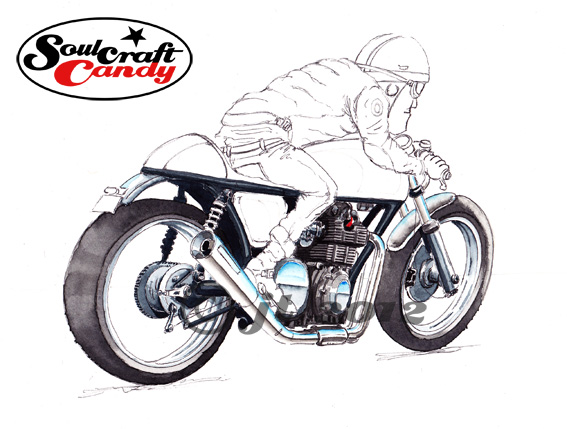
The third version of this sketch is now complete as far as the main subject of the image is concerned. So as not to reduce the exercise to one of exact and complete copying I elected to change a couple of features about the central picture in an effort to try rendering certain details differently as much as to maintain my interest in it. So you’ll see that this time the main body of the engine is made to look black, the bike has taken on a two tone colour scheme and the rider figure has taken to wearing a check shirt amongst other small changes.


Third time around this was still a fun picture to create and the inclusion of a bit more detail in these small areas, such as the shirt material make it much more interesting to look at. It is often said that both God and the Devil live in the details and this is utterly true, ones treatment of detail can make or break a drawing or design, so a cautious approach is always a watch word when trying things like this. Is it successful? I’m not sure that success is the right word to describe it, though I would say that working at a larger scale, this drawing is only six inches wide, would help in depicting the finer points and relieve the need to try achieve things with a very small brush which is still too big.


This buff background arises from necessity as much as choice. I wanted to post the image before departing for a long weekend away so time is short. Some careful trimming of the scanned image and a block fill, with a little shadow, was the solution to time pressures. Judging ones own work is always tricky but in this instance I’d say it works quite well. The colours are suitably contrasty to give the drawing some “pop” and help it stand out. What really ticks the box though is the contrast offered between the very hand made nature of the painted image and the utterly smooth, flat nature of the machine made background. It would be interesting to see how this looks in printed form, something I’ll experiment with later perhaps, and equally, it would be interesting to see what happens when this flat colour is applied by hand using Gouache or Acrylic paints.


There is some black and white pen work which desperately needs attention lavishing on it so messing about with colour may have to take a back seat for a time. The challenge is whether this exercise has committed enough to memory for it all to move forward again the next time I pick up the brush.


Better, but still work to do.

Cafe Gold.

Following the chromatic onslaught of yesterdays post, and those neon bushes, I’m rather hoping that everyones retinas have recovered sufficiently to absorb another blast of colour. Sincerest apologies go out to anyone mildly traumatised by the experience.


Todays featured image is the second attempt at the same picture and it is hopefully less bold than the first, but just as eye catching in its own way. This time around I made a serious effort to take a good look at the first image and learn from it, to analyse as much as address what problems existed. After all, technique isn’t going to get any better without being able to self criticise and understand not just what’s happening, but also to learn to know what to do about it. Without a tutor or associate looking over your shoulder all the time this is not always as easy as it sounds.


This second image took rather longer than the first as paint went down in a much more considered fashion.Firstly the base drawing was tightened up a bit. The rather “dauby” approach of the first is starting to be replaced by a tighter method. When employing wet on wet technique over areas of the picture it is a real skill to be able to control it and achieve the desired level of detail. One has to be confident but not overly so and using a smaller brush helps despite many manuals telling you otherwise. I also elected, and rightly so I think, to limit the creation of all grey areas in only two main colours. Winsor & Newton Payne’s grey, it’s got a lovely blueish hue, for all of the metal parts, and Schmincke Payne’s Grey, much more black in nature, for the tyres, leather and other details. This has  helped give various areas of the picture a more distinct separation than in the first where they are all mixed up. The golden yellow of the bodywork was tricky but worked out OK in the end. It was a deliberate choice to avoid trying to recreate perfect reflections in the tank and panels as I felt this just sucks you into a realm of photorealistic worrying and potentially ends up making the rest of the image look out of place. It’s an honest attempt to achieve a consistent feel across the whole image.


The background resulted from trying a few things out on other sheets of paper and a bit of photoshopping. Again it was about finding something simple that complimented the bike but didn’t overshadow it. I like it, it kind of works, and evokes memories of summer afternoon rides out through the countryside on small deserted roads with only the wind for company.


The third version is already underway and this will be a bit different again. Whether it ends up being any better is up for grabs. Here’s where it stands today.