Drawing from imagination – embedded knowledge.

A while ago a friend commented that my bike drawings looked like they had been done by someone who knew about bikes and that this was a good thing, it lent the images a believability which in some way rescued them from being merely the fantastical noodlings of a deranged mind. This got me thinking. What was it that enabled this believability given that all of the images are created without using specific photographic references or direct observation from life?

I have a very good book by Ron Tiner called “Figure drawing without a model”, get it here, which covers the subject of creative drawing from the imagination and, whilst reading the introduction my attention was drawn (excuse the pun) to a particular passage in which he references this point. In a nutshell he poses the argument that every one of us has a degree of embedded knowledge about the world around us and that the essence of drawing from the imagination is about developing various tools which allow us to access this knowledge and use it in image making. Although the book deals specifically with drawing the human figure there are many parallels to be found in rendering other subjects. What I find interesting about all this is this notion of embedded knowledge, how we acquire it, access it and use it in creative expression through drawing.

It’s probably worth considering this idea of embedded knowledge a bit more, what is it exactly? Our memories and imaginations are a huge combined resource that we carry with us at all times. Our minds are filled with stored references to the world around us, some are stored as images, others as direct tactile experiences. Some as emotional responses and others as smells and sounds. Our minds catalogue them and store them away for us to refer to later on through any number of triggers. If we consider the human form as an example, it is something we are all deeply familiar with and very knowledgable about. We have absorbed this knowledge since birth but, if we’re asked to draw a man running for example, we find it hard, we are unable to bring to the fore the precise information required to visualise this action in a believable way. This is because our mind has stored the act of running as exactly that, an action, not a picture of running. This makes drawing a running man difficult although we inherently “know” all there is to know about running already. This is, in it’s simplest form, embedded knowledge, and our challenge as we seek creative expression is teaching our minds to access it, our imaginations to use it, and finding ways to generate more of it.

The book goes on to explore lots of creative tools and practices which will aid the reader in the development of imaginative drawing techniques, but my own thoughts stayed very much with this first chapter. I wanted to consider further this idea and how it influences my own output.

Following the premise that Ron Tiner makes, that through observing and practicing the drawing of the human figure we learn it’s many characteristics, I arrived at the notion that this activity ultimately creates familiarity. We learn so much about, and become so familiar with the human figure that we can, in the end, visualise it in any situation we chose. It is this familiarity that struck a chord. If this is the case then there surely must be other ways to attain it as often we don’t have the luxury of endless visual practice?

So, here’s my theory about how we gain this familiarity. It seems to me that it comes from three main activities: learning, absorption and creation.

In learning we do what Ron suggests in his book, that we accrue knowledge through repeated action. By observing and drawing we learn the way things are and create the foundations for how things could be.

The absorption part breeds familiarity through purely being around something for a long time and physically interacting with it. For example, I have never really sat down and drawn a bike engine in any detail from observation, not even from a photograph. But having spent a good deal of my time around them, fixing them, cleaning them etc I have gained a familiarity which allows me to draw them with a degree of confidence if not precise detail.

Finally there is the creation element, and I hope this makes sense as I arrived at it from considering my time spent as a product designer. In this instance creating new design ideas or concepts requires the use of both imagination and pre-embedded knowledge from the outset. One informs the other to create new, never seen before, ideas. The process of developing a design fully often requires the visualisation and re-visualisation of every aspect of the object, its every facet and detail, even though it has never existed in reality. This generates in the mind of the designer a familiarity with the object which is both intimate and detailed and subsequently, enables them to visualise it without reference.

Although these three directions may appear distinct, there is always some overlap to be found. In fact, it wouldn’t surprise me if everyone uses a combination of at least two most of the time.They all lead to the same point. The final interesting thing about this familiarity, born of all of these activities, is that it itself becomes embedded knowledge and is there for us to access in future. So one could propose that by learning to access embedded knowledge, it leads us to being able to create more of it. Perhaps this is one of the reasons why our drawings get better as we do more of them?

A final thought for today is this. When someone says, “you have such a vivid imagination”, are they actually referring to your ability to dream up stuff, or the fact that you are purely able to access your embedded knowledge?
Variety, part 1.

“Do you draw anything other than bikey stuff?”

It’s an often asked question and the answer is, yes I do. Currently the focus is very much on the bike stuff but, there is increasing feeling that a bit of diversity wouldn’t go amiss every now and then. Looking back through the admittedly rather scant archive here serves as a constant reminder that other subjects do indeed come under the Soulcraftcandy spotlight every so often.

Admittedly it’s not very frequently but, now and again I am asked to do a small commission, or an upcoming event such as a birthday prompts the creation of something different. Providing there is enough time to get things done, including coming up with the right idea, doing small commissions and gifts can be a lot of fun and very rewarding. Not being a pro artist or illustrator means that engaging in these things is less pressured and remains fun.

Peoples reactions to them are often very positive and complimentary. If you are lucky enough and they are giving you some money in exchange for your labours, then usually this more than compensates for the ocassional hour or two you’ve spent burning the midnight oil to get it done in time. The rewards are also emotional, they feel good about receiving something unique, and you get a big buzz out of that and receiving the compliment. Lots of great Karma is shared.

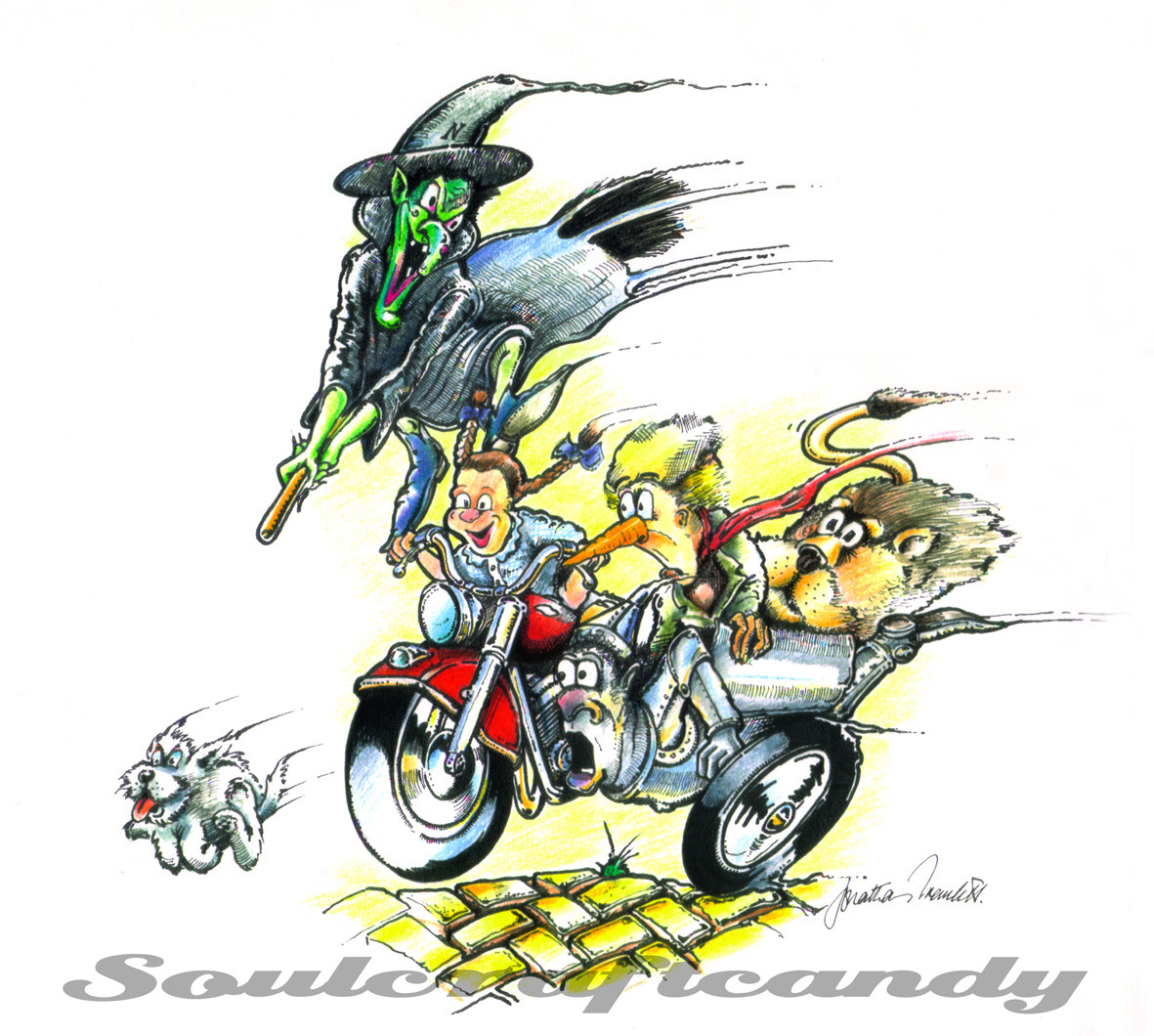
So here are a couple of things retrieved from the archive which aren’t focused on big bikes, blokes and big engines. The one above was done some years ago for a charity auction. A very old friend, who ran a gallery at the time, asked a number of people she knew to donate or create a work to be sold at an auction to raise money for a charitable cause. If my memory serves me correctly it was called The Yellow Brick Road Foundation, a children’s charity, hence the subject of the picture. I don’t remember how much it raised, but it was very satisfying to know that it sold and the proceeds went to a good cause.

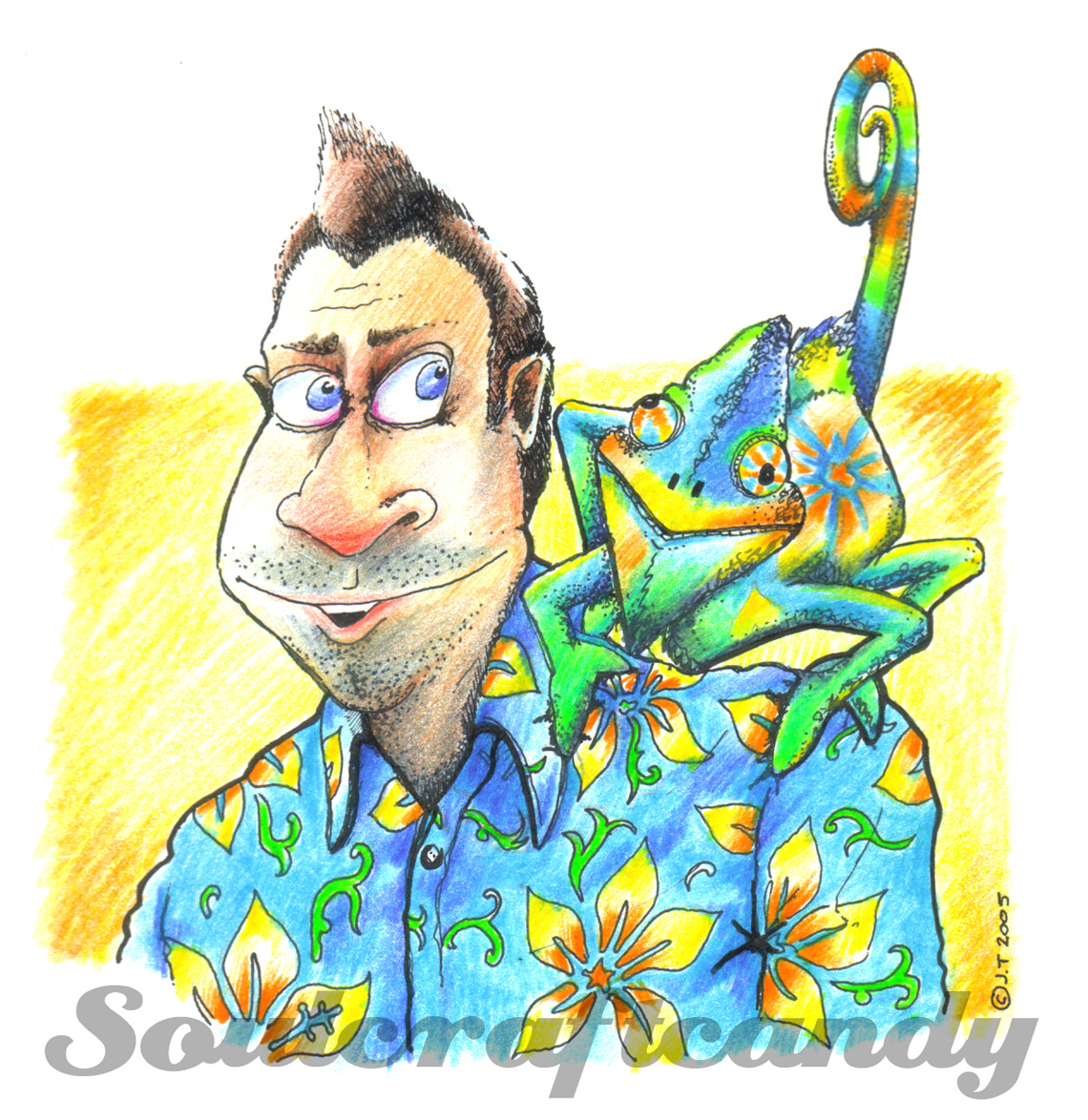
This second image is one of a number done over the years for my brother who runs a veterinary practice and likes to create a new brochure every now and again. Once the images have been scanned for printing he has them framed and placed around the surgery to add bit of light hearted interest to the place. It’s a nice touch and pleasing to know that many others get to enjoy the pictures on their visits. Here I was making a comment about the old adage that owners sometimes look like their pets, and vice versa.

If the archive is holding any other nuggets these will be posted too in the name of variety, which is the spice of life after all.

Both of the above were created using colour pencils and ink on cartridge paper, which was  pretty much my default setting for many years and remains a strong favourite.

Two for One.

Welcome to 2012, it’s the new year, and here’s hoping for all of us it will turn out better than the sooth sayers suggest. The new year always brings a short period for fresh resolution and reflection. Being a serial resolution maker and breaker it helps to keep things to a minimum these days, and whilst being happier, healthier and a little wealthier are all things to work towards, it is this small blog which is the main focus for attention this year.

Viewing the newly received stats report from the guys at WordPress will be interesting but, before that’s done I know already that I want to increase my blogging output this year, be more creative and get more stuff out there. Small and obvious goals but ones which are worth noting down. Employing a slightly sideways approach to this challenge the first task at hand is to clear the decks, as it were, and bring to light some things which have been sitting here waiting for a chance to strut their stuff and be viewed. By tidying up some loose ends, particularly in respect of showing a sketch and not the subsequently finished drawing, I’m hoping to clear a bit of a backlog, physically as well as mentally. The hope is that this will free up some much needed brain space for new ideas and projects.

The drawing at the top of the post featured as an initial scribbly biro layout and then a more tidy pencil sketch waiting to be given a good inking. It follows a theme which is proving to be quite enduring, lots of healthy detail centered around the middle of the drawing, some punchy contrast areas and a kind of fish eye lens effect in the perspective. It’s one of my personal favourites and neatly treads a line between feasibility, if you drag the idea towards reality, and a cartoon if you pull it the other way towards fantasy. Again it’s done in black Bic biro on A3 Bristol paper (250 gsm) which is rapidly becoming a kind of default medium for this type of drawing.

This second drawing, completed shortly after the previous one, again has the detail and contrast areas coming through. I don’t like to comment on my drawings too much other than to discuss more technical aspects of them, preferring to leave aesthetic judgements to others. What’s important to me in looking at these is seeing whether they show any improvements in style, technique and composition, that kind of thing. How far have things come from the early days of the blog when bike related drawings were starting to be a larger part of life.

Observations, of course, tend to vary depending on mood and other variables but, today three things in particular come across. First is the quality of my sometimes wayward cross hatching. It’s getting more even, probably due to being better able to balance control and patience. Certainly the latter, as making a zillion lines can get to you after a while, and remembering to wipe the end of the pen occasionally helps too, none of those horrible little inky blobs to contend with. The second is to do with shadows and ground lines. By worrying less about crispness, and more about texture, the “hairy” and “lumpy” approaches give texture to the ground the bike is riding over through implication rather than needing to render bits of earth. A happy accident really, it wasn’t part of the original plan. The final bit is about the riders and their clobber. Folding fabrics have always been a challenge and hard to figure out no matter how many times clothes were sketched etc. All I can summise is that less is more. Fewer wrinkles and bolder shading seems to be doing the trick. All that’s needed is to repeat how it goes from one drawing to another, the habit of referencing one drawing whilst making another has yet to take root fully, but it will in time.