Pleasingly vibrant.

Back at the start of January there was a post about clearing the decks to make way for fresh projects. It’s safe to say that this process is fully underway, though it’s a truism that as much as you try and finish off one set of things, you often can’t help yourself from generating more that only add to the pile. Not sure what that’s called but there must be a word for it somewhere.

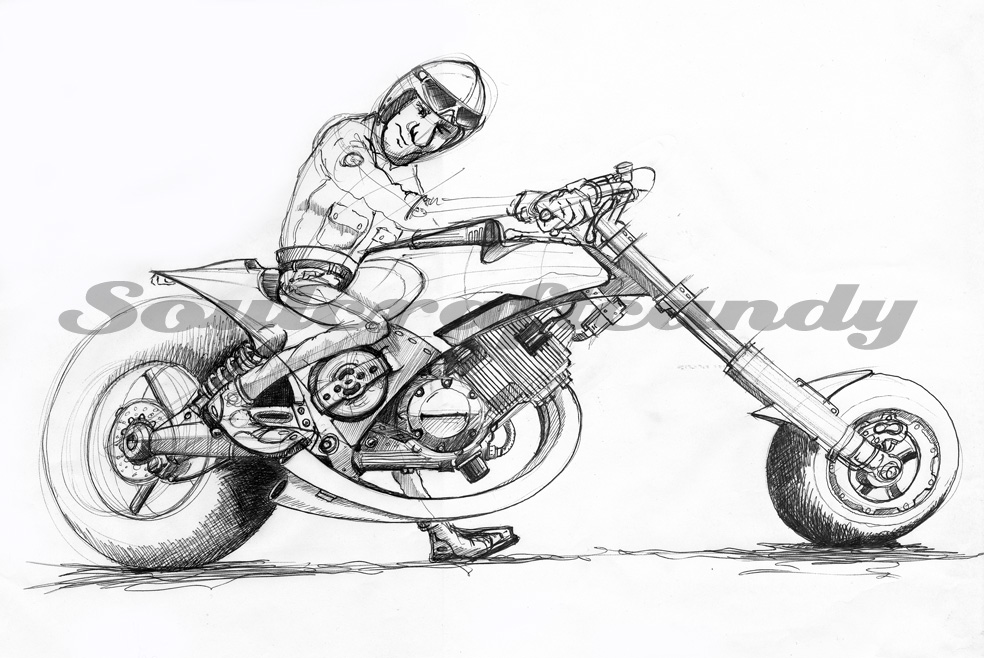
The image above is the latest to get the “I must finish that sometime” treatment. It would be safe to say that it has been hanging around in the pending file for too long. It stated life as a very quick and rough biro sketch in a rather ropey old A3 pad used for just such things (see below). And that’s where it stayed. Then one day it got scanned, the reason for which now escapes me, and finally was printed out as a test to see how the printer would cope with rough water colour paper, reduced to A4. For some reason only the tyres got the benefit of some paint, until this week when I finally surrendered, and decided to give it a bit more love and attention.

It is still really a test image in the sense that the greys are mostly of a new kind not used before, made by Schmincke, which needed road testing. Lovely paint. It comes in refreshingly old fashioned little metal tubes, at 5ml size, and has a depth to it that makes it great to use. The other trial aspect is wanting to see how these new greys worked up against the luminous intensity of the Dr. Ph Martin’s liquid water colours used on some of the smaller paintings. Choosing a bright orange for the main bodywork has taken the colour contrasts to an unexpected though very welcome level. Although water colour is a favoured medium it often leaves the image with a very dull feeling. Using the liquid colours enables me to get that “pop” back into the picture. Bikes are exciting things and it makes sense to communicate some of that through the colour. It is gratifying to realise that the persistence of the old drawings nagging has finally led to a very pleasing conclusion.
Here below is a reference pic of the liquid water colour. Available in two sizes, as shown, and available in most good art shops. Thoroughly recommended if you’re looking to pump up the colour intensity in a water colour image.

Background noise.

As mentioned before on the blog there are always things going on in the background while work on the larger finished drawings is progressing. Sometimes this takes the form of working sketches which will form the basis of larger works, at other times they are small drawings that are used to practice techniques or develop an idea.

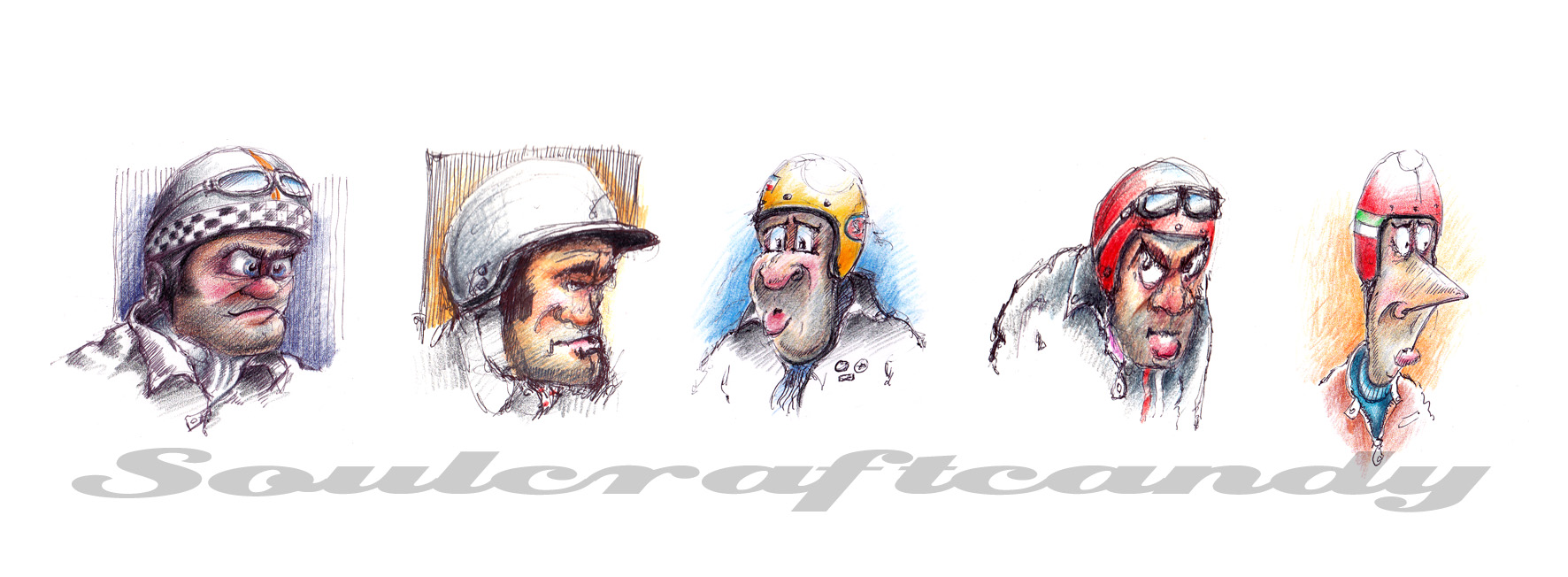
Above are a small group of what are known here as bikeheads. Invariably the larger drawings contain a character or two and it is often a challenge to get them looking right for the given context that they find themselves in. Finding the correct pose and body shape is never simple and the same goes for facial expression, and how this reflects the characters personality. The former are dealt with purely through sketching out varying forms but, the latter is harder, especially when you realise that even the slightest variation in line can change a facial expression completely. So as an aid to get things going I have started a kind of character bank in which to keep all the doodles of heads and faces that appear through the sketch sheets. It will then be easier to have a look through and find some inspiration when it’s needed. Adding some colour to these helps to bring out the character and keeps my colour pencil technique up to scratch too if it’s not being employed elsewhere.

Which leads me neatly onto this second group. Back in December a post contained some small groups of varying bike styles I was playing with at a reduced scale. Those had been completed in crayon and ink. These above were done purely to see what would happen if they were done using liquid inks and watercolours. To find out how intense the colours would be and how much of the detail could be held  given the very liquid nature of the medium and the coarser paper used. Very fine Rotring pen has been applied too, to firm up[ the outlines and add extra black where desired. The paper was fine for the paints but proved to be a bit too “wooly” for the finer stuff subsequently done with the pen. Next up will be a test on harder paper.

Some say you can’t learn to draw from a book. This may be so, or not, but a couple of really useful books I refer to regularly are Action Cartooning by Ben Caldwell, here, and Cartooning The Head & Figure by Jack Hamm, here. Both are invariably out on the desk when character sketching. Neither will teach you a style but, both will inform whatever your personal style may be. Great books.


Time well spent?

At last, managed to finish the first big scribble drawing last night. At last, because this thing took far, far longer to do than first imagined. Although the style might look quite quick (and it seemed as much at the start) it required a lot of time to move around the drawing, continuously teasing out the many details in order to create the right feeling of depth and movement. It is a very satisfying process but requires a lot of patience. This technique is definitely one where knowing when to stop is an undefined line somewhere amongst the thousands of little bits of shading.

Capturing the little sideways glances of the riders as they vie for supremacy is my favourite bit, although it’s a close run thing between that and the slightly out of focus nature of the image, which lends to the feeling of movement.

Another one has already been started (am I a glutton for punishment?), again using a fine nibbed Steadler 430 biro and an A2 sheet of 220 gsm heavyweight cartridge paper. What with all of the other things I’m playing with it may be a while before an update on its progress can be posted. Watch this space.