Tricky foam and happy clocks.

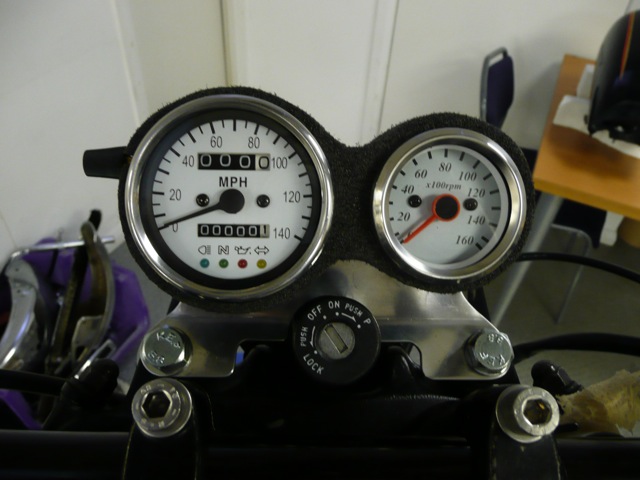
Now on to more important things. In the last build post I’d got as far as making a drawing of how I wanted to mount my new clocks. Conveniently the old clock assembly mounted to the front of the bike via two stout mounts on the front of the top triple clamp, so I decided I would use those for the new assembly as it was a quick and simple solution. With the plate marked out on to some 3mm Aluminium sheet I cut it out with a jigsaw and used hand files to clean up the shape. While it was still flat I drilled all the holes I needed for mounting the clocks and threading the associated wiring. I wanted the holes to be as small as possible so elected to complete the wiring after the clocks were mounted. Not the best solution should anything go wrong in future but I thought I could cross that bridge should it ever arise and, I wanted to decrease the risk of water getting in there as much as possible. This is the UK after all and the bike is for year round use, not just for sunny days. The last task on the plate was to bend it so that it sat at an angle when mounted, presenting me with an easy view of the dials when riding. The jaws of the bench vice were too narrow so I clamped the plate between two sturdy bits of wood on the edge of the workbench and reached for a soft hammer and a drift/dolly, again a piece of wood, and slowly worked my way along the bend until I’d got the angle I wanted, very satisfying.

When I got the clocks I realised I couldn’t make big enough clamps to go around their bodies, so the plate mount came about. The problem was that I didn’t want them looking like they were just stuck onto the face of the plate, they needed something to complete the look. For a long time I’ve been a fan of the way that instruments are mounted on race bikes with some kind of foam surround for cushioning. If I could concoct something like that then I’d be happy. Measuring the clock depth from the face of the plate gave me about 50mm of clock to cover in some way. A job I’d done at the workshop some time previously had involved making seat squabs out of a wonderful material called Zotefoam, which is a closed cell polyurethane foam that’s often used for shaped packaging inserts. I found an old off-cut from one of the seat pieces and it was exactly 50mm thick and black too.

As the clocks were quite close together I decided to try and make a single piece that would cover both in one go. It was also evident that the bezels on the top of the clocks would act to clamp the foam in place once the clocks were mounted to the plate, so no glueing or other fixing needed. It all made sense to me but cutting and shaping the foam proved a lot more difficult than I’d imagined. It took me three attempts to get it right. Roughing out the shape on the bandsaw was difficult enough but that gave me a very wooly finish. This problem repeated itself in the two holes also as I’d had to hand cut them to start with using a thin hacksaw blade. I reckoned I could sand the cut areas to get the right size and finish but trying it by hand just made a mess of it as I couldn’t control things enough. With no other options I knocked up a bobbin sander for the drill, a cylinder of wood with some abrasive paper glued to it, and very gently tried to smooth the surface. I used quite coarse paper as too fine and it just melted the surface rather than removing material. It required a great deal of patience. If you go too fast or use too much pressure the foam melts and you end up with big blobs of melted material stuck to your work piece or it goes completely out of shape. That’s why it took me three attempts, but fate rewards the patient.

I was, and still am, pleased with the result. Mounting the resultant piece on the bike it was plain that I would need to take care when fitting the headlamp as the ability of the tachometer and speedo drive cables to bend is not as great as one might think. I cut a small slit in the foam so that it would fit over the odometer knob on the speedo and started to prepare all the wires for attachment into the wiring loom, or more accurately for inclusion in the birds nest of wires that seems to occupy the headlight shell of all bikes of a certain age and type.

Completing the wiring was actually quite simple. It was simply a case of removing the connector block from the old clock wiring and matching the wires to the new wires that exited the back of the new ones. The only fly in the ointment was that the single orange turn signal lamp would not take a feed from the left hand indicator circuit. Undeterred, as I couldn’t get it to work no matter what I tried, I resolved to use what would have been a redundant red oil pressure lamp for the feed from the left turn circuit. It worked a treat and now the orange lamp flashes when I turn right and a red one flashes when I turn left. You might wonder why I bothered with turn signals at all, but I’ll tell you that when biking around London I find you need all the help you can get if it’s a case of showing other road users what you’re doing, so it’s a safety consideration more than anything else. Dull but true. What’s next?


Paint it black.

Song titles eh? Always good inspiration for a post title, thank you Rolling Stones.

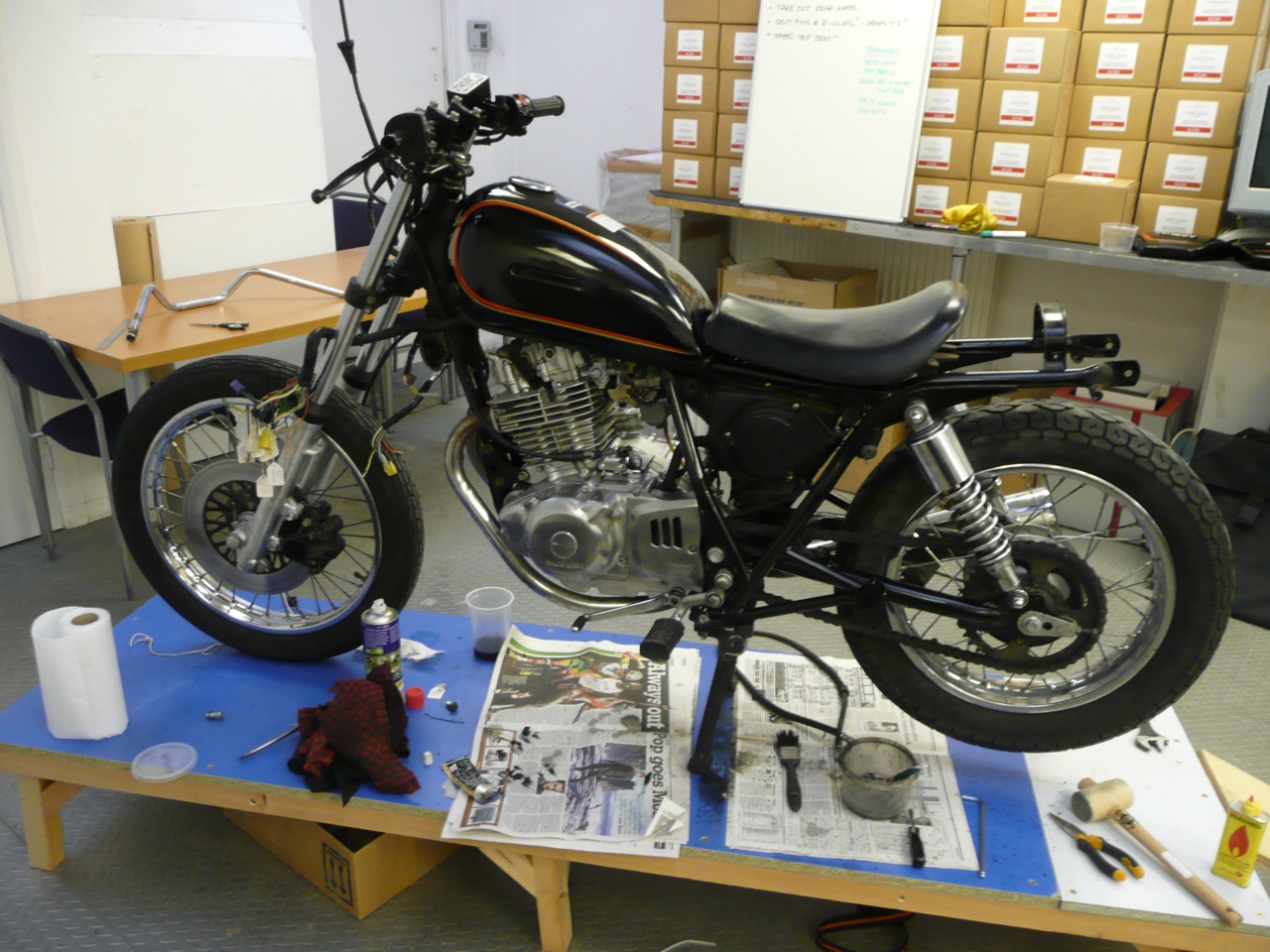
Man was I pleased when I’d chopped off those spars at the back end. The overwhelming sense of progress really hit home. The bike had suddenly taken on a completely different look. Whereas before the chop it had seemed as if the whole mass of the bike had been centred somewhere around the back wheel or just in front of it, now it all seemed to move forwards, it gave the whole thing a much needed sense of increased purpose, like the bike really was about going forwards.

As I said previously I filled the ends of the resultant open tube sections with hard body filler. At this point in time I’d never used a welder of any description since my college days and a brief acquaintance with some oxy-acetylene gear. So neatly welding a plug into each tube was not something I was up for as I doubtless would have made a complete pigs ear of it. So body filler it was and, at least I knew it would give me a lovely smooth finish. I painted the cleaned up ends with the smooth version of Hammerite, or Smoothrite as some call it. For those of you who don’t already know this is wonderful stuff, provided you apply it in accordance with the instructions. It’s an enamel based paint that you can apply directly, via spray or brush, onto bare steel without the need for all the fuss of a priming coat. It flows and dries into a lovely glossy black finish. Accept no substitutes.

It is perfect for things like this if you’re not going to be going the whole hog and having the complete frame sprayed or powder coated. I’d elected to use it to touch up all the little chips and blemishes on the main frame and for the small spots where I was going to grind off things like the pillion footrest hangers etc. A few dabs with a soft brush and hey presto. As you will see in later posts I also used it, because you can buy it in rattle cans, to paint all of the steel pieces I would make for finishing off the back end. It has proved utterly durable since the bike was finished and is well up to the job of protecting various bits through both foul weather conditions and the battering that a bike can get in the parking bays of London at the hands of carefree scooter commuters.

The parts that I’d ordered for taking the back end to the next stage, shocks, rear light and fender section had not yet arrived, so I diverted my attention to the front of the bike for a while. My plan was to fit a lighter and smaller front fender, some smaller clocks and do something about the front brake.

You will notice in the shot of the top yoke that the standard brake master cylinder was now sitting at an odd angle to the handlebar. Its orientation now that it was on flat bars was significantly altered from when it was attached to the high bars of the standard bike. I didn’t want the hassle in the future of trying to bleed the brake with the reservoir at a distinct angle, nothing worse than brake fluid to ruin anything it touches, like paintwork.I’d visited the local autojumble at Kempton Park to see if I could find anything appropriate but to no avail. However, a quick call to a contact alerted me to a good breaker in Aylesbury called Breaking 125’s (sorry no link, he’s not got a site). When I got there it was the usual Aladdins cave of bits and parts from all manner of bikes. I came away with a Magura master cylinder and reservoir from an old Aprilia and a plastic front fender off I don’t know what, but it looked kind of right.

The clocks had arrived early on so the main task for them was to make some kind of holding plate to fit the top yoke. I’d elected to keep both speedo and rev counter functions but had chosen different sizes, the speedo being the larger of the two. I could have done without a rev counter but I like them and thought that it might actually stop me over-revving the engine as I had no idea if it had any kind of limiter on the ignition.

The speedo on the other hand came with some tiny built in idiot lights and double odometers. How to mount them? I didn’t have any machine cutters big enough to make collars for the clock bodies so decided I’d put them on a plate in front of the bars roughly where the standard clocks had been.


I measured up the space and mounting points and drew up a simple plate on some graph paper that night, including all of the fixing points and cable holes needed to make a neat job of it. At times like this graph paper is such useful stuff. The grids are a fantastic guide for creating very quick technical drawings for parts you want to make and the drawing tools you need are no more than a pencil, compass, ruler and circle guide. For me, much faster than trying to knock something up on the computer. Finally I wanted to complete the clock mount with some kind of foam surround, a kind of homage to all those Ducati and GSXR clocks seen in the 90’s and on innumerable race bikes. There was a great bit of scrap seat foam in the workshop I’d had my eye on and quite by coincidence it was the same depth as the clocks themselves. Just perfect.


The lucky seat.

That'll do nicely.

Day two dawned and the first few parts that I’d ordered arrived, crucially the handlebars. Flat and black. The previous evening I’d spent some time wondering about the seat and what I could do. It took my subconscious all night to remind me that in the loft was the old seat from my Speed Triple and that it might, just might, fit. I fetched it out and took it with me along with the bars. First job then was offer the seat up to the mounted petrol tank and frame.

There is a moment at a time like this when your brain seems to be ahead of you somehow. Just the act of walking up to the stripped down machine filled me with a sense that I was onto something here. It’s as if your subconscious has already worked everything out using all of the visual information that your eyes have previously supplied. All bike seats seem to affix in a similar way, a tongue under the nose of the seat fits under a bar in the frame and the rear is then fastened down. I went straight over to the bike, got the seat out of my bag and plonked it on, stood back, raised an eyebrow and put the kettle on. With coffee in hand I returned to see if my luck was in.

Looks better already.

By God, it just sat there looking like it was destined for the job. I removed the old cover material and propped it on some wood for a better look. It was going to work. I’d already spoken to some seat coverers, P&P Seating, and their delivery time was the same as my deadline pretty much so if I sent it off that day for covering I’d get it back pretty much as my build finished. I had to move fast so I needed to make the seat fit before the day was out. The tongue on the front of the Triumph seat is integral with the seat base moulding and was not in the right place, so I cut it off. The Suzuki seat on the other hand had a pressed metal tongue screwed to the seat base, so I removed that too and offered it up to the now trimmed smaller seat. A bit of fiddling and three drilled holes later it was attached to the new seat with three bolts with the nuts sitting snugly under the seat foam.

My under-seat mods

The rear was a bit more awkward but fortune smiled again. The rear bolt holes of the Triumph seat sat directly in line with the mounts for the rear shocks, all I needed was to make a bridging piece mounted to these points to support the rear of the seat. But for now I merely cut a piece of wood as a stand in and gingerly sat on it. The middle of the seat sagged and thus required some support but, again the moulded seat base provided half of the solution. Four moulded bosses protrude from the seat moulding and it was simply a case of putting a packing piece under two of them which would rest firmly on the frame rails below. A bit of scrap 6mm ABS sheet did the job perfectly. Finally I filled the gap between the nose of the seat foam and the tank with a piece of shaped modelling foam and taped it to the original. At the same time I bent some steel strip to form a makeshift rear support to confirm my suspicions and sent it off. I reckoned I could use the newer seat from the Triumph as a reference to check the rear mountings as I went, knowing it would all fit the recovered seat when it came back. Job done, I hoped.

Ready for the chop.

With the new handlebars quickly mounted on the top yoke I could get a fair idea of the stance that I wanted the bike and rider to have. I was feeling quite pleased with myself until I noticed the two huge frame spars sticking out from behind where the seat would mount, an ugly legacy from supporting the original “bench” seat with a welded on cross piece sticking up too. There was no doubt about it, they had to go. I wanted a sleek curving fender there, not a rear end dominated by a couple of girders. A watershed moment approached, the first major modification of the frame and as it turned out, the only one. Now, where to make the cut? Before getting the hacksaw out I wanted to be sure that nothing was going to end up twisting once they were removed. The lateral frame bracing around the rear shock mounts looked pretty sturdy and so these rear rails didn’t seem to perform any other function  than to support the seat.

That's better.

With some masking tape applied I marked where I wanted to make the cuts and took a moment for a final check. Reassured that all would be fine I sawed straight down through the roots of the spars and part of the surrounding box bracing. Nothing moved, I grinned like an idiot. There is a plastic inner mudflap inserted into the space in front of the rear wheel between the frame rails so I marked and cut that down to size too, giving me a clean approach for mating up the new rear fender. To finish the day I filled the holes in the end of the cut spars with hard body filler and sanded it flush ready for painting.