Back to black.

On goes the ink.

A catchy title to todays post but, for all music fans out there I’m not going to be offering comment on the great studio album by the late, great Amy Winehouse, though I would say that Tears Dry On Their Own is my favourite track by far. Anyway I digress.


As you can see above The TT racer is nearing completion with a healthy dose of inking being done. As the title of the post implies this is very much an exercise in chasing all of the colour washed areas back towards black in the darkest shadows. This has proved quite tricky for a couple of reasons. Firstly it is incredibly easy to get a bit carried away and over do it, so teaching oneself when to stop is a constant challenge. The second reason is more techy in the sense that it’s about the touch of the pen on the drawing surface. Water colour paper is quite heavily textured relative to normal papers and so maintaining a delicate touch across areas is quite hard as you are not engaging with a smooth surface, so the line can be a bit inconsistent. It’s just something you have to get used to and work with. This also catches those little blobs of ink that gather on the pen tip every now and then so constantly cleaning the nib is a must do habit to get into.


It is coming together well though and should be finished soon. Then I’ll be able to release the paper from the back board, give it a proper scanning without there being a large bit of wood attached to it, and post it up here. Here’s a close up which reveals some of the dodgy line work.


Awash with colour.

TT racer washes.

Building a finished image is a really exciting part of the picture making process. As each area of colour goes down and every line gets drawn, ones original vision is slowly realised and brought to life. It’s at times like this that one realises that the making part of creativity is as enjoyable, and sometimes more so, than the spawning of ideas.


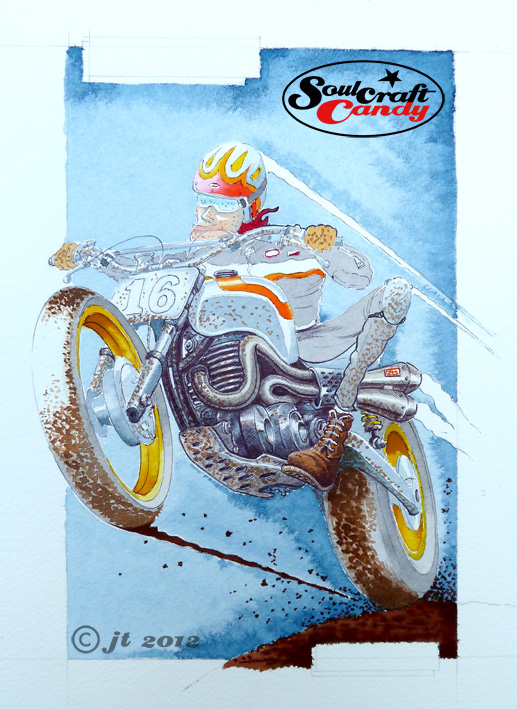
So the TT racer image now has its full compliment of colour washes and is now ready for the remainder of the line work. It has gone pretty well so far though I have to admit to a small mistake, over on the right hand side, where the two white streaks exit the frame. You’ll see that I let the wash run over the line on the top one a bit, which has let a bit of blue in. I will have a try at removing some of the colour with a damp flat brush once it’s fully dry. It may not work but it’s really not a problem, errors occur every now and then, and it is much better to learn to work with and around them rather than beating yourself up about it. This is as much an experimental drawing as anything else so mentally I’m ready for small things not being perfect. There’s nothing wrong with a bit of white gouache at the end if it proves stubborn.


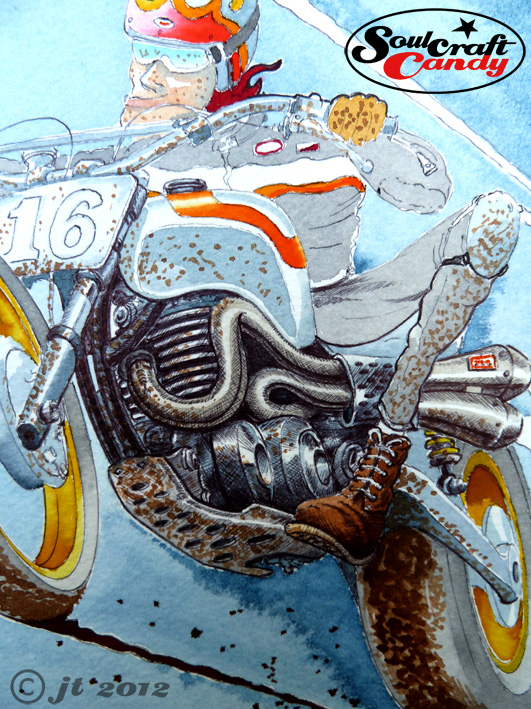
Putting the washes down, particularly the large areas of blue proved a bit nerve wracking as you never really know what it’s going to turn out like. Not being too proficient a water-colourist there is always a degree of unpredictability in laying in larger areas. But then again this provides a nice contrast to the precision of the following pen work. I have left two small blank boxes top and bottom, one for the story title and the other for any final thoughts or signature, we’ll see. Should have this done in a couple of days. Here’s a close up for you.

TT racer close up.


Telling stories, the second bit.

Dragster cartoon nearly finished.

So the search has been on to find how to start thinking about stories behind the images and how best to communicate them. In a way a potential solution was staring me in the face, though I’d failed to recognise it. A very strong instance of not being able to see the wood for the trees. The “tipping point” was completing the cut down dragster drawing featured in The Line Is Drawn post. By cropping the image I had essentially put a box around it, the story in the image was contained mainly within this box, though it broke out to imply the story being much bigger than this constraint. The issue with previous drawings had been the open nature of the final image, with nothing to hold the image it was left to sit adrift in a space that then just flowed out to the edge of the paper. Sometimes paintings and drawings only start to make sense once we have framed them for hanging, and it was this sentiment that I was trying to capture. Rather than rely purely on the edge of the paper to provide the boundary of the contextual space, I realised that what may best serve these kinds of drawings is to create this boundary myself. Create distinct frames like they do for comic books and graphic novels.


It was a kind of “aha” moment. Had I found a mechanism for completing the images and communicating the “story” better? It seemed such an obvious realisation but then what is directly in front of you can be the hardest thing to see sometimes.It is nothing new, a technique that has a long history running through the comic universe to storyboards and beyond but, such a simple approach could really compliment the images as they are essentially cartoons in themselves and might benefit hugely from such a solution.


Conveniently there was a drawing here which I have struggled with completing for quite some time. It’s another in the dragster series and is sitting in the middle of a big bit of A2 paper, you may remember it from a post back in August. I got so far with it, then kind of stopped, the more I worked on it, the more the life seemed to drain out of it. The context I’d created in my imagination just wasn’t working so it got put to one side, to await a flash of inspiration and energy. It seemed a perfect candidate for experimenting with the “crop and box” approach. Interestingly, what happened was that it made me think much harder about what’s inside the boundary I’ve drawn. As a consequence the story has changed and with it a new context is starting to emerge in the background. The drawing has a new life, one that I’m more than happy with so far and looking forward to finishing.


So as a first stab it’s kind of working, an image I was perhaps bored with has regained my interest, and that’s such an important part of this exercise. They key now is to explore how this development pans out across future images. Certainly I don’t want it to become an exercise in cutting and pasting formats and such across a host of work, each piece must remain unique in its own way. What’s good is the fact that the idea is so simple and basic that it is ripe for all manner of playing with, and that flexibility is exciting.