It’s bright, I’m happy and it’s shipped.

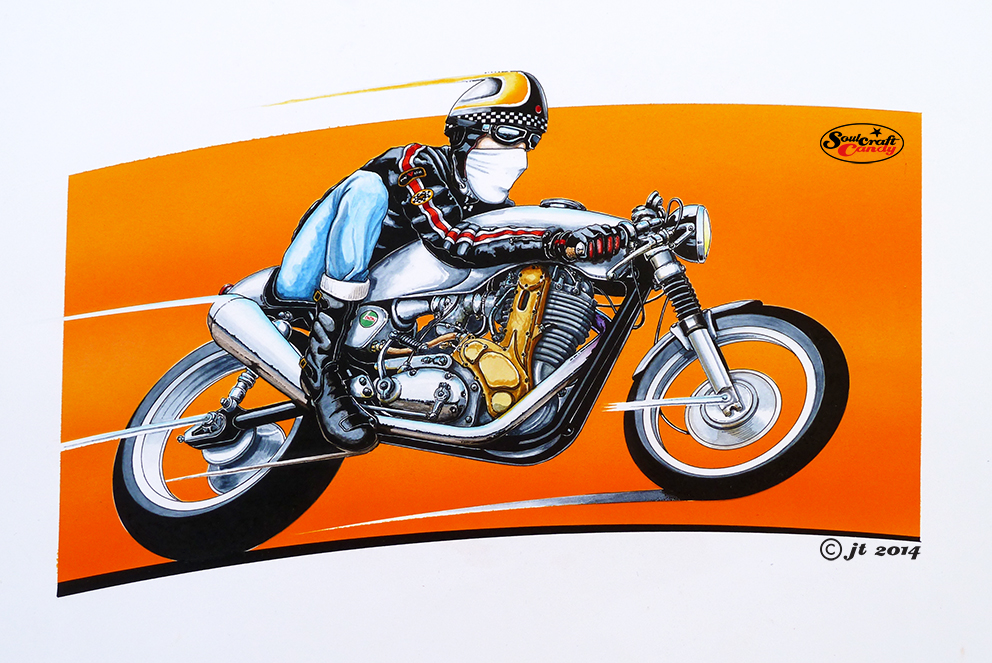
The Thumper © Jon Tremlett for Soulcraftcandy 2014

Those little thieves, that like to pinch bits of your time when you’re not looking are still hovering around the studio, turning hours into minutes. I’m experimenting with various strategies to combat their fiddling, the most effective so far being to shut down the email at certain times and turn the phone to silent mode. It’s working but it’s not a long term solution.


Despite these distractions I have finally managed to finish the picture featured in the last post, and it would be fair to say that I’m pretty pleased with how it turned out. For a long time I wondered if the speed streaks would work, and was tempted on many an occasion to just leave them out. I’m glad I didn’t, they add a bit of direction and dynamism to the image which wouldn’t be there otherwise. It’s a detail I need to work on to get absolutely right but for a first attempt it’s none too shabby. I’m also very happy with the balance, between cartoon and reality, I have managed to strike. It is such an overwhelming temptation sometimes to get utterly carried away in the painting and start working too much realism into the colouring.


As for that background, well it just needed something massive and punchy to lift it off the paper and grab the eyeballs. I did it in Dr. Martin’s liquid water colour with an airbrush, using two variations on orange. First a layer of orange and then some tangerine layed over the top. I always find using the airbrush completely nerve wracking. Laying down the masking film is enough to give me the jitters on its own, and then cutting out the mask with a scalpel and removing the pieces turns me into a shaking wreck! Spraying seems to be the easy bit. The ink takes ages to dry properly and in the end I had to remove it from the surface of the film with a carefully placed piece of blotting paper and a roller. Only then is it safe to remove the mask, very, very slowly.
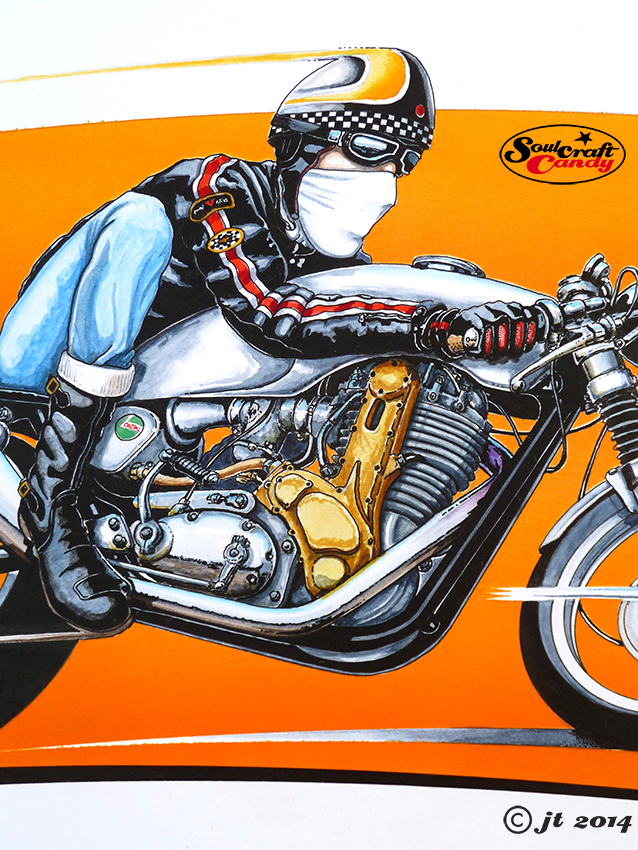
Detail of the Thumper by © Jon Tremlett 2014

As I mentioned before, I think I’ll leave this level of detail painting for a while and have a go at being a bit looser with things. I’ve been sketching out some other pieces in good old fashioned pencil this week and I want to take one of those onto a suitable paper and play with washes. I’m hoping it will be a bit experimental and free up the brain a bit, loosen the creative muscle as it were. I’ll let you know how I get on.


Confronting your creative comfort zone, one step at a time.

Paint and ink detail be Kon Tremnlett for Soulcraftcandy.

Welcome to the first post of the new year, a year supposedly fully fueled with fresh resolve to go beyond merely just carrying on. Actually, to be honest, I made no new resolutions regarding the blog, and this may end up being a good thing as it will keep the devil of disappointment from the door for a while. Y’see, it’s not even the end of January and the thieves of time have already raided the creative cupboard and made off with more than they usually swipe. The important thing at times like this is not to stop altogether, to keep chipping away, even if it is only a small bit at a time. This is how it goes sometimes and part time work can often morph into something with a greedy appetite for your precious time. I liken it to when we used to listen to the radio on sets that possessed a manual tuning dial. Often the signal would fade or go crackly, and in order to hear the music again you had to lean over and move the tuning control ever so slightly. Clarity would return. So currently the dial of life needs some subtle turning to get back to a more balanced feeling.


But creative work never stops and thankfully the drawing projects are still on going, just a bit more slowly than usual. The image above is a detail of what’s on the drawing board right now. Essentially it’s a larger colour version of a drawing I did over a year ago as part of the original cafe racer series in biro. I’ve been wanting to do a colour one for ages, so got the brushes out just before Christmas and have been chipping away ever since.


Like previous pictures this one is being done on Bristol Board using water colour washes and my trusty technical pens. Although progress is slow, I’m enjoying every minute of it and, taking my time has allowed me to make some considered changes to my plan and think a bit more deeply about what I’m doing.


This is all good stuff, but it’s also causing me to realise that I should perhaps be trying to do more with the paint. I’ll try and explain what I mean. At the core of it would be a feeling that I am not a natural painter, someone who’s automatically at home with the medium. For me, and this probably harks back to formative years, the application of paint to an image has always been a colouring in exercise, following some kind of predetermined outline to render a colour picture. It has never really ever been used as an expressive tool in its own right. As a result I’ve established this kind of comfort zone in which my painting exists and is quite cosy for me. So there’s a challenge in the near future to see if I can get out of that comfort zone and see if I can make more of what’s out there. People endlessly talk about thinking outside of the box these days, well this is a challenge of DOING outside of the box.Painting, whether it be in oils, acrylics or water colour is a combination of many skills and techniques and yes, it is daunting to think that one is only in possession of a small amount of skill and a couple of techniques but, it is also exciting to know that there is a world of image making still out there waiting to be tried. My professional life does not allow me the luxury of experimentation so, somehow expectedly, I’ll need to break some habits too if I’m going to improve my skills. Rather like the picture from the last post, you never know what’ll happen until you try, so flinging some paint around could reveal some interesting things. The key will be to learn, as much as create and make. Here’s to an experimental and rewarding 2014.  I’ll keep you posted.


Can I draw like a designer?

CB750 sketch by Jon Tremlett for Soulcraftcandy

When I got up this morning I knew I needed to write a blog post today. It’s been a while since the last one and my guilt is starting to gnaw at my conscience. My only problem was that I didn’t know what I was going to write about, and then the phone rang.


It was a good friend calling to ask for some advice on behalf of a colleague of his. In a nut shell the colleague was asking how she, an engineer, could learn to draw like a product designer and did I know of any courses that might teach such a thing? During the conversation my brain split into two parts, the first attempting to answer the question, the second thinking “ what a good subject for a post”. Here’s what the two parts came up with, given that the question can be answered in two ways, the simple answer and the slightly more complicated one.


Firstly I don’t know of any courses that will teach you how to draw like this in isolation. A design course might, but it’s not guaranteed and, let’s face it, if you only want to draw like a designer then a full blown design course is a very long winded way of going about it. However, if you have a modicum of drawing ability, then there are various books available which do a very good job of illustrating (sic) the various techniques that designers use to communicate their ideas in drawing form. Here’s a link to one I find very useful. The double sided key to this approach is knowing what it is you’re looking at on the page, and then putting in the hours and hours of practice that will embed the techniques into your canon of visualising skills. Although this is the simple answer to the question it is far more than a mental and creative cut and paste job. Only practice makes prefect, don’t forget, and you’ve got to have some drawing ability to start with.


The more complicated answer involves taking a closer look behind the question itself. The question, “ how do I draw like a product designer?”, provokes the immediate response, “well, how do you think product designers draw?”. Is the answer very quickly, or with a pen, or with one eye shut, or with magic ink? The answer is both none and all of the above, and this is where it gets complex. Essentially all designers who draw use it as a way of communicating their thinking, their ideas. Yes, we can all use words to back up what we are on about, but most of us draw our ideas because they are required to explain themselves when we are not there to represent them. Drawings are used to communicate everything from general concepts and aesthetics, to mechanical solutions and fine details. They are a core mechanism of the discipline which transcends language and helps others to understand the idea. Without some visual representation design is a pretty worthless exercise. Conversations between designers are often both visual and verbal.


The complexity arises when we realise that designers, even those working in a similar field, all draw differently, and the reason is because we have all spent a long time finding the techniques which we personally are most comfortable with, the ones we like the most, and are happiest exploiting. So, we are all the same but different. The other complicated bit is that drawing is a direct output from a thought process, which involves several elements like imagination, mechanical considerations, technical parameters and materials knowledge etc etc. So you can see that when designers draw, they are actually doing a lot more than purely making an image. Does this therefore mean that in order to be able to draw like a designer, you essentially have to be one? If you’re happy adopting a style or technique then perhaps not, but remember that whilst most designers can draw, not everyone who draws is a designer. I hope this makes sense as it’s taken me a while to boil it down to this brief explanation.


Here’s a lovely quote I read the other day about drawing, and is another great reason why all designers should consider the benefits of developing drawing skills.


“I prefer drawing to talking. Drawing is faster, and leaves no room for lies”. Le Corbusier.

Before I go, the sketch above is one of the projects on the go at the moment. A lovely chap called Larry sent me some info about his bike some time ago, we were discussing a possible commission. Sadly that didn’t happen, but I haven’t forgotten about it, and have finally got around to starting a drawing based on the bike, a Honda CB750. So Larry, if you’re reading this, I’ll be in touch soon.