Lights fantastic.

Been so busy with all of the drawing stuff that I’d clean forgotten to get back up to speed with the story of the 250 build, sorry. Actually it’s about time I started getting to the end of this otherwise it’s going to turn into the longest quick build in history.

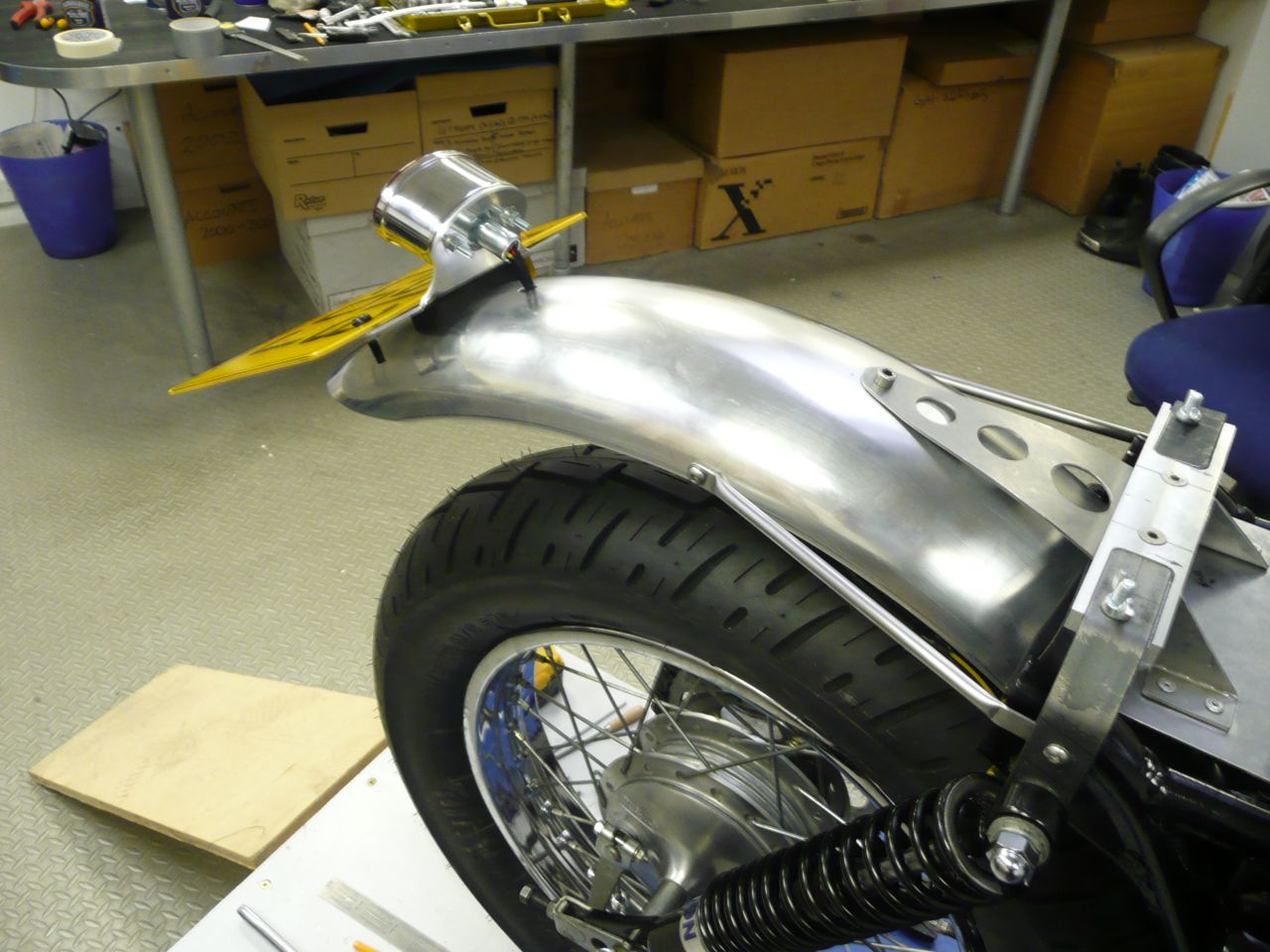
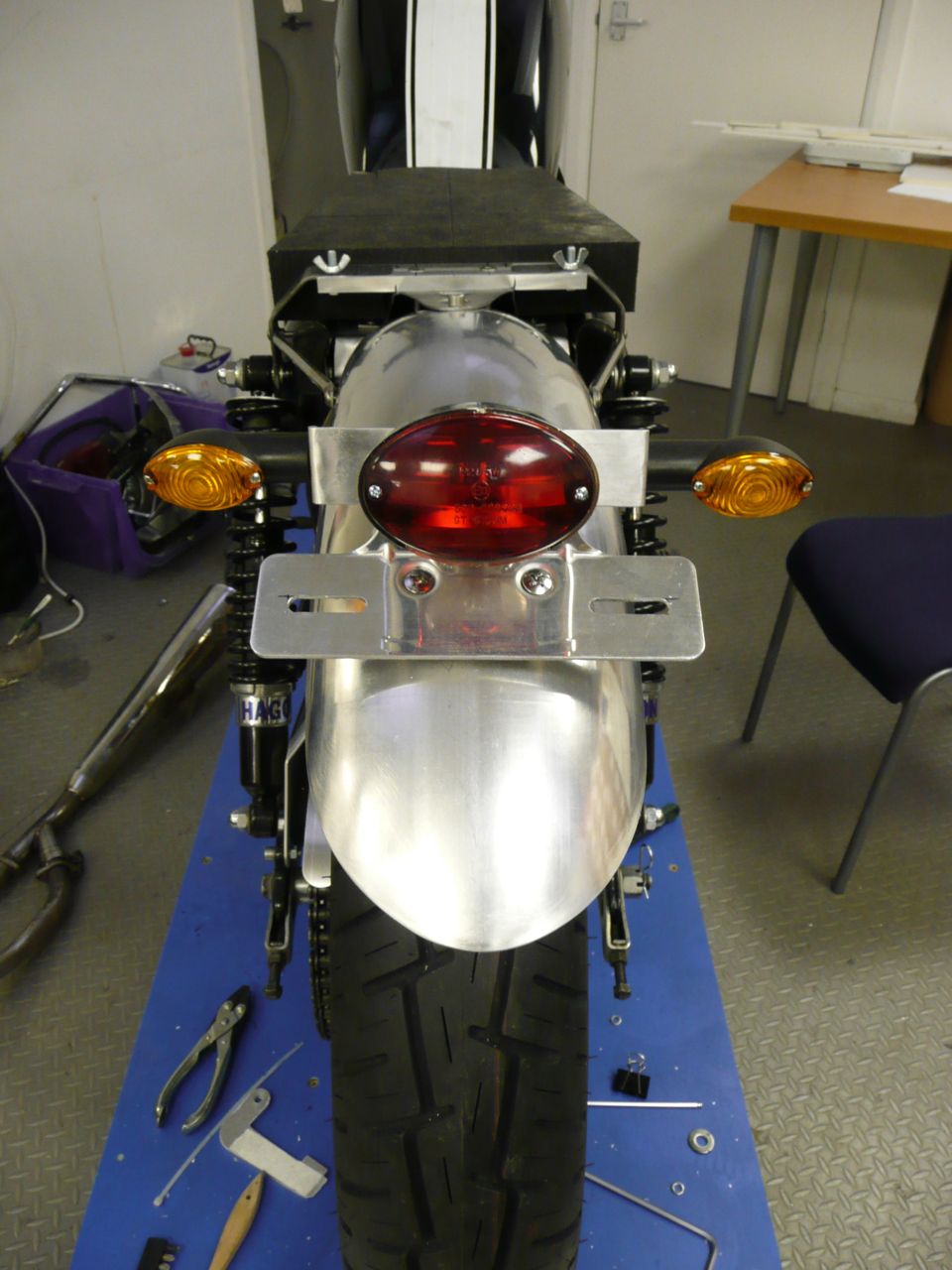
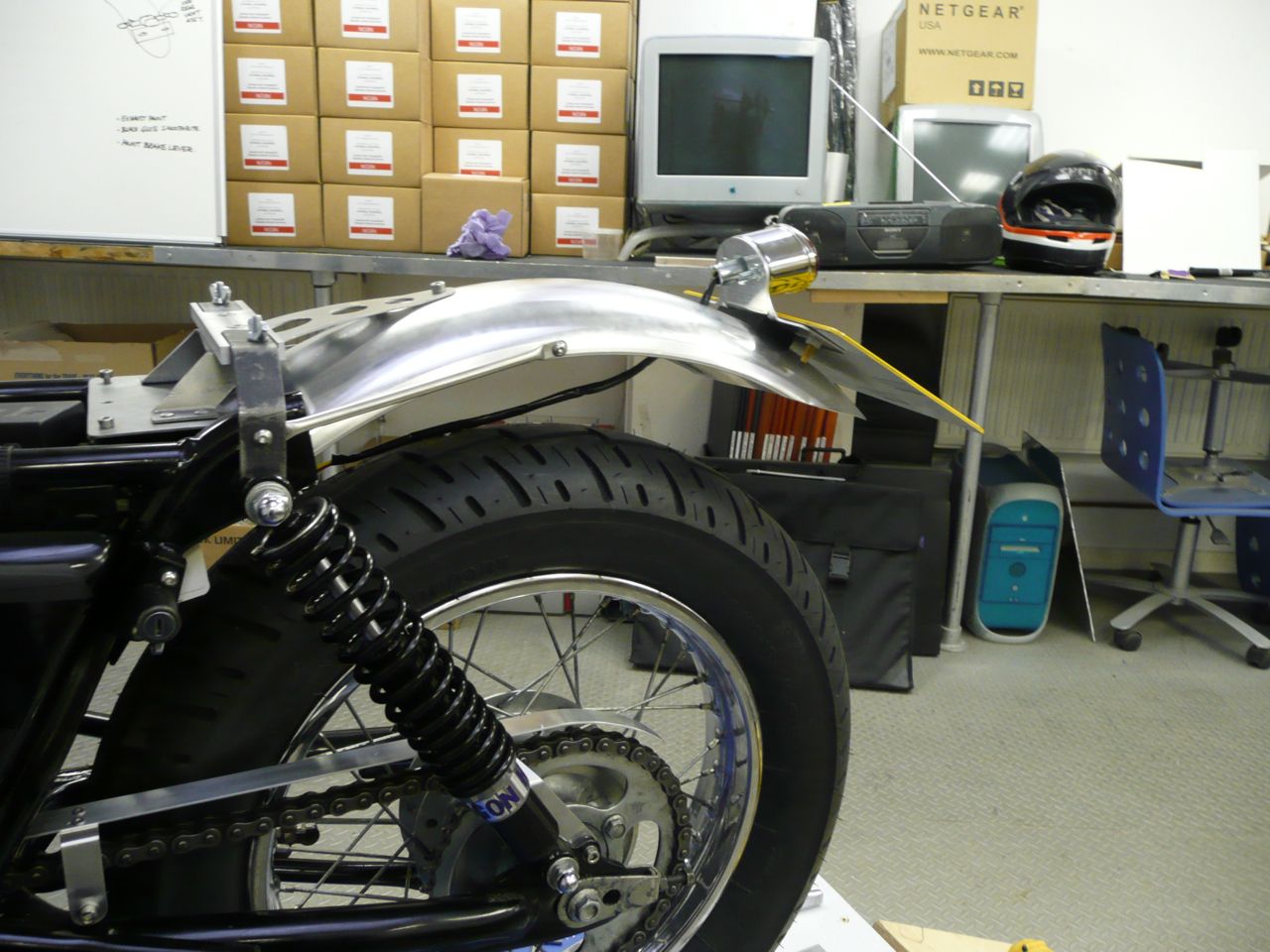
So where were we? With the metalwork completed for holding the rear fender and the rear of the seat in place it was time to cut it down to its final length. and attach the rear lamps. I’d decided on a rounded end to the fender and made up a thin card shape template using a combination of large radii. The line was drawn on the fender with a Sharpie and then cut round carefully using a jigsaw, much noise and dangerous looking manoeuvres. I finished it off carefully with a metal file and some wet and dry paper wrapped around a block for a smooth finish ready for painting.

I’d made up the rear lamp assembly in accordance with my build philosophy, this was to be a workhorse bike. So I wanted easy removal of the whole lot if needed, tidy wiring and if the registration plate was integral all the better. I knew I couldn’t have the plate mounted on the side of the bike to keep the back end clean as this would have been asking for trouble in the parking bays of London, so on the rear fender it had to go. I’d cut and bent a short length of flat aluminium, drilled appropriate holes and created an assembly which could be mounted and removed as one piece.

When attaching the light assembly I didn’t want to distort the aluminium of the fender by bolting the flat mounting directly to the top of it. So I needed to make a block of something to cope with the curvature of the top surface. I tried a whole host of solutions from solid plastic blocks to bits of bent metal strip but nothing worked well enough. Time for a think. In the end I settled on cutting and shaping a large lump of quite firm neoprene foam to sandwich between the lamp cluster and the fender. I figured it would compress into the correct shape, which it did admirably, and that it would provide a degree of vibration damping for the lamp bulbs. Whether it would or not I’ve never really proved but it looked good enough for my purposes so I went with it.

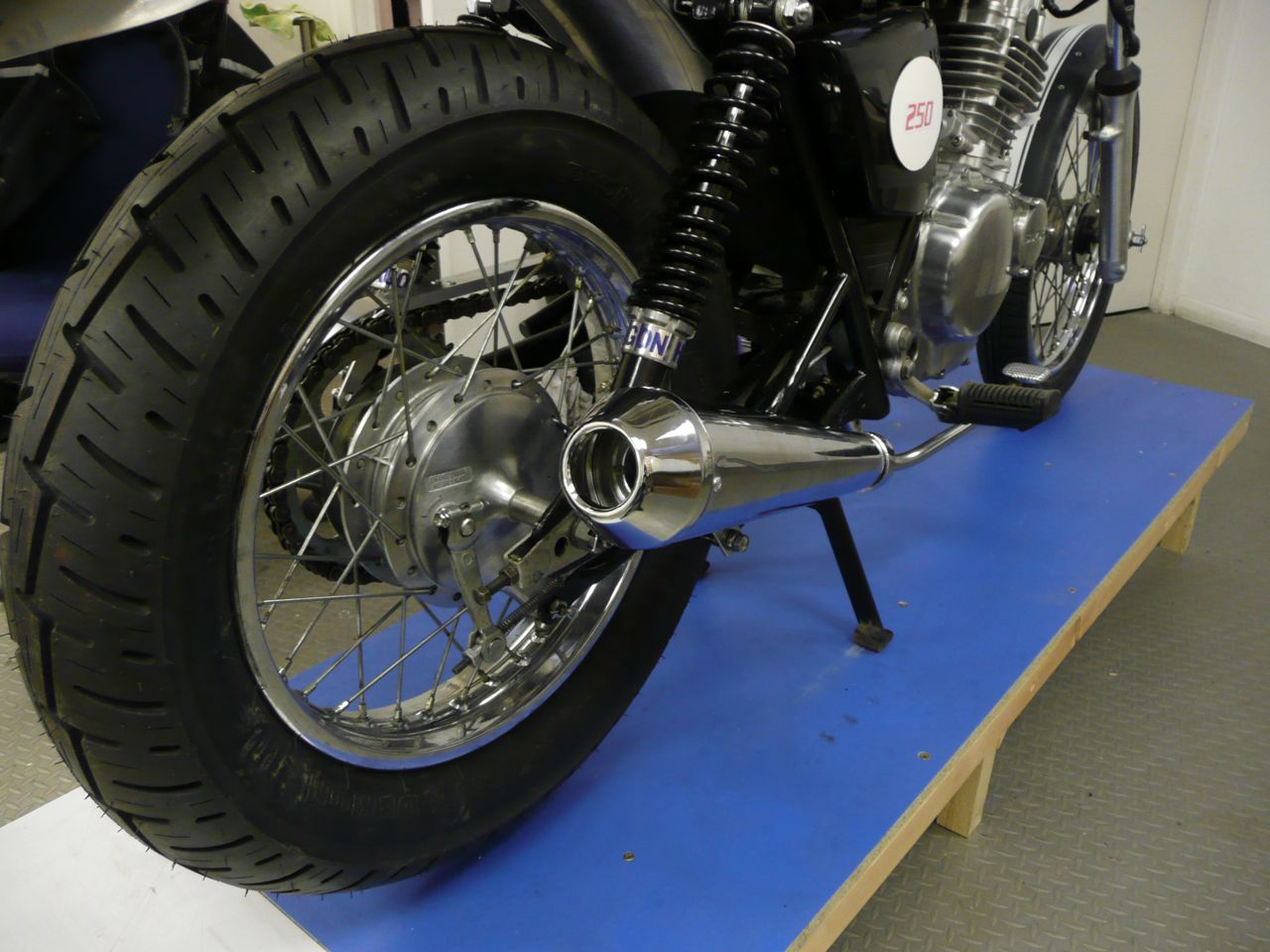
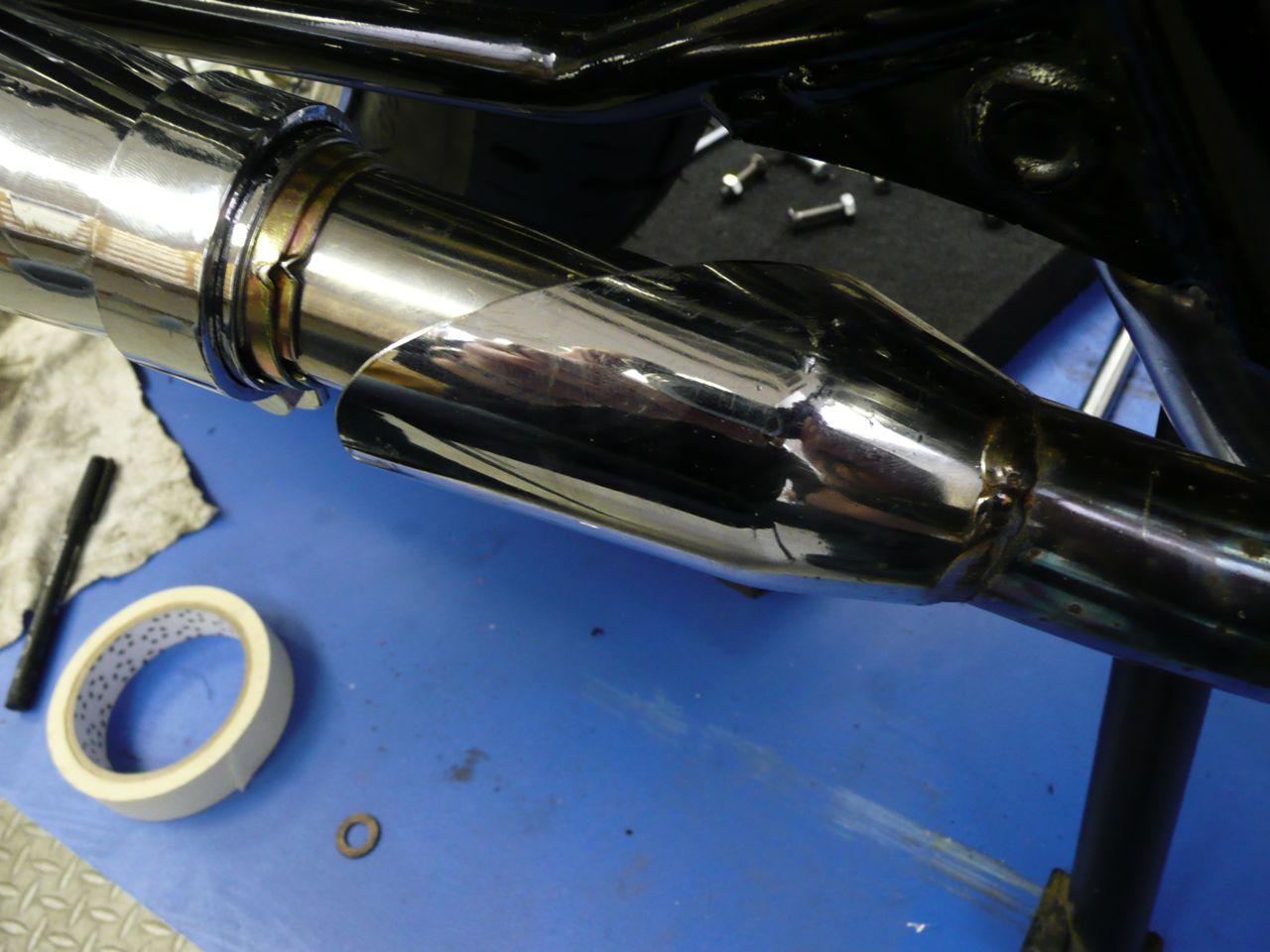
I’d also received by now the exhaust muffler I’d ordered and bolted this to the back of the bike to start the process of working out how to attach it to the engine. I’d decided, for budgetary reasons primarily, but also because of time to use the existing header pipes and junction but, I had no idea where to make the cut to remove the enormous and heavy standard muffler. Reckoning that the pipe would pass into the muffler for a short length I reached for the angle grinder and cut through the muffler at its root. Low and behold there was a length of exhaust passing right up into the offending muffler. I measured the diameter and was happy that I could attach the new muffler to it and tidied up the cut by taking a slice at an angle creating a kind of heat shield detail.

So the pipe went on very quickly much to my relief. But it was loud, so I knew i’d have to do some baffling if it was to stand any chance of getting through the MOT test.

Card shark.

In the previous post I said I’d say a few short things about card, or cardboard, and how it can help during a bike build. A lot of what follows may very well be obvious to some of you but it’s worth saying as there are bound to be some for whom this will be very useful stuff. There are of course a thousand and one things that you can do with card and I’m not going to attempt to cover them all here but, some are really relevant to us when making parts for assemblies when we don’t have full technical drawings to hand or we want to try out ideas quickly without the hassle of wasting precious resources like our stocks of metal sheet etc.

I use card a great deal in my professional life, for both proving ideas and for making complete models of various projects for clients. Some of the resulting constructions are deadly simple and others much more complex. In fact some of the work I’ve been doing over the past year has involved making whole rooms from card as a first step to proving out designs for aircraft interiors, in full size. Extreme card modelmaking in a sense. In order to try and make sense of what can easily turn out to be a quite complicated subject I’ll they and keep the following simple by looking at the two extremes of what mocking things up in card means to me.

Firstly card comes in two basic forms, rigid and flexible, all card being pliable to some degree. Rigid covers everything from foam core, see below, to the grey stuff you find as the backing on a good quality sketch pad. Flexible card is invariably much thinner, only about 0,5mm thick, and usually white. The kind of stuff you can buy at your local art shop. We call it ticket card and it’s much easier to bend, though like all sheet materials it will only bend in one plane. Of course there are many other varieties available but frankly I tend to steer clear of other types for what I consider to be good reason. Here are a couple of examples. Grey or light brown cards that you find on the back of a sketch pad or sold as basic mounting card look attractive because they are thin, about 1- 2mm thick. They look useful enough but have their own problems. Often made of layers of rolled or compressed pulp they can be hard work to cut neatly with a craft knife requiring several passes and a bugger if you’re trying to make fine details, no end of furry edges and corners. They also have a nasty habit of delaminating just when you don’t want them to or cracking, especially when you’ve done your best to score a line in readiness for a neat bend or crease. They other card that I steer clear of is common or garden box card or corrugated cardboard. It’s great for boxes to hold our shoes but useless for virtually everything else. It compresses when you apply the slightest pressure to it, makes your blade wander when cutting and worst of all it has a propensity to bend and crease at exactly the point and time when you least want it to, reducing your carefully prepared mock up into a floppy mess.

Here's one I made earlier.

The picture above, and it’s an old project so probably safe to post without causing any issues, is of a full size proof of concept model for a new business class aircraft seat. This model is made using foam core which is essentially two sheets of thin card with a foam centre, forming a kind of light weight and fairly rigid sandwich. It comes in varying thicknesses up to 10mm thick and is great stuff for creating large pieces quickly and cleanly. This is kind of Rolls-Royce card and is invariably accompanied by details created in more conventional card which is a lot thinner and much more flexible. The point I want to make in showing you this model is that foam card, although a fantastic material when used in flat pieces, is not naturally disposed to going around corners and needs to be encouraged to do so by relieving the stresses on the inside of bends. The striped areas on the model are where you cut through the card layer on the inside of the bend only and any compression in the bend is taken up by the foam core. Of course this technique requires patience in cutting out the strips and has its limits as the card will snap if you haven’t removed enough material from the inside face. Sometimes you have to cut the foam out too in strips just to get the stuff to hold the curve you want. Yes it’s time consuming but the results speak for themselves and one ends up with good sturdy models that retain their shape. This is the kind of stuff I’d use if fleshing out the form for a petrol tank. It’s great for creating all the internal ribbing and support structure which I would then “skin” with something thinner.

The parts that I mocked up in card for the bike build used thin ticket card, and are at the other end of the spectrum to foam core models. It might look bloody simple but again, there are very good reasons for using this material. Its thickness, or lack of it, makes it perfect for marking out and cutting quickly and accurately. A single pass with a sharp blade is usually sufficient. Being thin makes it much easier to cut out fine details and curves, either freehand or using a template. It bends predictably and when gently scored enables very fine bends and creases. Finally, because it’s not that much thinner than thin sheet metal it’s great for making almost facsimile parts which can then be flattened out and used as an accurate template for the final part. Oh, and you can cut it with scissors which is a mighty handy attribute.

Wow, this is turning into a long one. Not much more to go.

When I used to teach at a design school many of the students would say that the above is all very well but how do you glue things together because paper glues all seem to take an age to set. In some instances you can use good old fashioned wood glue or PVA adhesive but generally you don’t want to use even that much time. The secret lies in three small words: Hot Glue Gun. What a fantastic invention. I’ve used various makes and models over the years. Some are no more use than a chocolate tea pot, others much better. In the end I bought my own, it’s a constant companion made by an american company called Arrow if I remember rightly, and it’s the best I’ve ever used and must be over ten years old now. Like all good tool purchases it’s certainly worth buying good quality for a price rather than going cheap only to have to replace it soon after. Hot glue is perfect for mocking up in card believe me.

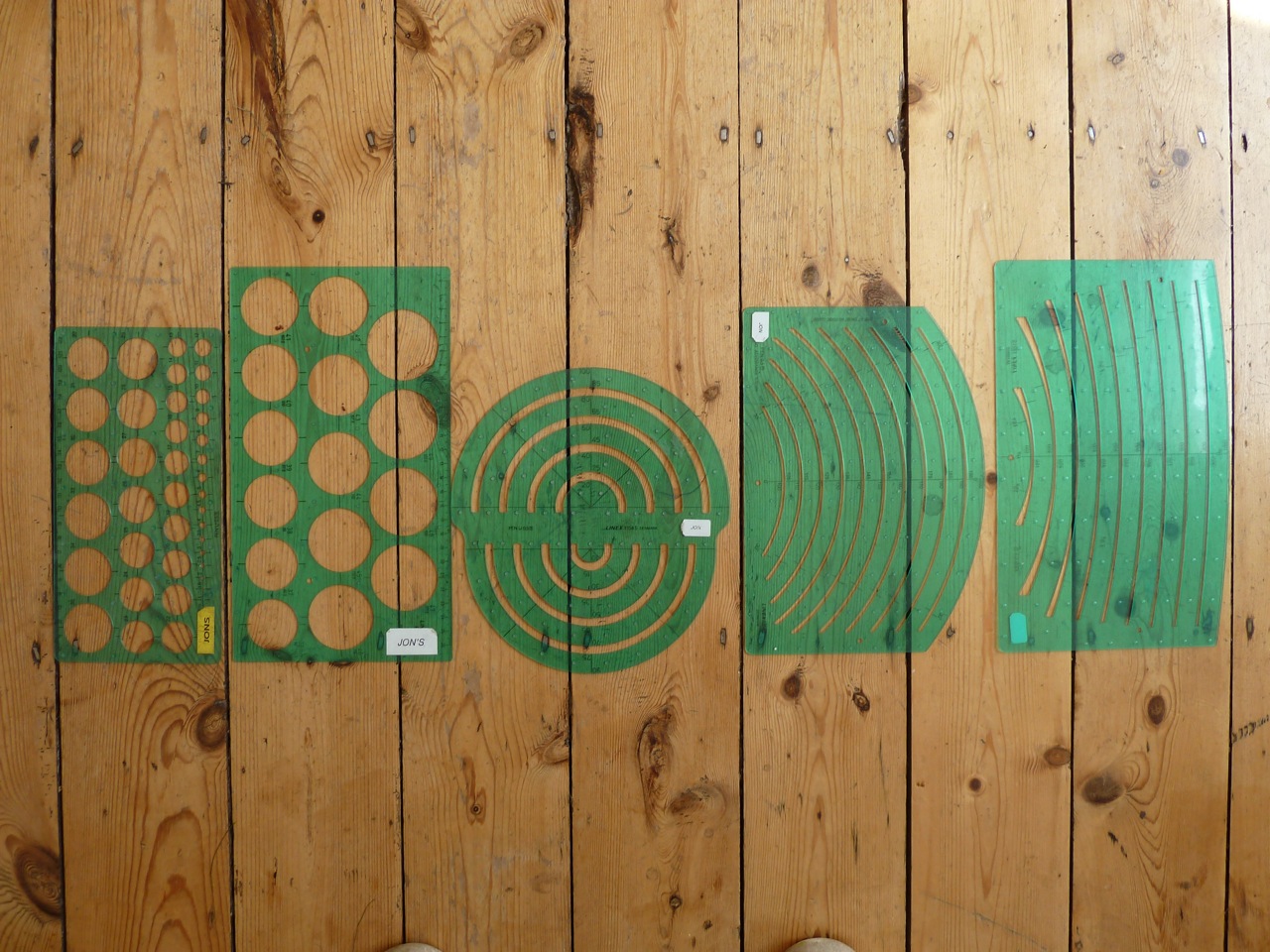
Finally here’s a couple of pics of some of the tools I use when making things in card. A selection of circle and curve templates, some set squares, a decent steel ruler and a small selection of French Curves. Like my glue gun these travel with me everywhere and though they cost a bit to buy initially they repay you in spades, just be careful if using them as cutting guides. The ruler is a narrow, thin and bendy one, great for measuring around curves, saves on all that trigonometry we were supposed to have learned at school!

All of the above is great for creating mock ups and templates for our various bike parts but none of them are much good if we don’t have to hand the most important tool of all, a craft knife, or scalpel, with a fresh sharp blade in it.
Making a lightbox.

It’s a great truism of anything connected to a hobby, making anything, fixing anything as much as of life in general, that whatever it is you’re doing the one bit of kit you find you need is the one you don’t have. How many times have you taken a whole bunch of stuff and tools out front to fix the car only to find that the one spanner you need is the one you didn’t bring.

So it was with me realising I needed a lightbox if I was going to stand any chance of transferring sketches to better quality paper for final drawings. I had a couple of sheets of a varirty of good old fashioned carbon copy paper but it wasn’t what I wanted and you can’t see where you’ve been so easily with it. Jumping on-line I realised I’d be in to over £200 for an A3 size. And the boxes on offer were just like I’d used in the past; big, heavy things fabricated out of metal extrusions and packed with great big fluoro tubes that get hot.

I wanted something slim and low in profile, capable of taking an A3 sheet and certainly cheaper than £200 or so. After no more than two minutes thought I decided to make my own. One mad project I’d done a couple of years ago was converting a new office machine into a do-it-all device complete with coffee machine, DVD player, stereo sound, screen etc. It was made to “float” on a bed of light, and for this purpose I’d usesome brilliant low voltage cold cathode light tubes. Very compact, bright and they don’t get hot. I tracked down the company Luxx and ordered some tubes in white and the various bits of power supply and inverters.

Luxx offer a service whereby you can order over the phone and they were really prompt in their despatch of the parts to me, try them though I’m not sure they send stuff abroad.

So with four tubes in hand I worked out how big I wanted the box to be, essentially A3 plus a bit. Again using an old work supplier, and there are lots of people out there who can supply you should you need, I purchased two pieces of Acrylic sheet (Perspex) cut to my dimensions. One is white, for the base of the box so I didn’t have to paint the whole interior and the other opal for the top.

Then off to the local wood store for some strip wood in two widths for the frame. By laminating the strips together I could create frame sides with an integral rebate to take the acrylic sheets and leave me with a flush surface.

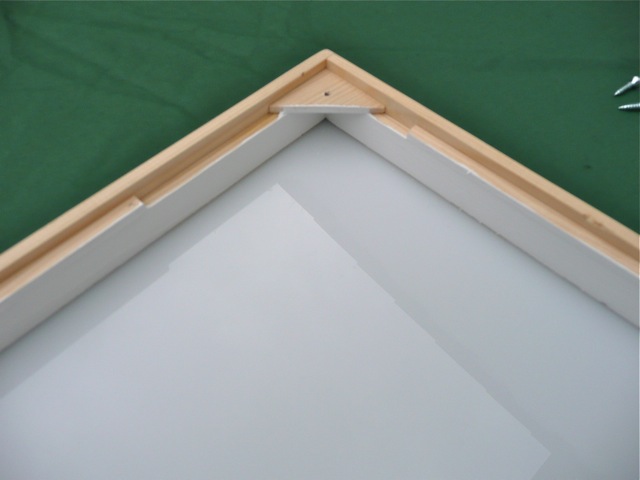
I made sure that this rebate was continuous around the top to fully support the top opal sheet. To fix the white base sheet I cut thin strips and four triangles to give me four corner fixing points and some support areas for the base. See pic on the right. I simply took my time, which means taking plenty of time to let glue dry and set, and simply glued the structure together. PVA wood glue is great stuff if you leave it alone to do its thing.

While the frame dried I got busy on the base sheet and lights. The tubes come in square section housings so you can rest them on whichever face you want for the best effect. Luxx usefully supply some very handy velcro tabs for fixing the lamps in position which makes life dead simple. I also measured the positions for some mounting holes for the inverters, the white boxes shown, drilled some holes and put them in place. two tubes can run off each one. Once I’d decided on the light spread I wanted it was merely a case of positioning the Velcro bits and fixing the lamps in place. Some white tape to manage the wiring and it was ready to go.

I’d used two layers of double sided tape to hold the front sheet in place and so everything mounted into the back of the frame using the foiur screw holes in the corner triangles I’d put in at the start. The base sheet slipped in without any fuss and once screwed together I had a great little light box.

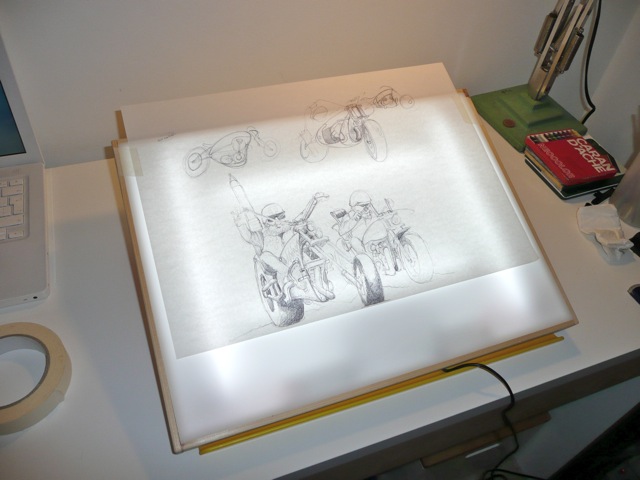
And here it is in action. I know full well that the light spread is not continuous across the box, but that’s not an issue. What I have is plenty of light coming through allowing me to trace away to my hearts content. It works through some pretty thick papers so all is well. I use it as shown, propped up on a plastic laptop support from our good friends at IKEA which makes a very comfortable working angle. I’m very pleased with it.

What you can see lurking on it in the pic is a loose sketch for a chopper/bobber/ low riding composition I’m starting to work up. Watch this space for the final version.

Oh, and by the way, if you do fancy making a similar lightbox the lamps are Deluxx 5 and the code number is TE26290-65UV. They will happily give you advice about inverters and cables if you need it, but it’s all on the website.