Pleasingly vibrant.

Back at the start of January there was a post about clearing the decks to make way for fresh projects. It’s safe to say that this process is fully underway, though it’s a truism that as much as you try and finish off one set of things, you often can’t help yourself from generating more that only add to the pile. Not sure what that’s called but there must be a word for it somewhere.

The image above is the latest to get the “I must finish that sometime” treatment. It would be safe to say that it has been hanging around in the pending file for too long. It stated life as a very quick and rough biro sketch in a rather ropey old A3 pad used for just such things (see below). And that’s where it stayed. Then one day it got scanned, the reason for which now escapes me, and finally was printed out as a test to see how the printer would cope with rough water colour paper, reduced to A4. For some reason only the tyres got the benefit of some paint, until this week when I finally surrendered, and decided to give it a bit more love and attention.

It is still really a test image in the sense that the greys are mostly of a new kind not used before, made by Schmincke, which needed road testing. Lovely paint. It comes in refreshingly old fashioned little metal tubes, at 5ml size, and has a depth to it that makes it great to use. The other trial aspect is wanting to see how these new greys worked up against the luminous intensity of the Dr. Ph Martin’s liquid water colours used on some of the smaller paintings. Choosing a bright orange for the main bodywork has taken the colour contrasts to an unexpected though very welcome level. Although water colour is a favoured medium it often leaves the image with a very dull feeling. Using the liquid colours enables me to get that “pop” back into the picture. Bikes are exciting things and it makes sense to communicate some of that through the colour. It is gratifying to realise that the persistence of the old drawings nagging has finally led to a very pleasing conclusion.
Here below is a reference pic of the liquid water colour. Available in two sizes, as shown, and available in most good art shops. Thoroughly recommended if you’re looking to pump up the colour intensity in a water colour image.

A change of scale.

It is most likely true that if you asked any creative person who produces stuff, if they just worked on one thing at a time, in a beautifully seamless procession of sequential order, they would likely say they did not. It seems to be in our nature to have as many things in the pipeline as we can manage, and then more. Our work spaces are doubtless littered with bits and pieces which remain unfinished, partially forgotten and “in development”. Our ability to accumulate projects is often quite astounding, and that’s before you even start talking about what’s in the brain bank, the unseen material hidden in the grey matter.

This is very much the case at Soulcraftcandy Mansions. Both the brain bank and endless pages of notebooks are filled with things that might be, one day. Sketches, doodles and diagrams all waiting patiently to be given life through some creative expression.

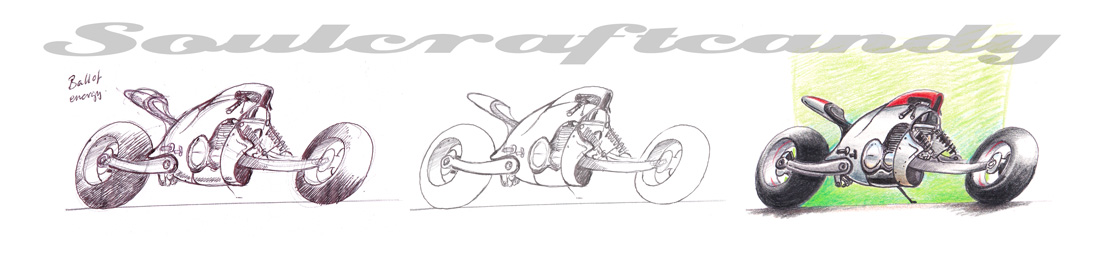
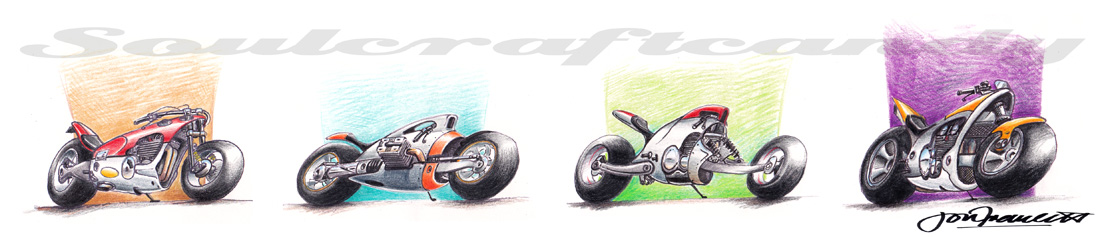
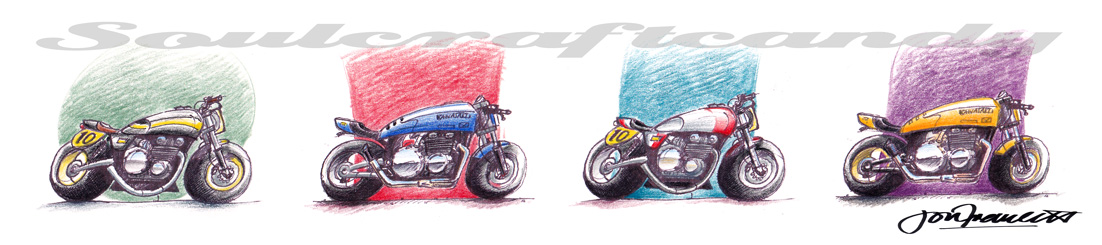
One such idea has been receiving such attention this week, small drawings in series. With the bigger drawings churning away nicely it was time to look at another idea for a while, to give my creativity a rest by way of a change of scale, pace and medium. Small drawings have always held my attention and this goes way back to when to being in a design studio and a winning idea would first appear in the corner of a page as a little thumbnail sketch. Of course the same thing happens these days but I’m now just as interested in the drawing as the idea it expresses.

The former situation would require enlarging the sketch and then investigating its potential as a design. Now the process is kind of reversed, rather than adding detail to the original sketch the process is reductive, what can be left out. The drop in scale really makes you think about what is the minimum required to get what you’re after. How do you compress all the complexity, mechanisms and complicated forms into a small space. Comic artists are consummate masters of this discipline. The hope is that it will refresh an appreciation for the details when returning to a larger format, but that might be hoping for too much.

Some might be tempted to sidestep this issue of detail by simply scaling down an already scanned drawing in Photoshop and printing it out, but that only gives you little dense balls of ink and not much else. So the idea was to draw as close to the required scale as possible to start with. Then, in the same way that we used to play with the photocopier all those years ago, it’s a question of cleaning up the image and changing the size until you’ve got something workable. Scanning, cleaning out unwanted lines, knocking back saturation levels and printing until I’m happy. Four of these images get gathered together and printed out in a 2×2 matrix on A4.

The old Epson A3 printer that’s sat here stopped doing beautiful ages ago but has a great ability for handling all manner of different kinds and weights of paper which my newer Canon is not that interested in doing.

This facility means that it’s also easy now to play with differing media on these different papers and, to play around with different colour combinations for the images. Colour crayons, inks and paints will all get a look in. So far it’s the crayons that have held my attention and the results are promising though there is certainly room for improvement. I’m using Derwent Studio crayons by Rexel Cumberland and they have a lovely soft waxiness to them, but they don’t stay sharp for long and laying on deep colour often requires you to labour them a bit. The paper too, is a bit coarse but picks up colour well so it will be a case of finding the right balance between these two attributes in order to get the desired level of intensity.

There are some liquid water colours ( Dr Ph Martin’s)sitting in a box on the shelf here. It will be interesting to see how they work on some fine surfaced water colour paper in the next experiment.

Let’s be critical.

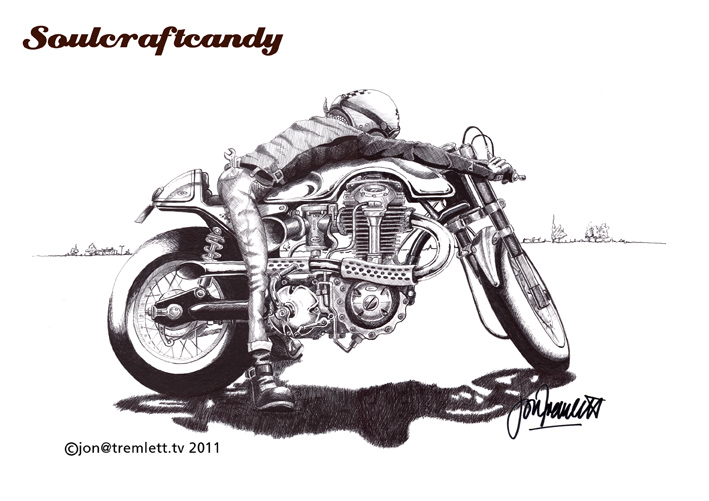
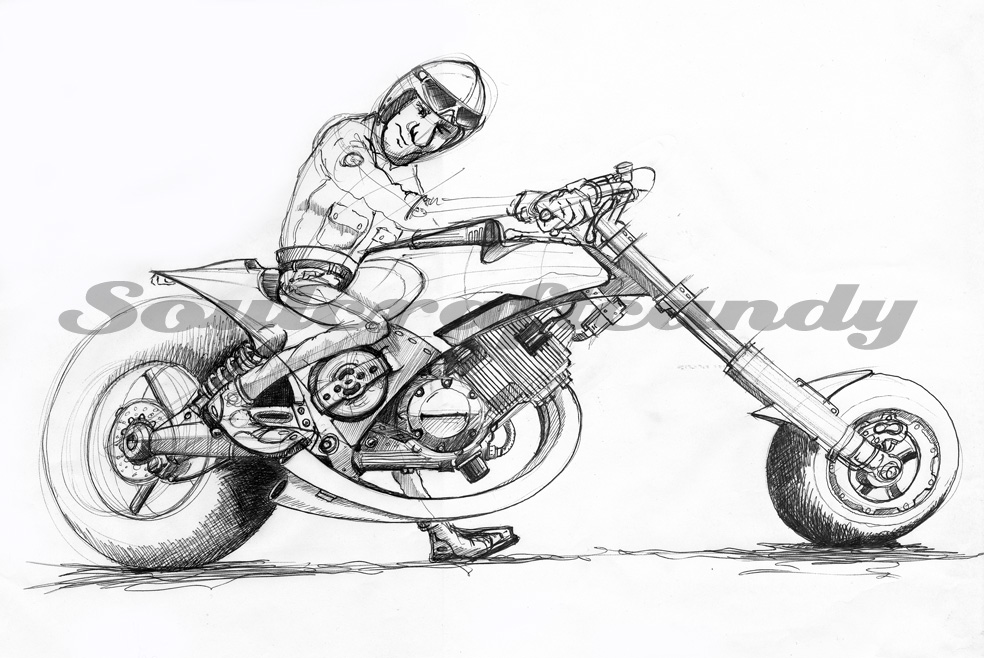
A couple of posts ago I showed a photograph of the above drawing about one third done. Well, here it is finished and I’m very happy with it. Every now and then you complete a drawing which just seems to eclipse some of the others, it has something about it which keeps your attention for a little bit longer and speaks to you in a louder voice (I know this sounds pretentious but bear with me). Even though it’s in black and white it has that “pop” that I talked about before. But these are not the only reasons I feel good about finishing it and looking at it.


For me it demonstrates a progression in my technique which is most gratifying. These things take many hours to complete in ink and the potential to lose ones way in the rendering looms large in the background. Here’s how I think it shows things moving forward.


Firstly, and most basically I’ve got the position on the page nailed. My shading technique is much better on this one and is much more confident. I say this because of two things. One is that working on the principal of less is more, I’ve managed to get a much better tonal range across the picture through creating better contrasts between the light and dark areas, which adds to the “pop”. Some of my drawings in the past have suffered from being a bit too grey. The other reason is that I’m starting to get to grips with how to deal with the shaded detail on the figure. By worrying less about all the little wrinkles and folds in clothing and leather, and so keeping these surfaces simpler somehow adds to the impression rather than detracting from it.


The inclusion of a simple horizon line in the background and a fairly simple approach to the shadow in the foreground give the main core of the image enough of a context to confidently occupy the centre of the page without taking away anything from it.


One of the hardest things to learn when engaging in self-initiated creative work is the ability to analyse ones own output, be critical of your own work and approach and, to subsequently work out what it is that you should do to improve and keep moving forward. The judging of creative output is a terribly subjective activity whether conducted by a single person or a group. The key is learning how to regard things objectively. Some people are naturally good at it, others need to learn. I started life very much in the latter group and as a result feel that I’m often still learning even after all this time.


My learning this critical skill started at art college and continued through all my years working professionally. It opened my eyes to the need to investigate options, to iterate, try different approaches and to realise that your first idea is never the right one or the final one. To many designers this sounds like teaching your granny to suck eggs but, it was amazing how much time I would spend with my students when I was teaching, explaining that without understanding ones own work in a critical fashion you had very little chance of explaining it to anyone else. It also meant that by the time one got to present ideas to a client, the ideas were of a higher quality and so stood more of a chance of being accepted. I’m sure there’s much more to say on this matter, but I’ll leave that to another time.

Before I go here’s another sneak peek. This is another big singled bike I’ve just started working on, a kind of sprinter. It’s sharing my time with some others on the drawing board so we’ll see which one gets to be finished first soon.