Keep your sketches.

There is an unseen conversation going on in this picture. It is a chat between man and machine.

When the original sketches for this picture were posted, my good friend Richard spotted them and sent me a mail. Although my own feelings what might be being said here leant towards the idea that either party could be asking of the other, “let’s see what you’ve got, what you’re made of?”, he likened it to ones acquaintance with a long term friend, and the continuation of a conversation. There is no questioning in his version, just a simple statement, “hello old friend, let’s go out and play”.

For me it works both ways and what lies at the core of either is the belief that one forms relationships with objects that you interact with, both on an emotional and physical level. This is true about many objects that we choose to spend time with.

Ask any motorcyclist about the bikes they own or have owned and they will fall into one of the following two categories (probably). Firstly there are those that do nothing more than give us access to their basic usefulness, provide transport for us, carry us from A to B. They are handy, but never indispensable. Appreciated but never loved. Used but never improved. The second group are different. They connect with us on an emotional level beyond the practical, we consider their good and bad points in equal measure and make improvements where we can. We clean them out of pride as much as necessity, and we like to show them off. In short we invest time in making them ours. They are often referred to as “keepers”.

To some extent it’s the same with the many sketches I produce. Again there are those whose only function seems to be to act as the expression of an idea and nothing more. Their purpose totally fulfilled purely through existence, visual jots to remind you that you had an idea. It would be easy to think that the group that sits alongside these would be those that hit the spot first time, but this would be untrue. They do occasionally appear but it’s rare. Like the bikes that turn into “keepers”, members of this other group connect with us in a different way. We see in them the potential of an idea that is yet to be fully formed. With a bit of time and effort thrown at it you know what’s lurking in there can be brought to the surface. It might mean totally redrawing it, many times over in some cases, or it may require nothing more than the addition or relocation of a few lines. The more you can see the potential emerge the more you’re inspired to tease more of it out. Before you realise it you’ve got another “keeper”, ready to work up to a finished image.

Have you ever wondered why so many of us scribblers keep so many piles of apparently jumbled and crumpled sketch sheets? Although I spend a great deal of time and energy sketching out fresh ideas, a good deal of time is also spent revisiting many older ones too. Spreading them out across the floor and having  another look for that spark always throws up something new that perhaps you didn’t see before. Finding these “sleepers” and working to turn them into “keepers” is one of the great pleasures in making these drawings. It provides a big chunk of the creative reward and always reminds me that it’s not always about the end goal, but the journey one took to reach it.

Chasing the thief away.

Welcome back. Having covered the time thieving monster of procrastination on my last post I’m happy to report that I’m now starting to get over it. It is an undoubted truism that it can be laid to rest by the mere act of sitting down and starting something, anything. So today I’ve had a bit of a scribble and come up with a new header for the blog, something which I hope says more about what goes on here than the last one, and the one before that etc. It’s been a lot of fun doing it as I managed to persuade myself that playing with my colour paints would be a very good thing today. The sun is shining and a bit of colour injected into what has been a very dreary few days lifts the mood.

In the previous post I showed one of two sketches I’ve been playing with recently. Here is the second of the pair. It follows along the lines of the theme for the first one and continues with the idea of a frame which is more of a monocoque forming the bodywork of the bike as much as the support for the engine and chassis parts. Again it’s also fun to experiment with some kind of extreme engineered front end, I’m developing a soft spot for these single legged kind of forks, and have another great big engine slung in there to create a fun feeling of speed and power.

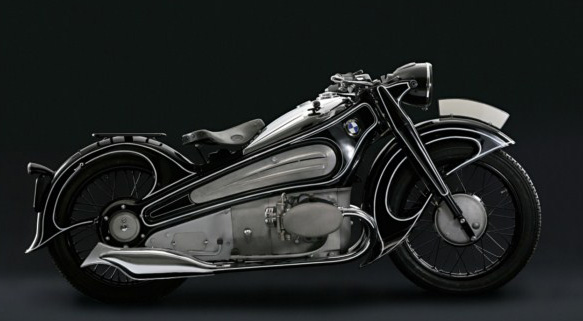
I was trying to work out where the inspiration for these two drawings came from. It’s interesting that often I’ll draw something and have no recollection of where the idea might have come from. I gather images of all kinds of stuff from books, the internet and photographs I take myself. In an attempt to be well organised I file them away on a hard drive somewhere and try to catalogue them so that I can refer to them later. But what often happens is that I rarely look at them at all whilst I’m drawing. As a consequence I often generate an initial sketch without their help but, some part of them must lodge itself in my mind somewhere as I can often find a link between a drawing and a stored image after the event. It’s a strange twist on post-rationalisation I suppose. The BMW R7 shown in the picture is where the main inspiration for these two drawings came from. It’s from the 1930’s as far as I know. I love it. It’s such a fantastic expression of futuristic thinking from that period. There is so much motion in the form language, extenuated by the white pin striping but it is the way that it appears to have no frame that catches my eye first. I’ve got a feeling this bike will influence a few more of my doodles before the effect wears off.

Anyway, this sketch above will get worked up along with the other one in ink to start with. I love it as it is in pencil so I’ll most likely work through onto another sheet with the light box and then revisit this image with more pencil work to get some more detail in there and some deeper tonal areas. I’d like to then scan the inked drawing and print a few out so that I can start to play around with some colour without risking mucking up the original, I’d hate to lose a good drawing through messing about with some paints. I’ll keep you posted on how it goes.

A time for ink.

Armed with the blue pencil sketch from the previous post, I used it as an underlay to create the final version of this drawing. Having said before that layout paper provides a good opacity for tracing through it became obvious fairly early on that despite this it was often difficult to pick out the lines that I wanted to follow. As a result I found working slowly and with a medium hardness pencil the best way to go. Basically I could erase things if I didn’t like them, though there is always the danger that you’re going to wreck the paper just at a critical moment as you get a bit enthusiastic with the eraser. I always try to avoid this by stretching my hand across the sheet and working the eraser slowly between my thumb and forefinger. Still, the danger is always not too far away.

I seem to have acquired a two pronged attack to adding detail to the drawings. I insert a certain amount in the pencil stage and then include more as I proceed with the ink pen stage, and so the drawing looks kind of half done at this stage. I also have to say that when I’m unsure about something, like the rider’s expression for example, I’ll leave it half done and continue to work on it in pencil as the inking process moves forward. Something in the way the drawing takes shape seems to help me find the right look further down the line.

Inking on this drawing was straight on top of the pencil on the layout paper. I realised I didn’t have any kind of light box that would allow me to easily transpose the image onto my favoured Bristol Board. This was something I didn’t forsee but was able to solve relatively quickly soon after as I made my own. I’ll cover that in the next post.

As a consequence the process of laying down layers of biro ink onto quite thin paper lead to the paper doing what it always does in these instances and that is to wrinkle quite badly, particularly around the areas where you put in the most effort. I suppose it must be that the constant pressure and side to side action of the pen stretches the paper. I could see myself ironing it in a desperate effort to make it flat enough to stick to a backing board. I know ironing a drawing sounds a bit mad but it does work provided you place it face down before you start and work slowly from the centre outwards and keep the iron dry. Stay away from the steam button. The strange things that my brain is filled with eh? As an aside, I first learned about ironing paper from the father of an old friend who I was best man for at his wedding. He told me to iron all the cash I was due to hand over to the chauffeur and various other folk that day. The reason being that it would give a great impression and that a man in a top hat and tails should be armed with suitably smart money. Whatever.

Fortunately I didn’t need to flatten out the drawing in the end before getting it onto a backing sheet, to protect it as much as anything else. In its current state the paper drawing doesn’t have any ground line or background, I’ve added these in a very scribbly way in photoshop just to see what it looked like. I’ve been mucking about on a multitude of photocopies with all kinds of backgrounds and ground lines. I’ve not found what I’m after yet but will add to the final drawing when I do. Coming up with ideas which both convey speed, and sit naturally with the style of the drawing is proving a lot harder than I thought it would. Perseverance will win out in the end though. I for one will certainly be happier when it does. The last thing I want to do at this point is f**k up a decent drawing with a failed background experiment.

The inspiration for this image is definitely from my love of racing machines and a burgeoning liking for big twins and singles. There’s something about these engines that’s kind of pure and simple, though having said that many are certainly not so. I also have tried to convey in the rider the sense of barely controlled power and the kind of expression that I’m sure many of us make when we feel we’re really opening the taps. There’s still much more work to do and progress to be made but at this point I feel the drawings gaining a definite look of their own.