Two pens are better than one.

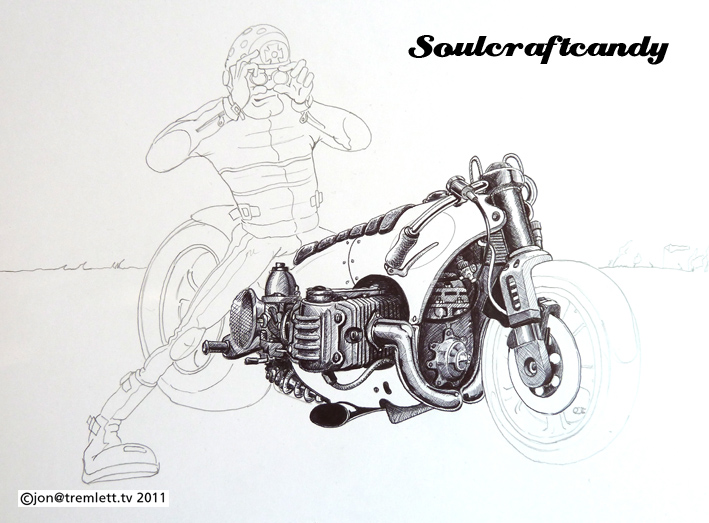
Ok, so here’s the final finished version of what’s called Megatwin 1. It took me some time to finish as working on getting all the shaded areas seemed to consume me. Knowing when to stop fiddling with an image can be such a difficult thing to learn, but with practise the end result becomes easier to see earlier, one would hope.


Working on this Bristol Board type of paper provides you with a very smooth surface which is ideal for pen work but its smoothness also seems to encourage the ink to flow with only the merest touch of the pen to the surface. Training your hand to almost hover over the drawing whilst shading, maintaining the lightest of touches consistently is quite difficult, not to say quite tiring at times. Thus getting consistency in some of the shaded areas with my usual weapon of choice, a Bic medium point, can be hard. As a way to get around this, and to create a wider variation of tone I have started to use a fine point pen, Bic again the one with the yellow barrel, in conjunction with the medium point pen. Not only does this give me the variations I’m looking for but also means it’s easier to achieve differences in the density and thickness of the cross-hatching. Ultimately you get greater control everywhere and it really helps in bringing out the forms in certain details like the belly pan underneath the engine.


No going back.

The inescapable fact of the matter when you’re making drawings like these is that ink can be a mightily unforgivable medium. Once you’ve made that mark on the paper there is invariably no going back. You can’t erase it. I remember there being such a thing as an erasable biro pen many years ago but, I also remember that it wasn’t really so and always left some kind of witness behind it and the eraser used scuffed up the surface of the paper. Not that great really when you’re after a perfect image. But I digress. There are advantages however to putting oneself in the situation where you can’t really afford to make any mistakes. I’ve always found that it tends to focus ones concentration on the drawing and where the marks and lines go. Over time this also builds a confidence in oneself which allows you to be much more relaxed during the creative process. There is a joy to be had in “knowing” what you’re doing and why you’re doing it. It makes it all feel very natural and in some way takes you closer to that point of flow that I’ve mentioned before.

There are many agonising moments during the making of a drawing, but the most can often be the point where you’re just about to make the very first marks on the page. I know I’m not alone in suffering that dreadful emptiness when faced with a blank sheet of paper. As a kid sat in art class the blank page presented you with so much possibility that you almost froze in the face of its intimidating emptiness. As you mature creatively this diminishes for sure but it can pop up occasionally to test you. Thankfully with a pencilled outline already on the page I don’t suffer this fate at present but I do take one last long stare at the bare image before that first biro contact. One is still faced with many choices one has to make even at this point but to combat any unsureity I employ a couple of simple strategies to get me by.

The sketches in this post demonstrate my simplest approach. I start in the middle of the drawing and work outwards. There is a practical reason behind this as much as anything. By starting in the centre I can move around the piece I’m working on very easily without running the risk of picking up “wet” ink on my hand and then promptly smearing it all around the page. I always use a loose sheet of paper to lean on to avoid this but it is so easy to forget to move it as you go and make a mess. As the drawing progresses I then divide it up into areas and attack those one at a time. So for example I’ll do the engine, then the surrounding bodywork etc. Wheels are always done as a pair and I leave the rendering of the figure until after I’ve competed the bike. the final step is any shadow and ground detail and then finally the horizon or background, if there is one.

These two drawings have taken shape in parallel. Again it’s another strategy I use to help me along, working on more than one thing at a time. Despite the obvious advantage of giving you two finished drawings at the same time what this really does is help we out when I get stuck. It keeps the flow going when I run into a set of details I’m perhaps not sure about, and rather than sit idly there letting my mind and focus wander I can reach for the other drawing and keep going while my subconscious mulls over how I’m going to deal with the problem. A happy consequence can also be that something done on one drawing provides a solution for the other. A kind of win win thing.

These two will be finished very soon.

Fresh eyes are often not your own.

This drawing is one that’s been hovering around unfinished for a while, but is now done. I hope you like it. I’ve always been intrigued by funny front ends. I’m in no position to ever build a bike with such a concoction of engineering complexity, but I get some satisfaction from drawing these things. There are lots of sketches in the pile but this one made the cut last time around. The lines in the background come as a result of the following tale.


A good friend mine met me for a casual late sunday pint over the weekend and made a couple of interesting observations about the last drawing post. He was very complimentary about the image itself but what he said after that was the bit that mattered. He began by making comments about some of the much earlier drawings that had been on the blog earlier in the year. He liked them too but felt that they were somewhat isolated and hovering in a space not tied to anything. We agreed that it was the lack of background which created this feeling. What was really interesting was what we discussed next. Asked if I would ever start doing drawings of real bikes like BSA’s and Triumphs I said that I wouldn’t. The reason I gave was that it didn’t interest me, creating images of what already existed. There were already plenty of those in the world I suggested, and besides I didn’t feel like getting bogged down in worrying if I’d got all those niggley little details correct, stuff like that. He did not disagree with this approach but said that by including even a very simple horizon line in the newer drawings, what it achieved was to bring the drawing into the real world. This creation of a reference to reality somehow made the drawing more believable, placing it in a context that could be related to and giving a dimension, a depth if you like, that had previously been missing. I liked his thinking and was impressed with his perception.


You may remember that some time ago I spent quite some time talking about what to do in terms of backgrounds for some of the images. I’d messed about with a whole stack of print outs but never settled on a final approach or approaches. This conversation with my friend, although short, provided all the validation that I had not been able to find within myself for the direction that these things should take. Fantastic.


This is not only a great relief, but also a great way to follow on from my previous post about learning to judge your own work and be critical about it. I realised that I had completely failed to fully analyse this aspect of the images and come up with a strategy for what to do about it moving forward. I must at this point also thank Cecilia, one of my subscribers, for alerting me to the fact that one very good and simple way of engaging with the process of being critical about ones output is to go and do something completely different for a while. To engage in something totally unrelated to what you’ve been focussing on. This clears the mind and freshens the eyes in a way few other things can. Fresh eyes bring a new perspective. In the above case my friend Richards eyes were the fresh perspective. Thanks mate.


Adopting this idea on the latest drawings is really working, what will be interesting is where it goes next.

This is how far I’ve got with the work up of the sketch I showed last time out. It’s going into ink now so watch this space.