Keep your sketches.

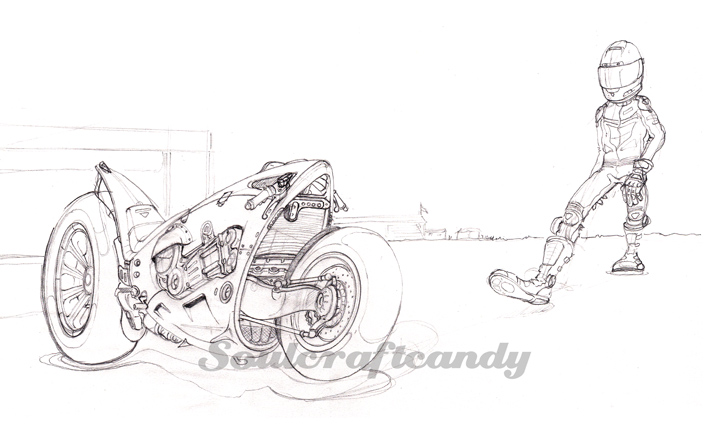
There is an unseen conversation going on in this picture. It is a chat between man and machine.

When the original sketches for this picture were posted, my good friend Richard spotted them and sent me a mail. Although my own feelings what might be being said here leant towards the idea that either party could be asking of the other, “let’s see what you’ve got, what you’re made of?”, he likened it to ones acquaintance with a long term friend, and the continuation of a conversation. There is no questioning in his version, just a simple statement, “hello old friend, let’s go out and play”.

For me it works both ways and what lies at the core of either is the belief that one forms relationships with objects that you interact with, both on an emotional and physical level. This is true about many objects that we choose to spend time with.

Ask any motorcyclist about the bikes they own or have owned and they will fall into one of the following two categories (probably). Firstly there are those that do nothing more than give us access to their basic usefulness, provide transport for us, carry us from A to B. They are handy, but never indispensable. Appreciated but never loved. Used but never improved. The second group are different. They connect with us on an emotional level beyond the practical, we consider their good and bad points in equal measure and make improvements where we can. We clean them out of pride as much as necessity, and we like to show them off. In short we invest time in making them ours. They are often referred to as “keepers”.

To some extent it’s the same with the many sketches I produce. Again there are those whose only function seems to be to act as the expression of an idea and nothing more. Their purpose totally fulfilled purely through existence, visual jots to remind you that you had an idea. It would be easy to think that the group that sits alongside these would be those that hit the spot first time, but this would be untrue. They do occasionally appear but it’s rare. Like the bikes that turn into “keepers”, members of this other group connect with us in a different way. We see in them the potential of an idea that is yet to be fully formed. With a bit of time and effort thrown at it you know what’s lurking in there can be brought to the surface. It might mean totally redrawing it, many times over in some cases, or it may require nothing more than the addition or relocation of a few lines. The more you can see the potential emerge the more you’re inspired to tease more of it out. Before you realise it you’ve got another “keeper”, ready to work up to a finished image.

Have you ever wondered why so many of us scribblers keep so many piles of apparently jumbled and crumpled sketch sheets? Although I spend a great deal of time and energy sketching out fresh ideas, a good deal of time is also spent revisiting many older ones too. Spreading them out across the floor and having  another look for that spark always throws up something new that perhaps you didn’t see before. Finding these “sleepers” and working to turn them into “keepers” is one of the great pleasures in making these drawings. It provides a big chunk of the creative reward and always reminds me that it’s not always about the end goal, but the journey one took to reach it.

Slow progress is still progress.

It’s been a while since the last post and it is great to say that the time was spent doing something incredible. More about that at the bottom of this post my friends.

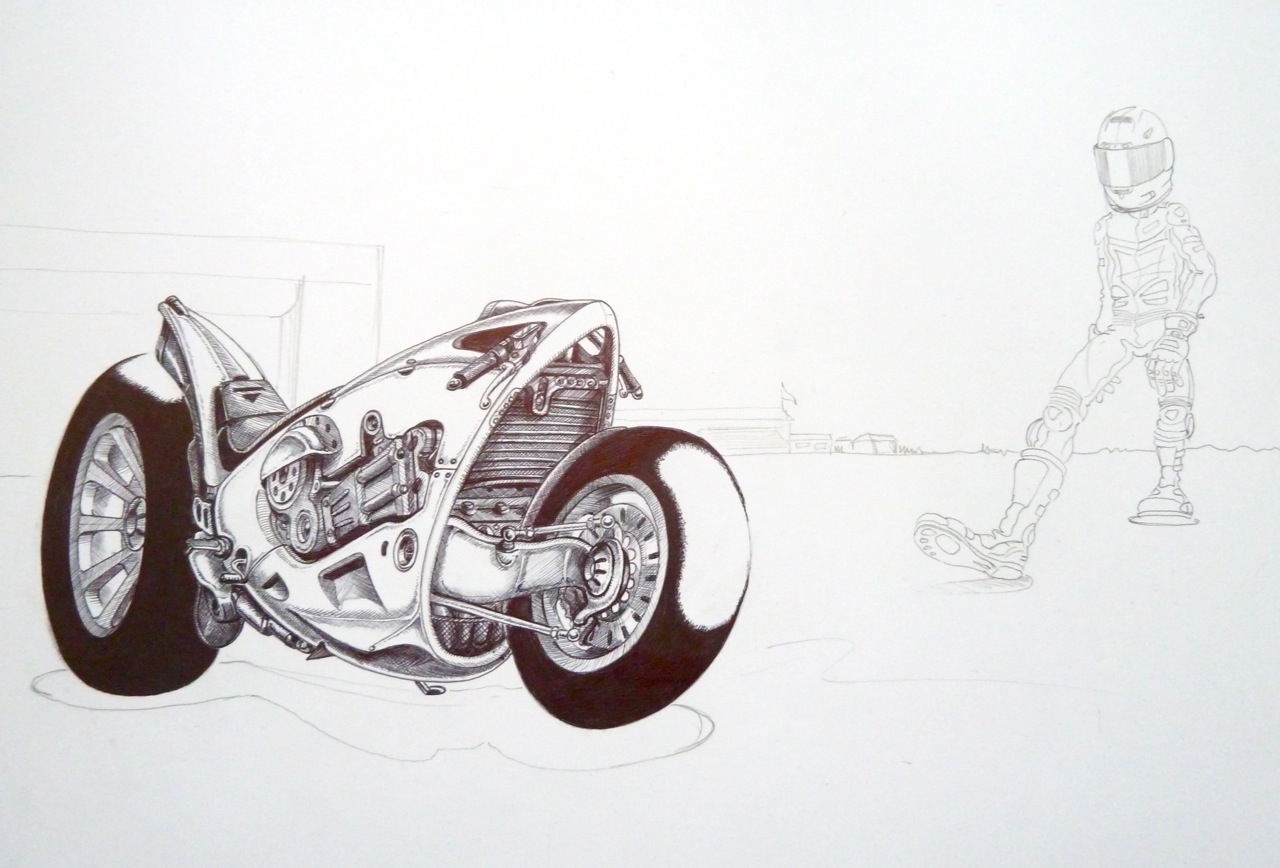
Although finding the time to sit and draw of an evening can be a challenge when working, the days are long, it’s really only the pace of things that changes. This drawing above has taken some time as a consequence, at least it feels very much like that. When you’re in the groove, getting these things finished has a most satisfying pace to it. If things are a bit rusty or periods between drawing are lengthy and sporadic it’s very much a different story. An apparently inordinate amount of time seems to be spent staring at the page wondering what to do next. And then, when you’re ready to put pen to paper a wave of unfounded nerves descends as if to ask, “are you sure you want to do it like that?”. Known in my lexicon as “scribblers block”, it is a battle royal sometimes to get out of it and break the cycle. One has to accept it and work through it, though it can be a kind of agony at times.

As mentioned elsewhere on the blog, there are lots of little strategies to get over it. Switching between a number of drawings is one, getting a sketch pad out and going nuts for five minutes or so is another. Getting out of the chair and going for a short walk helps too. Whatever you do it becomes easier as time progresses and can even be used to limber up or refresh the mind even when things are going great.

This drawing continues with one of my current themes which is playing with chassis forms which are enclosed or wrapped. Granted it doesn’t allow as much detail to come through from the engine but, this is not an issue frankly. It gives the bikes a cohesive form factor which pleases me greatly. By keeping bodywork shading to a minimum the aim was to get the eye to focus on the stark contrasts that run from right to left. I hope you like it.

You will recognise this other image from the previous post. it’s coming along nicely and work will be continuing apace to finish it soon. It’s a strange thing but this drawing says something different every time one looks at it, particularly as it’s not finished yet. Maybe it will find its voice when done, but then again…….

Now, as promised a quick bit about what work was keeping the author from his doodles. After all this is meant to be a blog as much about making as drawing. Certainly what we’ve been working on fits into the amazing category in my book as it’s been as much a learning experience as just another job. Anyway, my friend Mandy Smith, a modelmaker of considerable skill, and I have been busy making plastic chocolate for an advertising campaign. This strange endeavour has introduced me to the world of resin casting, making silicon moulds and making double castings. At first encounter this process appears quite complex but after initial ignorance is overcome one begins to see that like many things in this field it’s as much about being methodical as much as grasping huge levels of technical knowhow. It was fun and when the time is right there will be something about it featured here on the blog, but currently confidentiality prevents me from showing more. If this tickles your interest and you’d like to learn more about what we do you can visit Mandy’s site here:

 http://cargocollective.com/mandymaker#1656991/About. 

There are some more works in progress to show and tomorrow I want to play with some paint so who knows what the next post will contain.

More work in progress.

Having wrapped up the two “megatwin” drawings thoughts turn immediately to what’s going to follow on behind them. As methodical as one might wish to be it’s not always a simple case of reaching over to shelf and picking up the next sheet in the pile and cleaning off the business end of the biro.

Not being in a position to work on the drawings every day means that the work flow can be a bit erratic at times. As much as one would like to have a selection of different pictures in various states of readiness to work on it don’t always happen like that. Gaps appear in the chain, as it were, when only doodles and quick sketches lie on top of the pile. At these times I reach for said sketch pile and skim through them looking for any likely candidates for refinement. My noodling sessions, coffee powered periods of ploughing through the image archive, bike mags and various web sites with a pen in one hand and a pad to hand always throw up a rich crop of little ideas. Now it’s simply a case of working a few of them up to a point where a more finished idea emerges.

The sketches here show that kind of process in loose form, from initial doodle to something I’ll transpose onto Bristol Board for inking in. It may very well end up as two versions, one with the question mark thought bubbles and one without. easy enough to do but there’s a good chance one may end up getting some paint thrown at it. The form of the bike may lend itself very well to that. Also, the detail on the horizon line in the initial sketch has been left off the latest version but may very well re-appear later on.