Celebrate unexpected outcomes.

The finished thing, blobs and all.

The finished thing, blobs and all.

Those of you who’ve followed the blog for some time will know that I have a thing for a ball point pen. I have my favourites obviously, just like painters tend to have a favourite brush or colour, but generally speaking it doesn’t really matter what brand it is or how cheap. In fact some of the best for drawing are amongst the cheapest you can buy. Although I tend to use black mainly, there’s nothing wrong with other colours, they bring a certain something to an image. But I digress.

This drawing you see here must be one of the messiest I have done for quite some time. I have no problem with this, in fact it was a joy to make, really, and it was made using a ball point pen. Well, I’ll call it a pen for now, but in fact it’s more of a marker and actually I used two different types to make the picture. You may remember some time ago I posted that I’d had a sketch of one of the original Cafe Racer drawings printed out at life size. The resultant print, taken from a scan of a loose biro sketch, revealed all of the feathering and broken line work that were not really visible on the original. It looked great, one could really see where the pen had travelled and what marks it had left behind. On the back of this experiment I wanted to investigate whether I could create a giant ball point pen to try and replicate this character and do some massive drawings at life size. Scaling things up I needed to find a pen with a ball of roughly 3.0mm in diameter. My searches unfortunately proved that no such thing existed but something very similar did. What I found were ball point paint markers which are used in the construction and engineering fields for marking parts and assemblies. Finding a convenient supplier in Royston, Hertfordshire I duly bought a couple to try. In black.

Detail showing paint build up.

Detail showing paint build up.

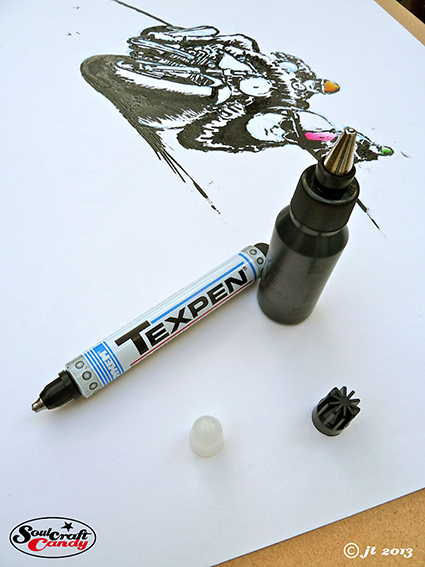
Both of the markers are shown in the bottom picture. The first, a thing called a Texpen made by Dykem, is a fairly conventional looking marker and quite easy to hold and manipulate. The other is a more heavy duty one from a company called Suremark. As you can see it’s essentially a bottle of paint with a ball point cap screwed onto the top. Lasts longer but not so easy to handle, and is refillable.

Before venturing into huge scale and wrecking large pieces of paper I thought I’d try something smaller to start with, to see if my suspicions were correct or not. The picture you see here is on a piece of A2 cartridge paper. I roughed out a sketch in blue biro first and then hit it with the paint markers. After half an hour of struggling I had to get up and have a cup of tea whilst I coped with my disappointment. After sweet tea and swearing I sat down and tried again, and this time really enjoyed myself.

These things are not like ball point pens at all, no sir. Firstly the paint is thick, gooey and doesn’t really flow. Secondly, the balls in the nibs are spring loaded so you have to press down to release the paint, so describing a line in a sweep is virtually impossible. Once I’d got my head around mark making though, I found I could squidge and blob my way to creating an image without too much trouble, the key bit was realising that detail and line consistency were never going to come to this party. It was a great lesson in learning how to approach getting the best out of an unfamiliar tool. The paint takes a short while to dry so avoiding putting your drawing hand in it is quite difficult, hence various blobs scattered about. The bottle option proved best for filling in solid areas while the pen option was easier to “draw” with. You can see from the detail shot, I hope, that paint tends to build up quite a bit on the blackest areas.
Paint_sketch3©JonTremlett2013

I stopped at a point beyond which I thought I might spoil it, and let it dry. When I returned I wanted to give it something extra so grabbed some cheap coloured biros I have here and put some colour on the riders helmets to lift the whole thing a little.


I hope you like it. This isn’t the end of my experiments with these markers, there are different papers to try in the search for different results and different types of drawings to try too. All very exciting, I’ll let you know how I get on.

 

Can I draw like a designer?

CB750 sketch by Jon Tremlett for Soulcraftcandy

When I got up this morning I knew I needed to write a blog post today. It’s been a while since the last one and my guilt is starting to gnaw at my conscience. My only problem was that I didn’t know what I was going to write about, and then the phone rang.


It was a good friend calling to ask for some advice on behalf of a colleague of his. In a nut shell the colleague was asking how she, an engineer, could learn to draw like a product designer and did I know of any courses that might teach such a thing? During the conversation my brain split into two parts, the first attempting to answer the question, the second thinking “ what a good subject for a post”. Here’s what the two parts came up with, given that the question can be answered in two ways, the simple answer and the slightly more complicated one.


Firstly I don’t know of any courses that will teach you how to draw like this in isolation. A design course might, but it’s not guaranteed and, let’s face it, if you only want to draw like a designer then a full blown design course is a very long winded way of going about it. However, if you have a modicum of drawing ability, then there are various books available which do a very good job of illustrating (sic) the various techniques that designers use to communicate their ideas in drawing form. Here’s a link to one I find very useful. The double sided key to this approach is knowing what it is you’re looking at on the page, and then putting in the hours and hours of practice that will embed the techniques into your canon of visualising skills. Although this is the simple answer to the question it is far more than a mental and creative cut and paste job. Only practice makes prefect, don’t forget, and you’ve got to have some drawing ability to start with.


The more complicated answer involves taking a closer look behind the question itself. The question, “ how do I draw like a product designer?”, provokes the immediate response, “well, how do you think product designers draw?”. Is the answer very quickly, or with a pen, or with one eye shut, or with magic ink? The answer is both none and all of the above, and this is where it gets complex. Essentially all designers who draw use it as a way of communicating their thinking, their ideas. Yes, we can all use words to back up what we are on about, but most of us draw our ideas because they are required to explain themselves when we are not there to represent them. Drawings are used to communicate everything from general concepts and aesthetics, to mechanical solutions and fine details. They are a core mechanism of the discipline which transcends language and helps others to understand the idea. Without some visual representation design is a pretty worthless exercise. Conversations between designers are often both visual and verbal.


The complexity arises when we realise that designers, even those working in a similar field, all draw differently, and the reason is because we have all spent a long time finding the techniques which we personally are most comfortable with, the ones we like the most, and are happiest exploiting. So, we are all the same but different. The other complicated bit is that drawing is a direct output from a thought process, which involves several elements like imagination, mechanical considerations, technical parameters and materials knowledge etc etc. So you can see that when designers draw, they are actually doing a lot more than purely making an image. Does this therefore mean that in order to be able to draw like a designer, you essentially have to be one? If you’re happy adopting a style or technique then perhaps not, but remember that whilst most designers can draw, not everyone who draws is a designer. I hope this makes sense as it’s taken me a while to boil it down to this brief explanation.


Here’s a lovely quote I read the other day about drawing, and is another great reason why all designers should consider the benefits of developing drawing skills.


“I prefer drawing to talking. Drawing is faster, and leaves no room for lies”. Le Corbusier.

Before I go, the sketch above is one of the projects on the go at the moment. A lovely chap called Larry sent me some info about his bike some time ago, we were discussing a possible commission. Sadly that didn’t happen, but I haven’t forgotten about it, and have finally got around to starting a drawing based on the bike, a Honda CB750. So Larry, if you’re reading this, I’ll be in touch soon.


Never say never again.

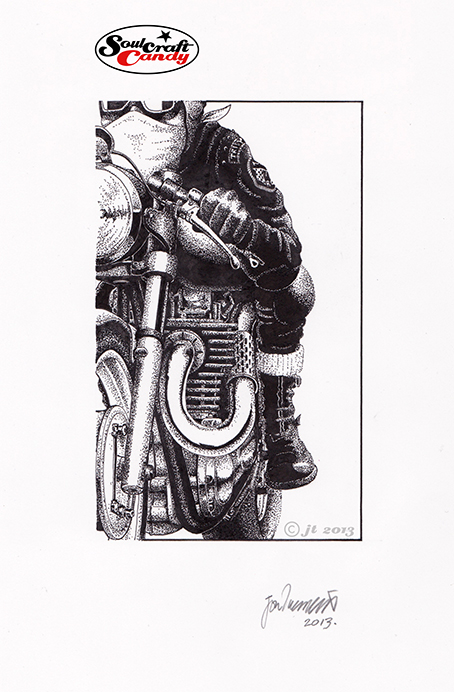
Pen and ink drawing by Jon Tremlett for soulcraftcandy.

The weekend proved reasonably productive in the end with a fair bit achieved on both of the pictures featured in the last post. Not bad going, considering that most of Saturday was actually spent grappling with the pruning of a monster shrub that lives in my back garden. This thing puts on about four feet of fresh growth annually and as a result needs a good trim at least once a year. I swear it’s a Trifid, its appetite for resources must be huge and it dwarfs everything around it. The killer app is a telescopic long range pruning cutter, but I digress.


The big picture now has a rider figure with jeans and a jacket but not much more. More importantly the small “dot” picture is now finished, as you can see above. There was a bit of tidying up to do yesterday but that is now it, the end, it’s done. I’m pretty happy and so is my drawing hand which was starting to shake involuntarily by the end of a marathon dotting session on Sunday. All things considered it’s not too shabby and although I was unsure to start with, using the framing line on the right hand side only, really helps to balance the image. All it needs now is a proper title, it has a working one which is not quite right. 


What’s next? Time for some gentle watercolour stuff I think, I have an image already traced out in pencil, and some low impact biro work to get a couple of pending projects up and running. They say “never say never again”, but no more dotting, oh no, not for a while.