
In the last post I showed how I create the base drawing for one of the small colour images I’ve been making recently. Now it’s time to take a look at how the colour and ink go down onto the paper. There is no right or wrong way of doing this, we are all individuals after all and our working methods all differ accordingly, but this is how I do it. There are about seven steps involved, and they pretty much alternate between applying colour washes and inking in. I have a preference for building the image from the centre outward so this is where I start, engine, chassis and other cycle parts.
Greys go down first, in this case Payne’s Grey, slowly building up in layers to give shadow where I want it, form where I need it and a backing for black areas which may contain a high or low light. Using a very small brush with barely any paint on, things start to take shape. There is a strangely imprecise precision to the process. Next come the smaller areas of browns, ochres and blues which begin to define the ground and sky reflections on the various metal parts. I leave the exhaust for now as I find this easier to do later, working within the confines of the outline after it has been inked in.

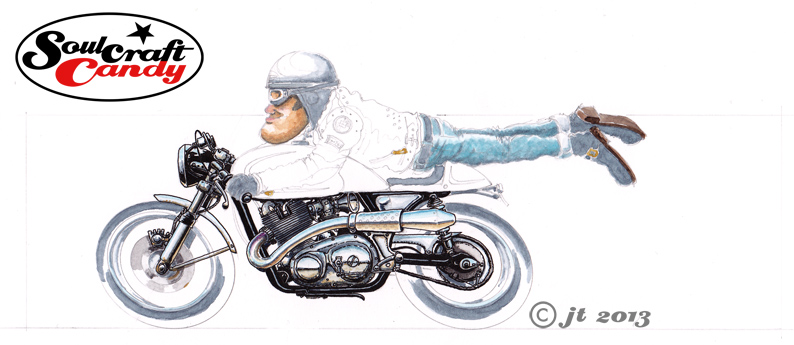
With the core of the image coloured, it’s time for the first pass with the technical pen, and being an old fashioned kind of bloke I’m still very fond of a good Rotring pen, in this case a 0.25mm nib width. The tightening of the detail that this achieves also has the benefit of allowing you to see where you may need to apply a bit more colour, or even a different colour, to an area which needs a bit more punch. You’ll notice I’ve also applied wash to the front and rear brake areas in this step to put myself in the position where the core of the bike is very much done. The frame rails, which were washed all in grey are now mostly black apart from a highlight line and I’ve applied solid black in selected areas to bring other details to the fore and create some depth.

This second wash stage involves getting the rider figure underway and laying the base colour pieces to the wheels as well as getting that tricky curving exhaust sorted out. As with the frame I put grey on the wheels and tyres in the places where I know I’ll leave gaps in the black of the ink, and apply this same method to parts of the rider like boots, helmet parts and goggles. Now, a quick word about that exhaust. Back when all of us budding designers were drilled in the fine art of marker rendering, it was obvious after a while that the practice involved learning a few, what I would call, conventions. Little techniques for doing curved surfaces, metal parts, areas of high gloss, textures and chrome amongst others. Although I haven’t picked up a marker in years, some of them remain useful when dabbling in other media. Shiny exhaust pipes are a case in point. A grey line to denote a horizon below which a brown area denotes ground reflections, and finally a blue upper area to signify the sky. Simple and effective, with some extra colour tones around the cylinder head exit where the metal changes colour due to the heat.

Time for more ink using the same approach as before, tightening detail and bringing definition. The wheel outlines get some attention using an ellipse guide for neatness, to be honest my freehand ellipse drawing is not what it used to be, and picking out a couple of details on the jacket and such will remind me not to wash over these at the next stage. The bike’s going to be a golden yellow colour so that’s what is coming in the next installment.



 Soulcraftcandy