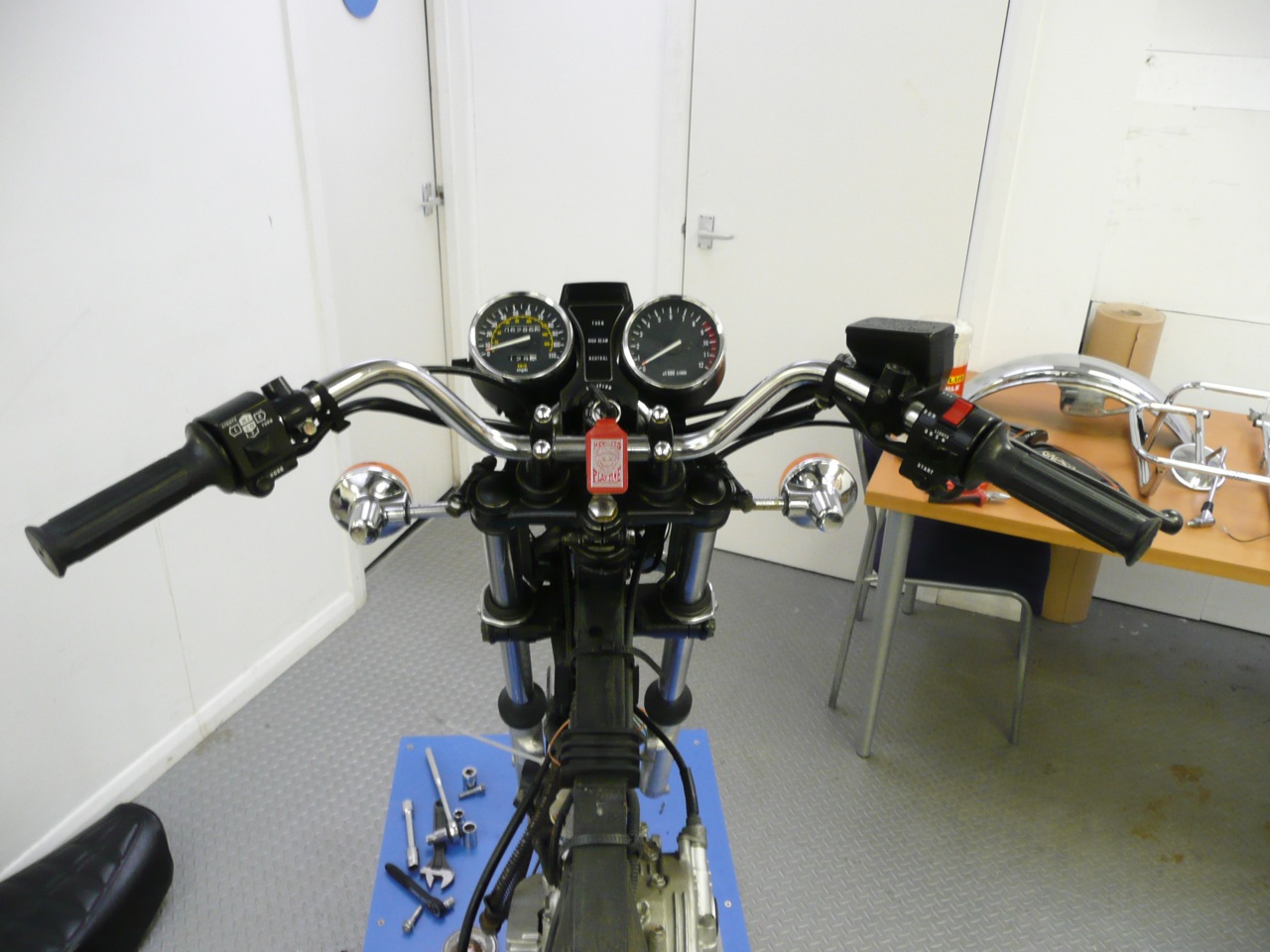
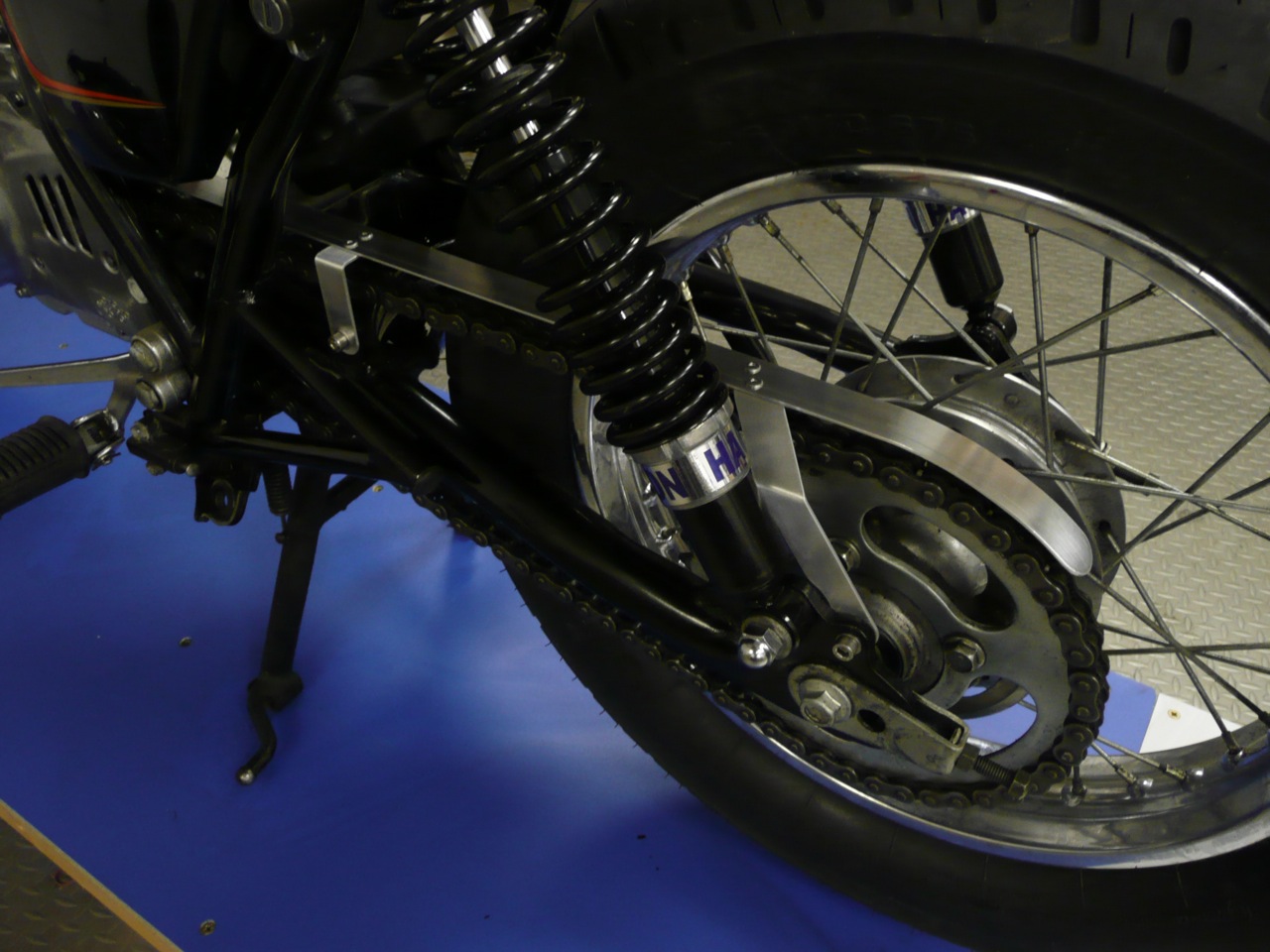
The chain run.

Does it make sense?

I knew that having made the clock mount and its accompanying surround I should really have got on with some kind of front screen, but I didn’t. I decided to make a chain guard instead. In a funny kind of way I found myself in the situation where I’d tried to plan everything out as much as possible, in a loosely efficient project management kind of way, and then found myself deliberately jumping from one part of the plan to another rather randomly. I’d call it something like organic execution. Having planned everything out systematically, I was free to approach the list of tasks depending on how I felt on the day. That day I was much more in the mood to make a chain guard than to start to get to grips with the next big thing which was the rear mudguard or fender.

At least with this next part I followed very closely one of my guiding principles of the build which was to lose weight. The standard part, as any GN owner will tell you, is a substantial piece of kit. Whilst I understand fully the need to prevent ingress of foreign objects into the chain run, I can’t for the life of me see why said part has to be the depth of a piece of industrial guttering and sturdy enough to shake off an attack of rocket propelled grenades. Whatever, it weighs a ton and made its way swiftly into the ever growing pile of discarded ironwork growing in the corner.

A bit blurry I'm afraid

It would have been much easier I know, to have followed the weight saving creed to its maximum and not fitted anything at all but I wanted something there to stop things like loose rucksack straps getting too close and prevent the back of the bike and ultimately me, getting a good spattering of flung off chain lube.

A quick trip to the DIY store and I’d got myself a very handy length of aluminium ‘L’ section, the angle to give it some rigidity, and a length of flat bar as well for making a couple of brackets. By trimming off part of the angle, to create a flat section, it was easy enough to bend the strip around a quick wooden former to get a radius that would sit nicely above the rear sprocket. I could then trim the length of the whole thing at the end that goes over the front sprocket. Duly done it was just a question of working out how high off the upper chain run I wanted it to sit. As the chain can flap whilst your traveling, too low and each journey would be a rattling affair. To tell the truth I did get it a bit low to start with and modified it very quickly soon after the first test ride. For the rear of the guard I made the bracket at an angle to match the rake of the rear shocks, to kind of blend in, and secured it to a conveniently located hole above the chain adjuster on that side. The front bracket was a simple piece with a single 90 degree bend in it, and I cut it to a length which would allow me to raise or lower the guard at that point should I need to, which I did as you’ve already read. I attached the brackets to the guard using some ‘Pop’ rivets, another godsend to the home builder, and it was complete and ready for a coat of trusty old black paint. Job done. Now I knew I couldn’t put off the rear fender any longer.
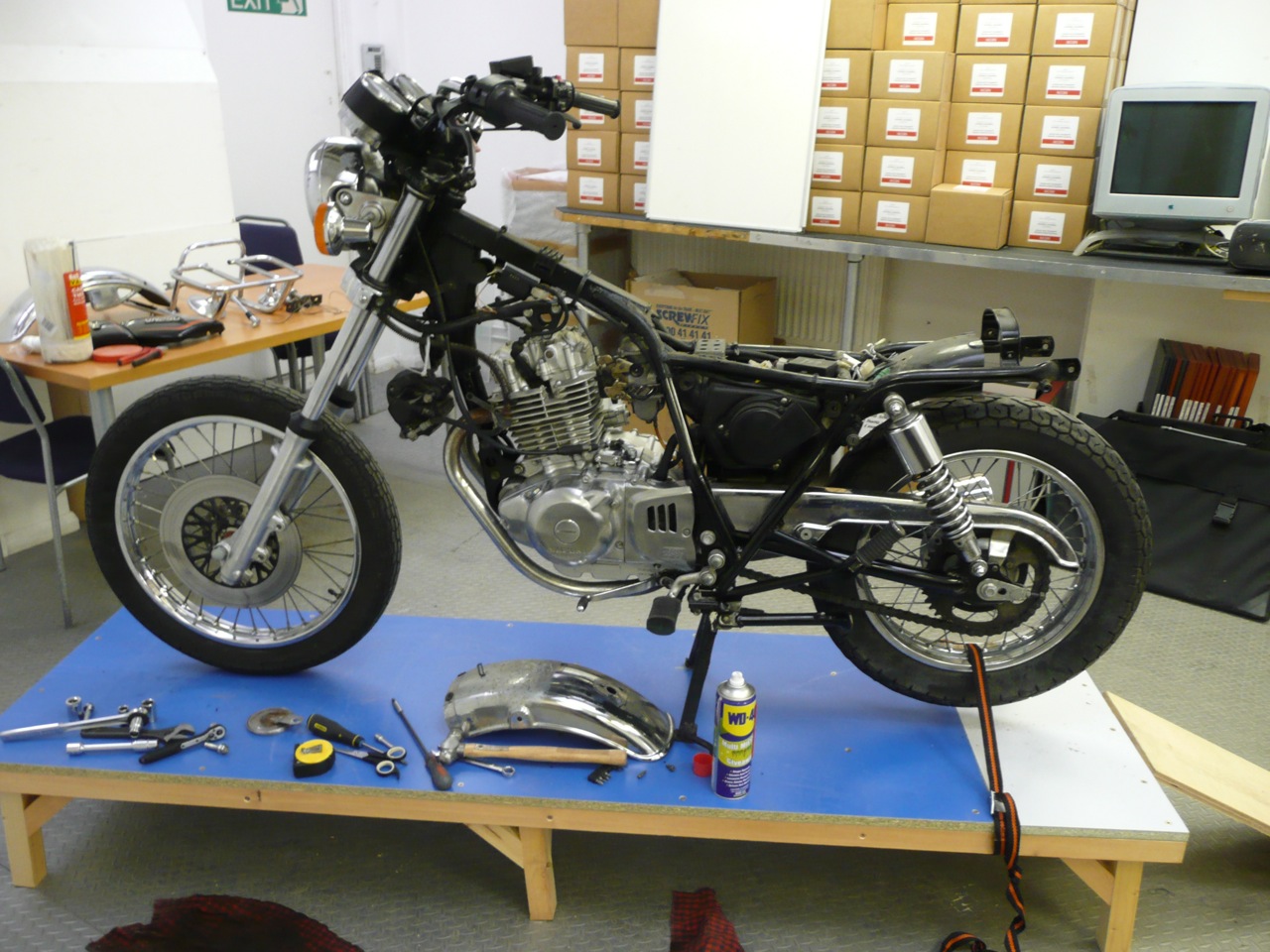
Let’s get naked.

There is nothing like the appearance of a large assembly of parts to give a project a real spur. I’m sure every project bike builder who’s spent months or even years waiting for the commencement of a new undertaking has felt oddly in limbo until that first day when bits of metal are actually there for you to pick up, touch, feel and smell. In a way it’s the same as with a design project where for so long things exist only on paper or in the rarified atmosphere of the computer screen as a photorealistic rendering. There is a palpable sense of things actually happening when that first model is made or the first prototype arrives for testing. So with the bike acquired and the workshop ready it was time to take those first tentative steps.

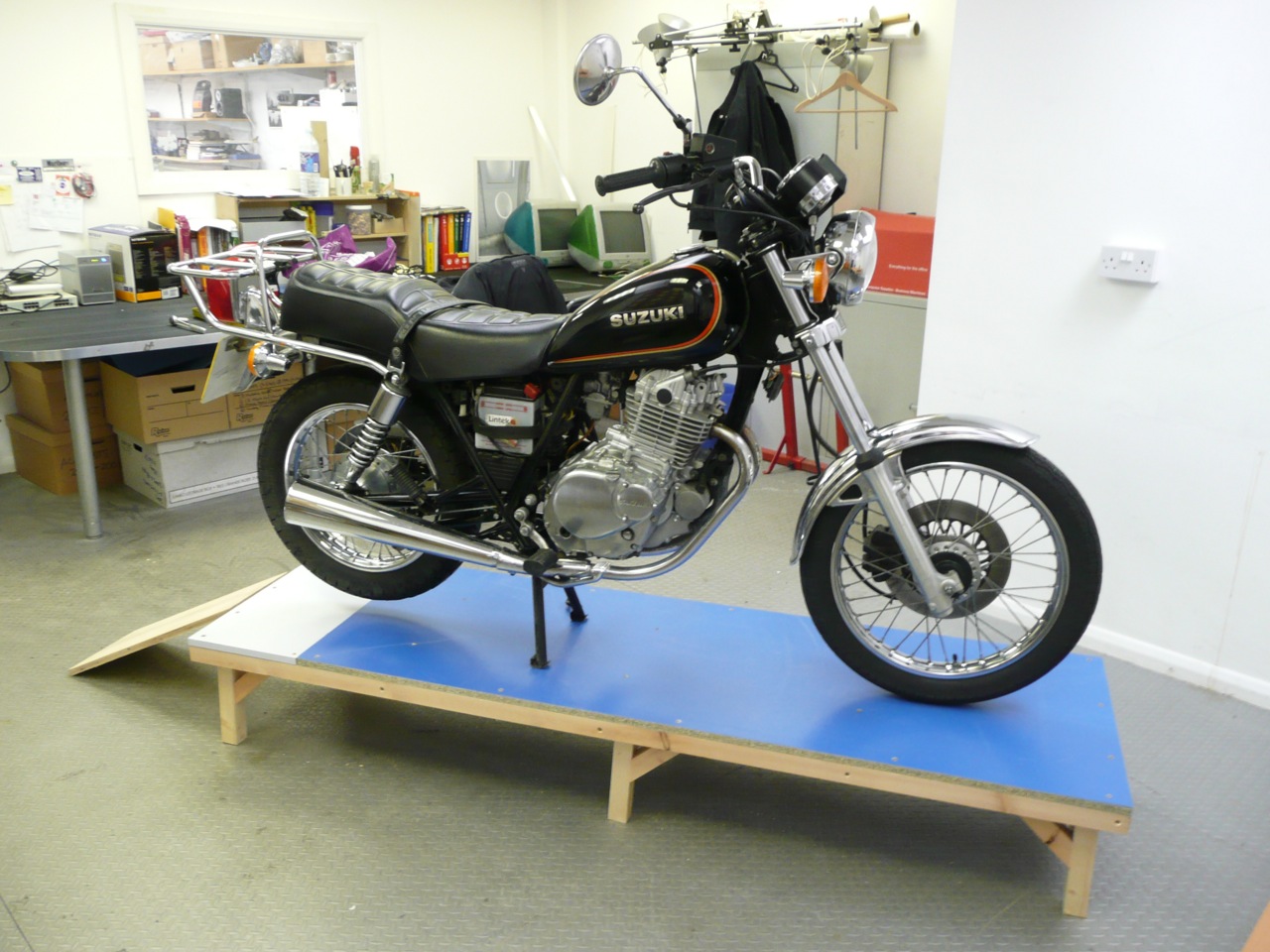
In the best traditions of passionate and lustful young relationships, there was an almost unbearable urge to get the old girls clothes off and see what lay beneath. To find what mysteries, if any, she concealed under those heavy swathes of chromed steel and whether her heart really was as true as she’d intimated on that first journey home. Like an expectant youth on that first night when his parents are finally out for the evening, I plumped the cushions on my metaphorical sofa by constructing a low workbench out of scrap wood and board. I made sure everything I needed was to hand by laying all my tools out nearby and, even in readiness for any severe grappling made sure I had the appropriate protection to hand in the form of a fresh box of vinyl rubber gloves.

The correctness of my choice of machine was apparent immediately in the ease with which I was able to remove parts. It wasn’t long before I’d started to build a substantial pile of bits of motorcycle on one side of the work space. It was also a sign of how well looked after the bike had been that all fasteners were easy to undo, no rusted up nuts and corroded bolts. If I’d been blessed with a set of air tools it would have taken even less time to take it apart. Within an hour I’d got it back to a state where I could see clearly what I needed to do. Over a cup of coffee I made a note to weigh all the parts that had been removed never to be put back on. It amazes me how much metal even these small bikes have to cart around, without the added mass of a human being on board. No wonder they are generally so slow. The seat alone weighed a ton and, so did the rear rack, and that was what someone had added. No matter it was off now.

Serious diet required.

As I stripped bits off I got busy with a pile of rags and some WD40 and cleaned everything of all the accumulated road dirt and general crud which manages to occupy every crevice of a bike no matter how fastidious you are at keeping them clean in use. Thus duly cleansed I could prod about to my hearts content without getting covered in muck. I revisited my pile of bits and separated those I knew I wanted to keep from those I knew would be sold or chucked. When it came to the time to disconnect all electrical components I took out my handy little bag of tie-on labels and attached one to each wire or connector block. I’ve never had much of a clue about bike electrics so labeling everything was the only way I was going to remember what connected to what when it was time to put it all back together.

Briefly going back to my point about weight. It’s only when you take a part off a bike do you realise the amount of material contained in it. And all that metal must have a detrimental effect on performance. The headlamp brackets weighed about three pounds and the front mudguard about a further ten. I knew I couldn’t do much about the engine at this time but, I resolved to keep the weight down as much as possible in a bid to minimise the mass that the little engine would have to push along.

In the days before I got to the workshop I’d made a list of all the parts that I knew I wanted to buy and had ordered those which were easy to source such as handlebars, rear shocks, headlight brackets and a bit pot of mixed stainless steel fasteners. I’d rather optimistically thought that I might be able to modify the seat unit by basically chopping it in half but now that it was off I could see it was a flawed concept and, would have been pig ugly to boot. I knew I didn’t have time to make one from scratch. Time for a bit of a re-think.


Don’t buy it, build it.

A couple of years ago I came to the end of a long term contract which had seen me running a modelmaking and prototype workshop for a small Industrial Design company in west London. I’d had, and in fact still do have, a very good relationship with the guys at the company and had often been able to work on small personal projects after hours over the course of the contract. Before I headed out into the world again to look for more work I had a desire to make something substantial for myself. After not much thought I decided I’d like to build a motorbike, or at least modify one to my personal spec. This is something that I’d actually been wanting to do for years but never had the time or opportunity to have a go.

Over the course of an evening, armed with three of my favourite creative tools, a pint of beer, a pencil and a pad of paper I sat down to plan my project. I had managed to persuade the guys to let me use the workshop for an extra month before going, so that set my timeframe. But what bike was I going to modify? I wrote many lists covering capacities, bike type and performance criteria in an effort to get a clear idea. I’ve always had a soft spot for 250cc bikes and after rejecting many other larger alternatives (I’ve already got a big bike anyway) I settled on the idea of creating a small runabout for town use based around a single cylinder 250.

I wrote a little brief for finding the donor bike in the form of a list. It had to be light and manoeuvrable, cheap to buy, run and fix but, most importantly it had to have potential. With only a month of workshop time available I knew I wouldn’t have time for complex frame work or to farm stuff out, I had to do whatever I could myself and quickly. I set myself a budget and dived into the web in search of a likely candidate. I finally settled on Suzuki’s GN250, an oft maligned little commuter custom like a Yamaha SR250, but better looking and with more appropriate geometry. Although they turned up on ebay fairly regularly the prices were high and condition questionable. I tracked a good one down in Gloucester – lady owner, low mileage, big rear rack. Perfect. I took the train down, and rode it home the same day.

I was as excited about going to get it as I’d been some years ago when I went to pick up my new Triumph. It was everything I wanted it to be. The dealer had serviced it for me and put in new oil etc. It started easily and coped admirably with everything I threw at it on the ride back to London. Assuming an “aero” tuck with my nose buried in the clocks we hit an indicated 80 mph, the brakes worked ok, and despite minimal suspension damping, floppy steering and a totally square rear tyre I stayed out of all the hedgerows. It was 120 miles of fun. And it did the whole lot on less than a tank of juice.

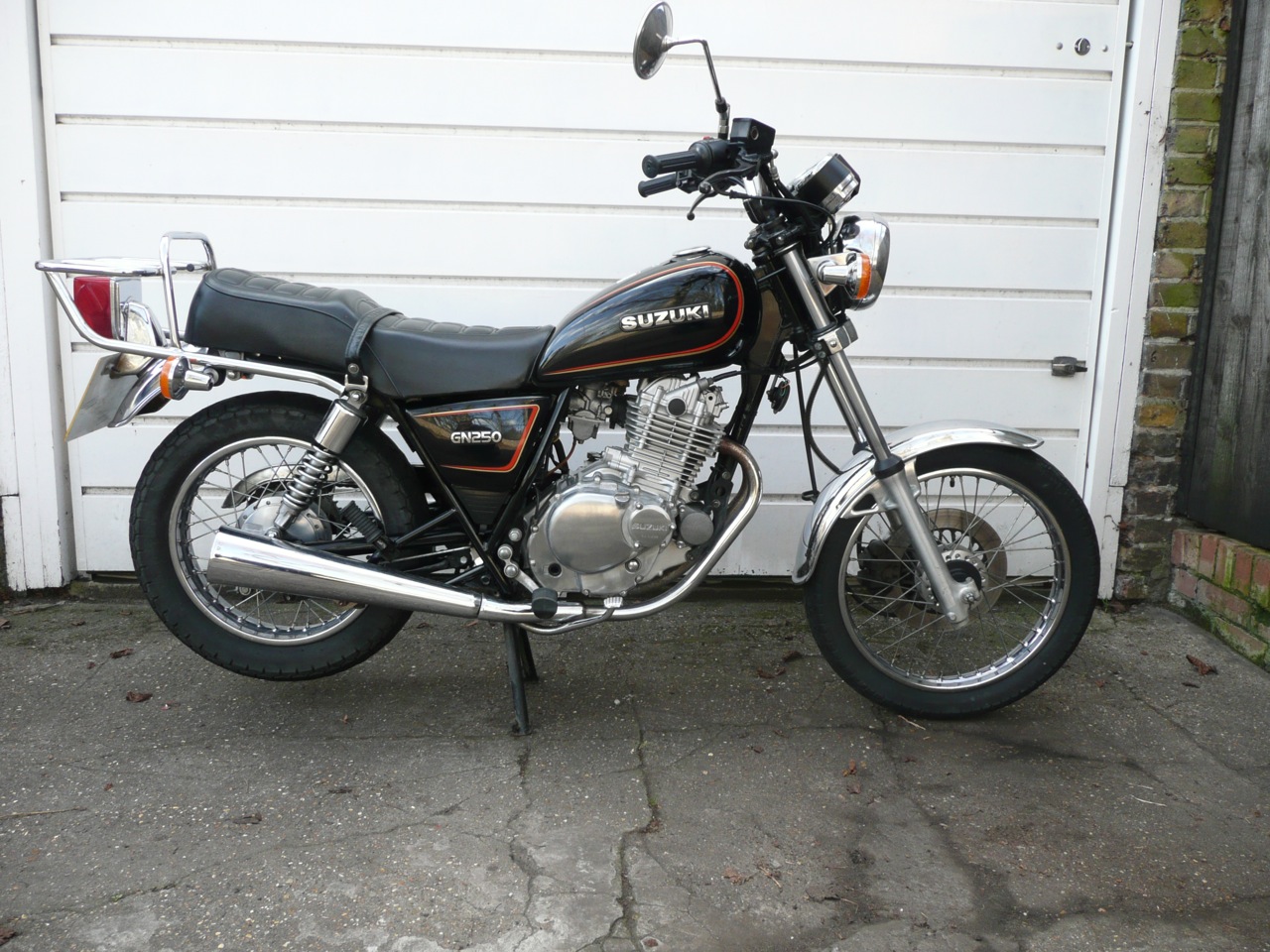
Once my mate Richard and my girlfriend had stopped laughing at my new purchase it got a good clean and I took some quick photos outside Rich’s garage so I could chop the thing about in Photoshop and sketch out my planned mods.

Ever since I’d decided that I wanted to create a little roadster for town I’d not stopped thinking about a retro styled scoot with a single seat and so this was my start point for mucking about very roughly in Photoshop. Without much work it turned out that I could get close to what I had in my minds eye quite quickly. One of the reasons I’d gone for the GN was that geometrically it already possessed the right kind of stance, not too high at the front end, with a short wheelbase. As a result I could leave the wheels where they were, and the frame too for that matter and just chop the rest around, creating mudguards, seats etc as I went. This was a Sunday, so I gave myself until the end of the day to reach my final idea.

Inspired by classic bikes of the 50’s and 60’s I’d very much latched onto the “Bobber” style, though I had no intention of giving the little 250 a hard tail, really not a practical solution for London riding. Other details would be changing though, like suspension, fenders, handlebars and exhaust but, for now these simple visuals gave me enough information to get on with the task of planning the build.

Next up, where to start and where to get the bits I was going to need.