Two for One.

Welcome to 2012, it’s the new year, and here’s hoping for all of us it will turn out better than the sooth sayers suggest. The new year always brings a short period for fresh resolution and reflection. Being a serial resolution maker and breaker it helps to keep things to a minimum these days, and whilst being happier, healthier and a little wealthier are all things to work towards, it is this small blog which is the main focus for attention this year.

Viewing the newly received stats report from the guys at WordPress will be interesting but, before that’s done I know already that I want to increase my blogging output this year, be more creative and get more stuff out there. Small and obvious goals but ones which are worth noting down. Employing a slightly sideways approach to this challenge the first task at hand is to clear the decks, as it were, and bring to light some things which have been sitting here waiting for a chance to strut their stuff and be viewed. By tidying up some loose ends, particularly in respect of showing a sketch and not the subsequently finished drawing, I’m hoping to clear a bit of a backlog, physically as well as mentally. The hope is that this will free up some much needed brain space for new ideas and projects.

The drawing at the top of the post featured as an initial scribbly biro layout and then a more tidy pencil sketch waiting to be given a good inking. It follows a theme which is proving to be quite enduring, lots of healthy detail centered around the middle of the drawing, some punchy contrast areas and a kind of fish eye lens effect in the perspective. It’s one of my personal favourites and neatly treads a line between feasibility, if you drag the idea towards reality, and a cartoon if you pull it the other way towards fantasy. Again it’s done in black Bic biro on A3 Bristol paper (250 gsm) which is rapidly becoming a kind of default medium for this type of drawing.

This second drawing, completed shortly after the previous one, again has the detail and contrast areas coming through. I don’t like to comment on my drawings too much other than to discuss more technical aspects of them, preferring to leave aesthetic judgements to others. What’s important to me in looking at these is seeing whether they show any improvements in style, technique and composition, that kind of thing. How far have things come from the early days of the blog when bike related drawings were starting to be a larger part of life.

Observations, of course, tend to vary depending on mood and other variables but, today three things in particular come across. First is the quality of my sometimes wayward cross hatching. It’s getting more even, probably due to being better able to balance control and patience. Certainly the latter, as making a zillion lines can get to you after a while, and remembering to wipe the end of the pen occasionally helps too, none of those horrible little inky blobs to contend with. The second is to do with shadows and ground lines. By worrying less about crispness, and more about texture, the “hairy” and “lumpy” approaches give texture to the ground the bike is riding over through implication rather than needing to render bits of earth. A happy accident really, it wasn’t part of the original plan. The final bit is about the riders and their clobber. Folding fabrics have always been a challenge and hard to figure out no matter how many times clothes were sketched etc. All I can summise is that less is more. Fewer wrinkles and bolder shading seems to be doing the trick. All that’s needed is to repeat how it goes from one drawing to another, the habit of referencing one drawing whilst making another has yet to take root fully, but it will in time.

Deep joy.

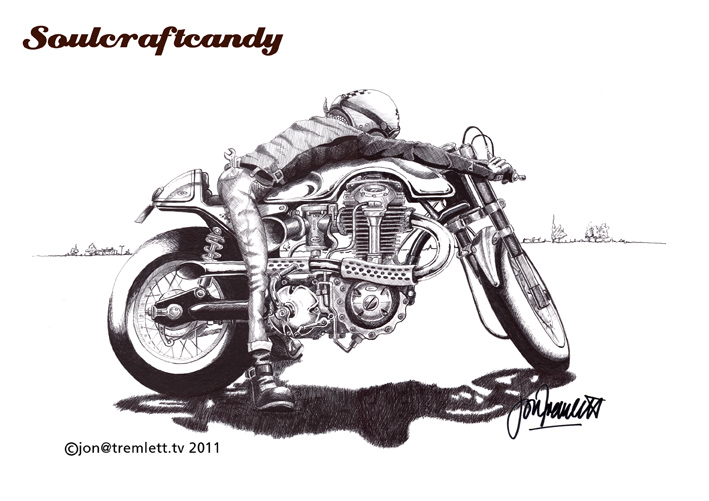
The big twinned sled is finally finished and I’m very happy with the final drawing. What I finally think of it will come in time, there’s that process of revisiting a picture and casting a fresh look over it to come over the next few days. For now though a couple of things spring to mind.

What pleases me most is the tonal balance across the image, I’ve managed to avoid what I dread in some cases and that is that an overriding sense of greyness comes across. By not over shading certain areas of the drawing such as the upper bodywork I’ve managed to preserve enough contrast to keep a sense of depth. I find it very easy to keep laying on the ink, chasing some contrast only to end up with a picture that has very little real contrast left, just swathes of varying tones of grey.

The other aspect that pleases me is the figure on the bike. He’s come out just right. I have to admit that it is a slow process learning how to make the wrinkles and folds in any clothing look convincing with plunging into too much detail. It’s getting there but there is still some way to go, and the end results that I’m looking for may very well come from applying less, not more detail.

Overall not a bad effort and I’ll write some more thoughts about it as subsequent viewings stir the grey matter. Things are definitely moving forward though.

Let’s be critical.

A couple of posts ago I showed a photograph of the above drawing about one third done. Well, here it is finished and I’m very happy with it. Every now and then you complete a drawing which just seems to eclipse some of the others, it has something about it which keeps your attention for a little bit longer and speaks to you in a louder voice (I know this sounds pretentious but bear with me). Even though it’s in black and white it has that “pop” that I talked about before. But these are not the only reasons I feel good about finishing it and looking at it.


For me it demonstrates a progression in my technique which is most gratifying. These things take many hours to complete in ink and the potential to lose ones way in the rendering looms large in the background. Here’s how I think it shows things moving forward.


Firstly, and most basically I’ve got the position on the page nailed. My shading technique is much better on this one and is much more confident. I say this because of two things. One is that working on the principal of less is more, I’ve managed to get a much better tonal range across the picture through creating better contrasts between the light and dark areas, which adds to the “pop”. Some of my drawings in the past have suffered from being a bit too grey. The other reason is that I’m starting to get to grips with how to deal with the shaded detail on the figure. By worrying less about all the little wrinkles and folds in clothing and leather, and so keeping these surfaces simpler somehow adds to the impression rather than detracting from it.


The inclusion of a simple horizon line in the background and a fairly simple approach to the shadow in the foreground give the main core of the image enough of a context to confidently occupy the centre of the page without taking away anything from it.


One of the hardest things to learn when engaging in self-initiated creative work is the ability to analyse ones own output, be critical of your own work and approach and, to subsequently work out what it is that you should do to improve and keep moving forward. The judging of creative output is a terribly subjective activity whether conducted by a single person or a group. The key is learning how to regard things objectively. Some people are naturally good at it, others need to learn. I started life very much in the latter group and as a result feel that I’m often still learning even after all this time.


My learning this critical skill started at art college and continued through all my years working professionally. It opened my eyes to the need to investigate options, to iterate, try different approaches and to realise that your first idea is never the right one or the final one. To many designers this sounds like teaching your granny to suck eggs but, it was amazing how much time I would spend with my students when I was teaching, explaining that without understanding ones own work in a critical fashion you had very little chance of explaining it to anyone else. It also meant that by the time one got to present ideas to a client, the ideas were of a higher quality and so stood more of a chance of being accepted. I’m sure there’s much more to say on this matter, but I’ll leave that to another time.

Before I go here’s another sneak peek. This is another big singled bike I’ve just started working on, a kind of sprinter. It’s sharing my time with some others on the drawing board so we’ll see which one gets to be finished first soon.