The right way to go.

Just when you think you’ve got a strong idea in your mind it has to be admitted by this scribbler that my minds ability to create an image is far more polished than my hand/eye combo. Full of a new found confidence and a belief that I’d finally started to crack a nut that had been bothering me for some time, I leaned back and presumed things would just flow out. No, it was a lot harder than that. Sketch after sketch after sketch. Locked into a kind of one man battle with a pad of layout paper I just went round and round in circles. Over a cup of desperately needed coffee I laid everything out on the floor and had a think about what I was doing. Doing this is such a great way of seeing where you are with a project and a practice ‘d completely neglected to incorporate into my working.

By turning over all of the skamps that I felt weren’t going anywhere I ended up with three or four which showed promise. I rarely throw any drawing away, no matter how crappy, you never know what you might see in them on another day with fresh eyes. So I had a pile of duds and a select few to work on further.
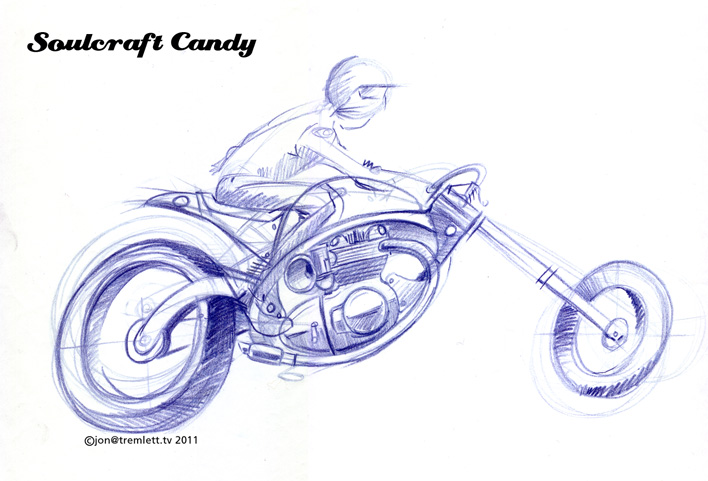
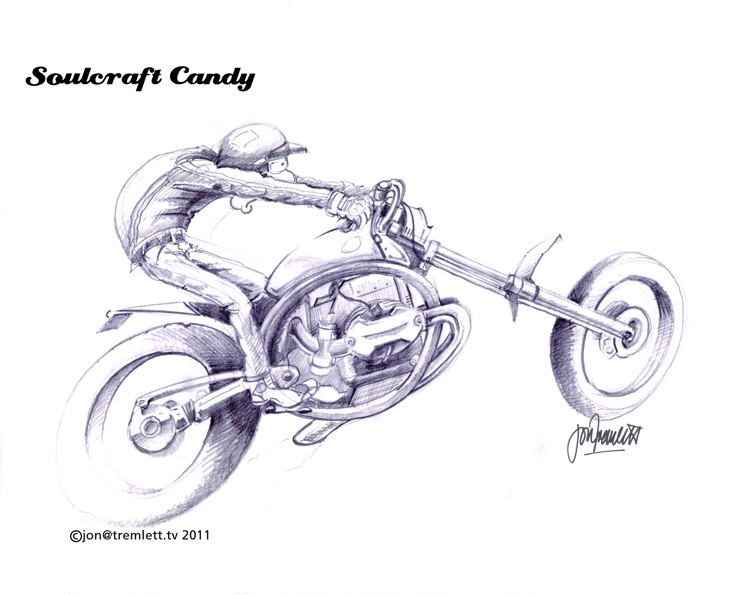
I stuck with pencils and layout paper. One has a beautiful progressive nature to it, in that it allows you to press as softly or hard as you wish and the line quality is a direct reflection of your actions and, the other is opaque enough for a good background but thin enough to allow you to place drawings underneath the top sheet and trace through. The two sketches in this post are preliminary drawings for others that I’ve now done in ink.

Because I’d been thinking about context and how to create it in the drawings I’d decided to always draw a rider on board unless he’s close by doing something to the bike and it’s stationary. I kind of thought that that, and the attitude of the bike in the picture would be enough to keep me going for now and that I’d worry about fuller backgrounds later on. I wanted to master drawing the bikes first. I also wanted to try and find a style of drawing that was comfortable and more importantly, repeatable, in the sense that layout and other elements would come more naturally rather than feeling forced in any way.

Too much too soon-Part 1.

Previously you’ve read me giving myself a little bit of a hard time about getting colour onto the drawings a bit too hastily. On reflection I was probably a little too critical of what I was doing but, I suppose it was my reaction to finding myself making images that were a long way from where I wanted them to be that early on.

Before I move on and take a look at where things went from here I thought I’d make a quick series of posts which Illustrate (excuse the pun) a bit more precisely what I’d got myself into.

Here is a layout for a drawing I’d had in mind for ages but had never taken the time to sketch out. As a result I drew it up directly onto a sheet of fine paper without my usual rough sketch to guide me. I chose to mark it out using blue pencil, in fact it’s blue leads in one of those fine propelling pencils, 0.9 mm lead thickness. The paper is what’s known as Bristol Board, which is an extra fine surfaced drawing paper. It’s lovely stuff but being very smooth it’s not that receptive to certain media, blue pencil being one of them. As a consequence you have to apply a little bit more pressure than you would like to get a line to stand out. This also means that the lines are more work to erase once you’ve been over the drawing with pen, biro or paint.  One needs to take care because whilst pressing a bit harder works well you also run the risk of “denting” the surface and then you end up with a drawing covered in little grooves which really cause problems when you apply colour pencil or a fine wash. At this stage I leave all construction lines and little errors in place as there’s no need to erase them yet.

The tinting of the white background on the image is due to me photographing the image with my camera rather than scanning it. This is another side effect of blue pencil, my scanner doesn’t pick up the image very well. I’m not sure why but this characteristic used to be something I took advantage of when working in the studio, and we did everything by hand, as you could layout a drawing in blue pencil, ink over it and then blow it up or down on the copier without the blue showing through on the copies. Maybe it has something to do with the reflectivity of that particular colour, I don’t know. It’s a slight shame as drawings in this form are often great visually and it would be great to leave them as is, but they are often tricky to reproduce. Note to self; experiment with blue pencil images and the scanner. If anyone out there knows a quick fix for this, please be kind enough to let me know.

Once I’m happy with a roughed out drawing I’ll often leave it for a day or so before working on it further. For some reason, and I’m sure it’s got something to do with woods and trees, revisiting an image after a break enables you to see very clearly anything which is not quite right. It really is like having a fresh set of eyes sometimes. Sometimes I’ll come back to a drawing after only a couple of hours, and it looks so crap I pretty much start again, but that’s not often.

The next step is doing the drawing proper in ink or biro.