Working it out first.

Could this work?

It’s often the case in more complex projects that the whole can be broken down into various parts. For example, if I’m asked to make a large working model of something I often find that it breaks down into a number of smaller tasks each of which has its own challenges to overcome and in a resultant way its own design brief. What does this assembly need to do, how will it function and how am I going to achieve these criteria. The same was very much the case with the build of the bike. Controls, rear section, front section, exhaust etc all had specific things about them I wanted to achieve, not just visually but also functionally. The construction of this rear fender area then, had its own set of requirements that I needed to satisfy. A little brief all of its own.

Going back to my original brief that I’d set myself, that the bike was for everyday use, I knew that durability and robustness were important things to consider. British roads can be pretty bumpy and London’s are no exception. The parking bays that we are all invariably required to use in and around town can often be a totally unsympathetic battleground, with people cramming their bikes and scooters into the smallest of spaces with scant regard for any damage caused to your adjacent bike by footrests, handlebars and anything else that protrudes. So with all this in mind I knew that whatever I built would need to be pretty sturdy and resistant to bending and scraping. This rather delicate piece of rolled aluminium fender section was going to have to be turned into something a bit more substantial.

Can you see where I'm going with this?

Another habit that I’ve got into on any job is to have a sketch book or pad handy at all times during the job. This helps me to organise workflows, keep track of component purchases and budgets and the like. But it’s also very handy for sketching out ideas and thoughts when trying to solve specific problems. Importantly it enables me to keep everything in one place, there’s nothing more frustrating than constantly having to find loose bits of paper in a pile, especially the one that often manages to fall behind or under a workbench. Similarly I also go and buy some of those plastic document envelopes from the stationers for collecting all sales receipts, brochures and technical sheets one invariably accumulates during a job.
Getting somewhere now.

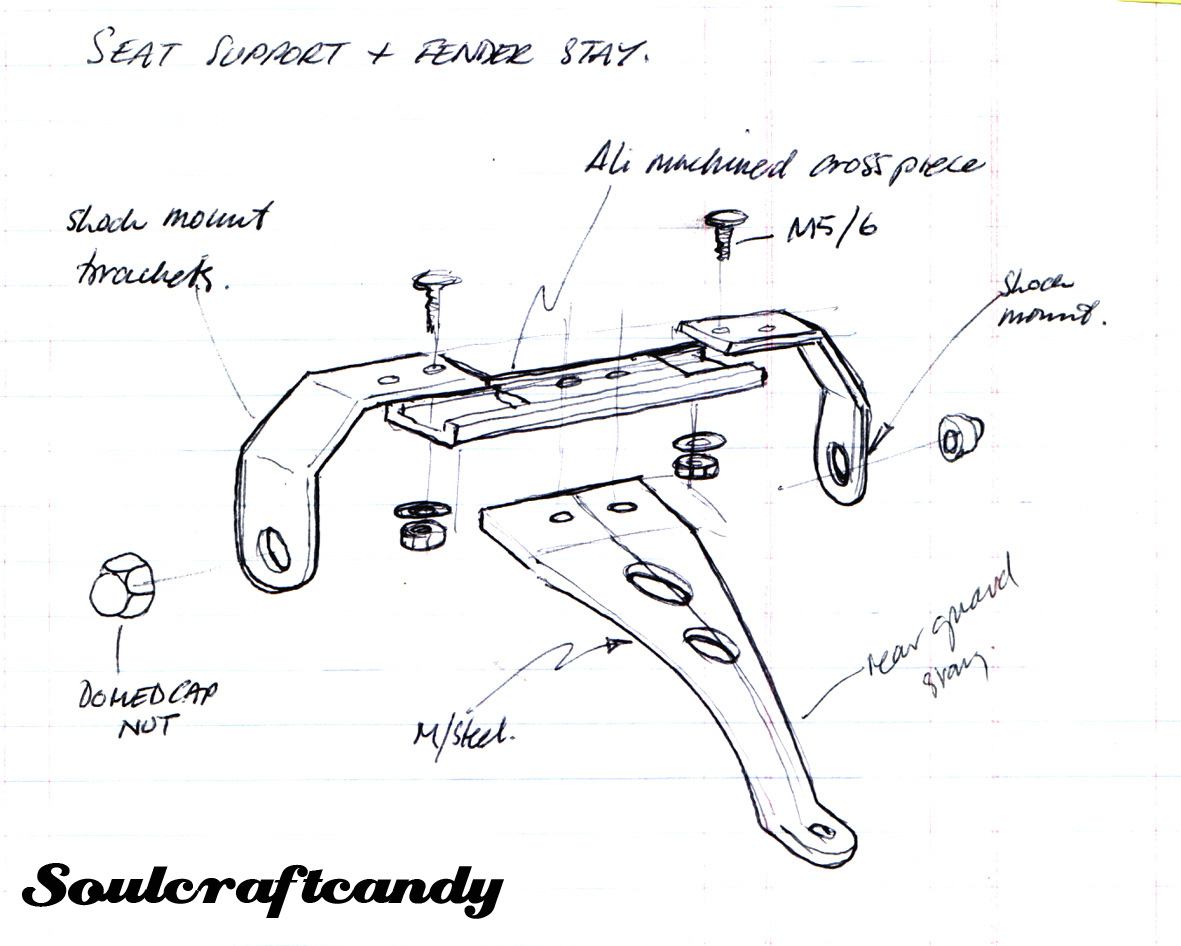
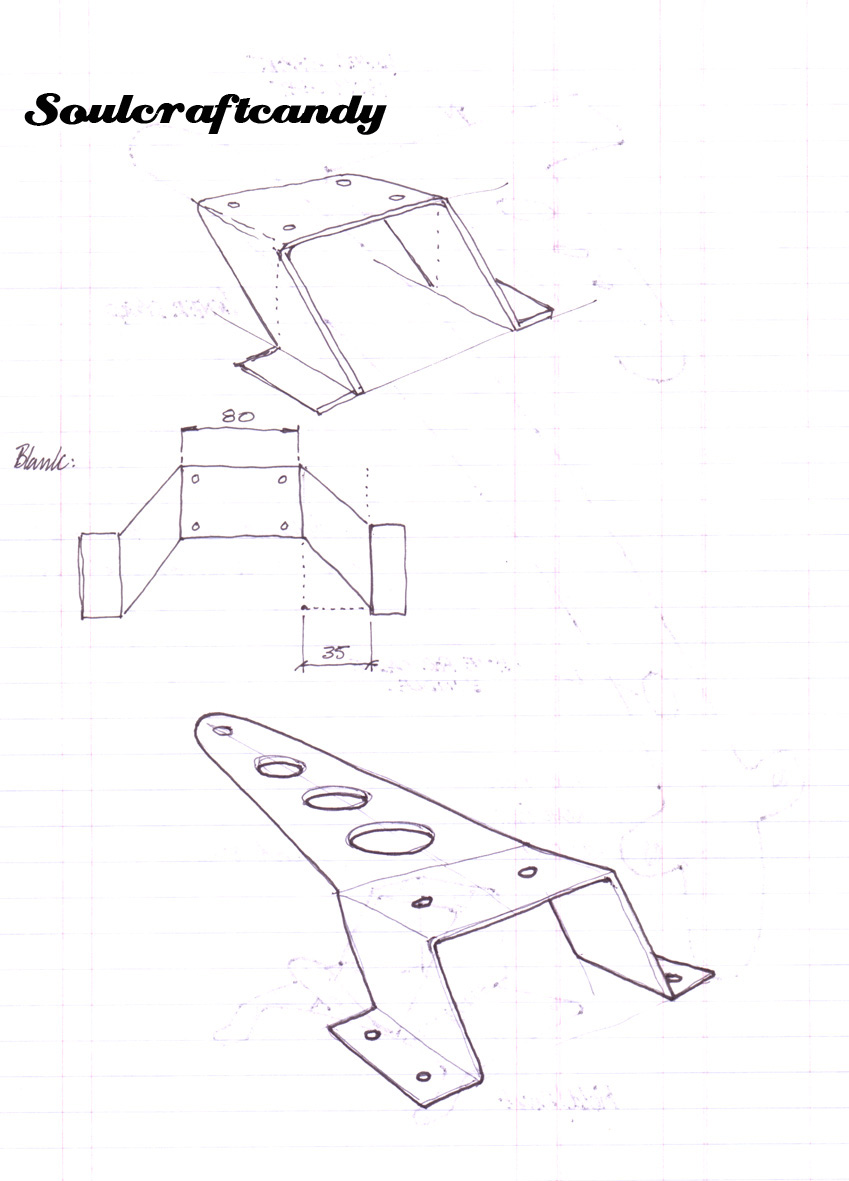
These three sketches above are from my notebook and show my thinking about how I could overcome the stability and strength issues with my rear fender. The top two sketches show a rough idea of the kind of upper support I wanted, a tapering finger of material with some holes pierced in it for a kind of lightweight look. This would be coupled with a large strip of slightly heavier gauge steel than ran down the centre of the underside of the fender piece. This strap would mount at the front end via a hole to match up with that on the mounting plate and at the back end two spaced holes would line up to accept the two mounting bolts passing through the fender from the rear lighting cluster and numberplate mount. Like a kind of backbone to the whole affair. I reckoned this would contribute significantly to the rigidity of the fender piece both in a vertical plane and horizontally. There was still the issue of dealing with any twisting action though. The final sketch is me investigating how to fix the upper mount to the assembly already in place for holding the seat in place.The first thing to do then, was to translate my sketched ideas into three dimensions and see how it worked.

No batteries required, just a brain and a pen.

Before I get on to that it’s also worth mentioning that one of the best tools to have in your work space is a dry wipe board. It doesn’t matter what size it is but, my advice is get one if you can. Working in conjunction with your notebook it assists in organising what you’re doing and helps you prioritise your tasks. I find it invaluable. Its perfect for creating lists of things to be done and in what order. Time and time again you read in magazines about other peoples builds and often they mention the value of such a device and attest to the immense sense of satisfaction to be gained by erasing jobs on the list as you go and replacing them with new ones. Two other great things about it are that you can sketch on it at an enlarged size to really work things through and, if you place it sensibly and write large enough, you can see it from anywhere in your work area. I picked up this one from a discount store for a couple of pounds. Some of the wall mount parts were missing, hence the price, but worth every penny.

Too much too soon-Part 1.

Previously you’ve read me giving myself a little bit of a hard time about getting colour onto the drawings a bit too hastily. On reflection I was probably a little too critical of what I was doing but, I suppose it was my reaction to finding myself making images that were a long way from where I wanted them to be that early on.

Before I move on and take a look at where things went from here I thought I’d make a quick series of posts which Illustrate (excuse the pun) a bit more precisely what I’d got myself into.

Here is a layout for a drawing I’d had in mind for ages but had never taken the time to sketch out. As a result I drew it up directly onto a sheet of fine paper without my usual rough sketch to guide me. I chose to mark it out using blue pencil, in fact it’s blue leads in one of those fine propelling pencils, 0.9 mm lead thickness. The paper is what’s known as Bristol Board, which is an extra fine surfaced drawing paper. It’s lovely stuff but being very smooth it’s not that receptive to certain media, blue pencil being one of them. As a consequence you have to apply a little bit more pressure than you would like to get a line to stand out. This also means that the lines are more work to erase once you’ve been over the drawing with pen, biro or paint.  One needs to take care because whilst pressing a bit harder works well you also run the risk of “denting” the surface and then you end up with a drawing covered in little grooves which really cause problems when you apply colour pencil or a fine wash. At this stage I leave all construction lines and little errors in place as there’s no need to erase them yet.

The tinting of the white background on the image is due to me photographing the image with my camera rather than scanning it. This is another side effect of blue pencil, my scanner doesn’t pick up the image very well. I’m not sure why but this characteristic used to be something I took advantage of when working in the studio, and we did everything by hand, as you could layout a drawing in blue pencil, ink over it and then blow it up or down on the copier without the blue showing through on the copies. Maybe it has something to do with the reflectivity of that particular colour, I don’t know. It’s a slight shame as drawings in this form are often great visually and it would be great to leave them as is, but they are often tricky to reproduce. Note to self; experiment with blue pencil images and the scanner. If anyone out there knows a quick fix for this, please be kind enough to let me know.

Once I’m happy with a roughed out drawing I’ll often leave it for a day or so before working on it further. For some reason, and I’m sure it’s got something to do with woods and trees, revisiting an image after a break enables you to see very clearly anything which is not quite right. It really is like having a fresh set of eyes sometimes. Sometimes I’ll come back to a drawing after only a couple of hours, and it looks so crap I pretty much start again, but that’s not often.

The next step is doing the drawing proper in ink or biro.

Old habits die hard.

When I made the decision to share some of my output with the world and start this blog I had very little idea how difficult it would sometimes be to distill thoughts and processes into meaningful words. I suppose rather naively I didn’t realise that I would need to learn to cast a more critical eye over my work. What I mean is that normally when one is making an image you make judgements about what you’re doing all the time but, you don’t have to express them, the conversation happens in your head. Alterations and changes that you want to make are decided silently before proceeding.

Now, up until now I’d been drawing away to my hearts content and was pretty happy with how things seemed to be going. I’d realised that bikes were quite difficult things to draw, they are actually quite complicated things really, but had satisfied myself that I could stick with plain elevational views for the time being, while I learned more about them from a form perspective. Getting a drawing to look right in terms of shape and proportion was quite a challenge to start with. It was surprising that so many of the elements had to come and work together just so the thing looked like, well, a motorbike. There was a lot more involved than I first reckoned. So achieving a drawing which hung together and looked ok  just in line form turned out to be quite hard work to start with.

Fine, and then for some mad reason that even I can’t fathom I started colouring them in.

Great, but what was I thinking? I’m sure I had told myself to stay away from all the myriad colour pencils and pens that litter my workroom. I’m pretty sure I’d had a word with myself about reaching into the drawer for a circle guide or French Curve as well. But no, I couldn’t resist it.

I mentioned in the previous post that something reared it’s head and this was it. Big deal you might think but, it actually created more problems for me than I wanted, and influenced a number of things. For I start I began to think constantly about how I would render the drawing and this influenced the way I drew things at the outset. It also meant that I was covering the drawing in a kind of cloak of realism which I had initially intended to leave out until I’d built up a bit more confidence and competence. I was sat there thinking, “what colour should this bit be?” and “how many spokes should this wheel have?” If I wasn’t careful I’d be diving headlong into the realms of reflections and then there would be no end to it.


I’d done a few line drawings and suddenly found myself staring at a pile of colouring in. I got myself truly stuck in. I’d started with colour pencils as they are my kind of default medium, I’ve always been very comfortable with them, and started piling on the pigment. Here’s another one that got the treatment.

In isolation these aren’t bad drawings, even though I say that myself, but they were lacking something which had been very evident in the first drag bike cartoon. They were a bit dry and lacked a certain something, a dynamism? And there weren’t any people in them.

I was reminded of an old tutor I had when studying at the Central School of Art in London back in the early eighties. In his spare time he would sit at home and paint pictures of vintage cars in gouache and ink. They were impressive technically but, as dry as a bone visually. I looked at my drawings and got a feeling that I was headed, albeit slowly, down some road toward a similar end, spending days painstakingly recreating every last detail in perfect likeness. That was not what I wanted and so had to rein myself in somehow. I knew that there would be a time for lots of colour but it wasn’t now and it wasn’t like this either.

The learnings from this experience were interesting though. Quite unwittingly I’d found myself charging off down a path I had not readied myself to pursue. This is what I think happened. They say that old habits die hard and perhaps this is the case here. Over years of making images to illustrate design ideas one gets into a groove. Not only does each designer develop their own unique style, but I think they also embed within themselves certain ways of doing things. These are like creative habits. If I look back at some of my work from studio days I can clearly see that I went about things in a very particular way. In a sense that’s what I found myself doing now, doing it in a certain way. I was going from sketch to line drawing and then to colour etc etc. For things to be finished they had to be in colour, properly shaded and kind of looking “real”. Despite the fact that the images were not of real things I’d started to try and make them look as real as possible and had found myself “designing” them, which in it’s own way effected the lines I drew. I was sat there worrying about whether they looked real enough, when the whole idea in the first place had been for them not to be real at all. Most importantly the process had started to be less fun. I hadn’t got the mix of ingredients right. Time for a rethink.