Pain and no gain.

This is a drawing I’ve been wanting to post for some time. I don’t have a great deal to say about it other than it’s one of my favourites. This version has a quickly scribbled ground line just to place it on the page but I’m still mucking around with it. I love the sense of fun you get from the riders facial expression and shape of the frame rails. If I knew how to build a frame I’d like to have a go at something like this.

The other thing I have to say on this post should be in way of an apology as it’s been some time since my last post. There is a very good reason for this absence and it’s nothing to do with laziness. Truthfully I have been suffering from a strained neck and shoulder which have combined to make it near impossible to sit at the computer in any degree of comfort, and to periods, during the day and night, of excruciating pain. Normally I wouldn’t harp on about this kind of thing, I’ve had a bad shoulder now for some time since busting my collar bone a couple of years ago. But I will take a moment now to elucidate as this takes the form of a small cautionary tale. My cricked neck, which was the root of all the discomfort was certainly aggravated by bad posture. Anyone who spends hours sat at a desk will warn you of the perils of not getting your sitting position right. What no one goes on to tell you is how important it also is to get your position right when drawing for long stints. I’d spent far too long craning over my work that I’d all but seized up and one morning back in early March the whole lot screamed “enough!” One muscle cramp led to another and before I knew it I was totally incapable of moving my left arm and shoulder. It pretty much laid me out for three weeks and only started easing following some physiotherapy and a couple of good hot saunas whilst visiting my in-laws in Finland. So, to all budding artists, designers and scribblers, please take care and get up every now and then and move about. I wouldn’t wish the same on anyone, ever. I’ve changed my work area around totally and can at least now use the computer, but I’ve yet to finalise how I adjust my drawing board and chair, I’ll keep you posted on that…….


Comfort in the familiar.

With the lightbox constructed the speed and easiness with which I can transpose drawings onto fine quality paper is greatly improved. What I really like about it is the ability it gives you to not only see where you are with the drawing as you go but, also it’s become much easier to make those fine adjustments to the composition. I appreciate that this all sounds wonderfully old fashioned but there is a beauty in that.

Another problem I’ve been dealing with on a relatively regular basis is that of getting into the rhythm of drawing on days when it doesn’t come easily. I’m not an artist and as such I’m not in the habit of engaging with my work on a daily basis. There are often gaps and I find that my eye takes time to get back in when I return to the page and the pen. Normally I find a good scribble gets me into the swing but there are other times when nothing progresses beyond that. Angles, proportions and perspectives are all out of my creative reach.

What I’ve found helps me get over this hurdle is to go back to something familiar and draw that. Something that I know intimately and when it comes to drawing bikes there’s nothing more familiar than your own machine. As I’ve mentioned before, I’m lucky enough to have two, but it’s the smaller one which always gets the job. Having spent a month modifying it a couple of years ago, and riding it a lot since then I know it inside out.

Above is a “getting into the rhythm” sketch of the little 250 that eventually went all the way to a finished drawing, below.

Like many of my other images I’m still fiddling about with what device to use to ground the picture and have so far only scratched something rough in using Photoshop. What I find happens when I follow this path to warming up is that the familiarity of the object in some way makes it easier to distort the view and the drawing. Sitting here writing this I’m actually struck by the fact that I haven’t needed to draw the 250 for a couple of weeks, so things in general must be getting better and easier to engage with.

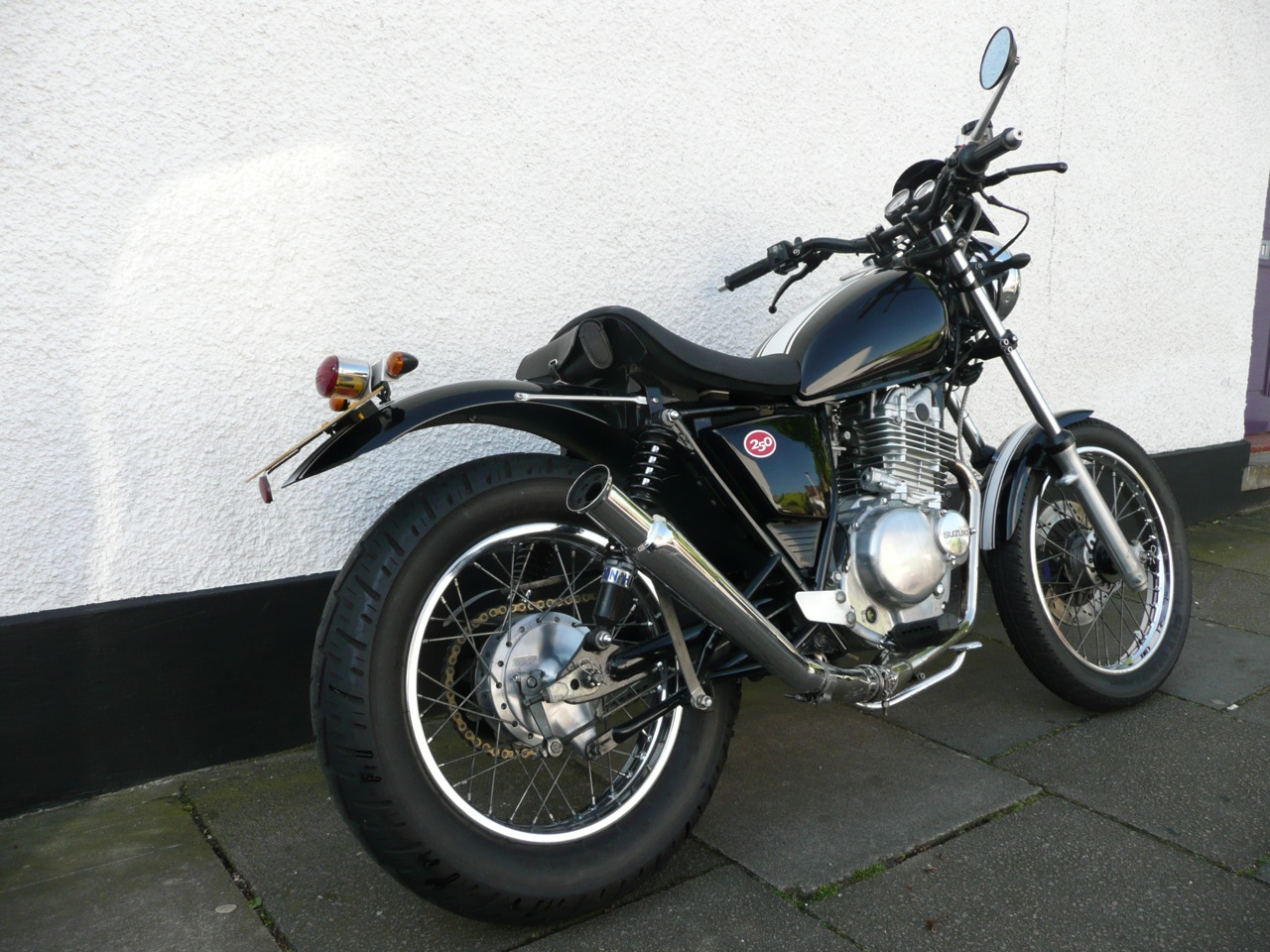
Here’s pic of the bike. I mentioned ages ago in a very early post that I would tell some of the story behind this little special build. This is supposed to be a blog about drawing and making after all. So I shall sprinkle some of that into the mix over the next few posts.


Too much too soon – Part 3


Without much of an idea about how I wanted to start this post I sat staring at the screen for a while before staring out of the window. “It might still be January but, what a beautiful days it is” I thought as the sun streamed into the room.

In fact I’d just charged up the battery for the Triumph yesterday so what better thing to do than to take the ol’ fella out for a quick spin. and have a think about my post over a cup of hot tea at The Ace Cafe.

Having removed the bike cover and installed the newly charged battery I couldn’t help noticing how brightly the sky was reflecting in the polished alloy of the exhaust silencer. It looked just like how we were taught to render chrome, all blue sky up top and a  brownish ground line with a bit of black in there for effect. A bit cartoonish really. I realised I didn’t need to contemplate my post over a cuppa at the Ace, but I went for a ride anyway, it was the right thing to do.

And that’s the thing about colouring metal, particularly tubes, pipes and so forth. You can really ham it up in a cartoonish way and it still ends up looking kind of real. Obviously to the purist there’s a lot more to it than that but it’s surprising what you can achieve with very little effort. A dark line or area denotes a reflection of the ground and another in blue gives you that reflection of the sky and the whole lot looks kind of shiny. No matter how many reference pictures you look at, you will always see that shiny metal is the same colour(s) as everything around it. This is my very simplistic view but it works for me and prevents me from becoming utterly confused when I start to wonder about what is reflected in what.

There’s a similarly simple approach to the flat alloy surfaces which make up engine cases etc. Parts are generally a tone of grey and the junctions between the surfaces pick up the highlights. From this simple premise you can then go into as much detail as you want but for me it’s always a safe place to start. Build it up slowly and stop when you’re happy to.

I’m not exactly sure why I decided to apply colour to the metal bits first on this drawing, it was some kind of subconscious decision to do with methodical working or something like that. It kind of worked but left two areas of indecision in my mind. First, I couldn’t decide what the main exhaust should be, chrome or a kind of brownish stainless steel. Second, I didn’t know at this point what colour the bodywork would be so I couldn’t reflect that in anything. I thought I’d make my mind up about those two things at the next stage.