A Teaser

In my last post I mentioned that I wanted to work up those two BMW inspired sketches in ink as a next step before playing around with some colour. Well, things as ever never go according to even the simplest of plans. Not through anything going wrong, far from it, but from being led up another path by my inquisitiveness.

When I’m playing about with colour on an image I’m always fearful of making a mess of it and spoiling a perfectly good drawing through the inappropriate application of paint or crayon. The latter you can sometimes remove with an eraser but, the former is a more tricky medium to shift. It always leaves a stain at the very least. So my thinking was that to avoid such situations I could print the sketch onto another sheet and play about with that. I’ve tried this before and it’s always been onto standard cartridge or stock printer paper. It’s a habit carried over from doing coloured design renderings back in the studio many moons ago, before anyone thought an Apple mac might be useful and anyone had any idea about Photoshop. The copier was my best friend.


My problem, or what I perceived as a problem was that I wanted to use some watercolours and these do not sit well with standard printer paper. The paint goes all streaky and the paper quickly starts to look like an unpressed shirt. I’d never thought to try printing onto watercolour paper as I’d always thought it would be too thick to go through my old Epson. How wrong I was. After a couple of false starts as the paper feeder got to grips with what must have felt like someone feeding it a doormat, it chugged through and the results are pleasing enough to warrant throwing some colour at it. As you can see from the picture above it’s not too shabby a result. I’ve printed out a couple of other scanned pencil sketches in the same way and I’ll pop those up on the blog as they come together and I get to grips with re-familiarising myself with my favourite paint medium.

Here is a bit of a teaser image for you too today. It shows me (though I’m not in the shot obviously) about coming up to half way through inking in a drawing of a massively engined single cylinder cafe racer I sketched out ages ago. I’d left it languishing in the sketch pile while I got on with other drawings but, coming across it the other day I thought I’d do something about it now. Of course I’ll put the finished article up on the blog as soon as it’s done for your delectation.


Also in the shot is one of my favourite tools. It’s a book, a fabulous book by a chap called Daniel Peirce and covers the story of a photographic project he undertook called Up-N-Smoke. It is essentially 140 pages or so of beautifully photographed bike engines. All vintages, all types and all lovingly lit. For me it’s a fantastic reference for shading in all of those apparently similar coloured metal parts, how reflections get cast on surfaces and bags of engineering details to feed the imagination for future drawings. It’s published by Veloce books (ISBN 978-1-84584-174-4 ).


There is art to be found in engines, that’s for sure.


Every once in a while.

Today I was going to post about the next phase of metal bashing for the 250 build but, I’ve changed my mind following a visit to the Ace Cafe yesterday. It was another sunny Sunday in a chain of bright spring weather we’re having here in London, and a short spin up the road was called for. As it happened it was Italian Bike Day at the Ace and I decided to drop in on my way to nowhere in particular and back. I’m glad I did as there is almost always something to be seen up at the cafe that stirs the soul.

I’ve always tried to avoid the temptation, and will continue to resist it, to turn the blog into an endless catalogue of images of stuff that interests me without much comment. There are plenty of those around already for our delectation. But yesterday I was prompted to think that on occasion, when I come across something on my travels that catches my eye I’ll reach for the camera and share it with my readers. So here’s the first one.

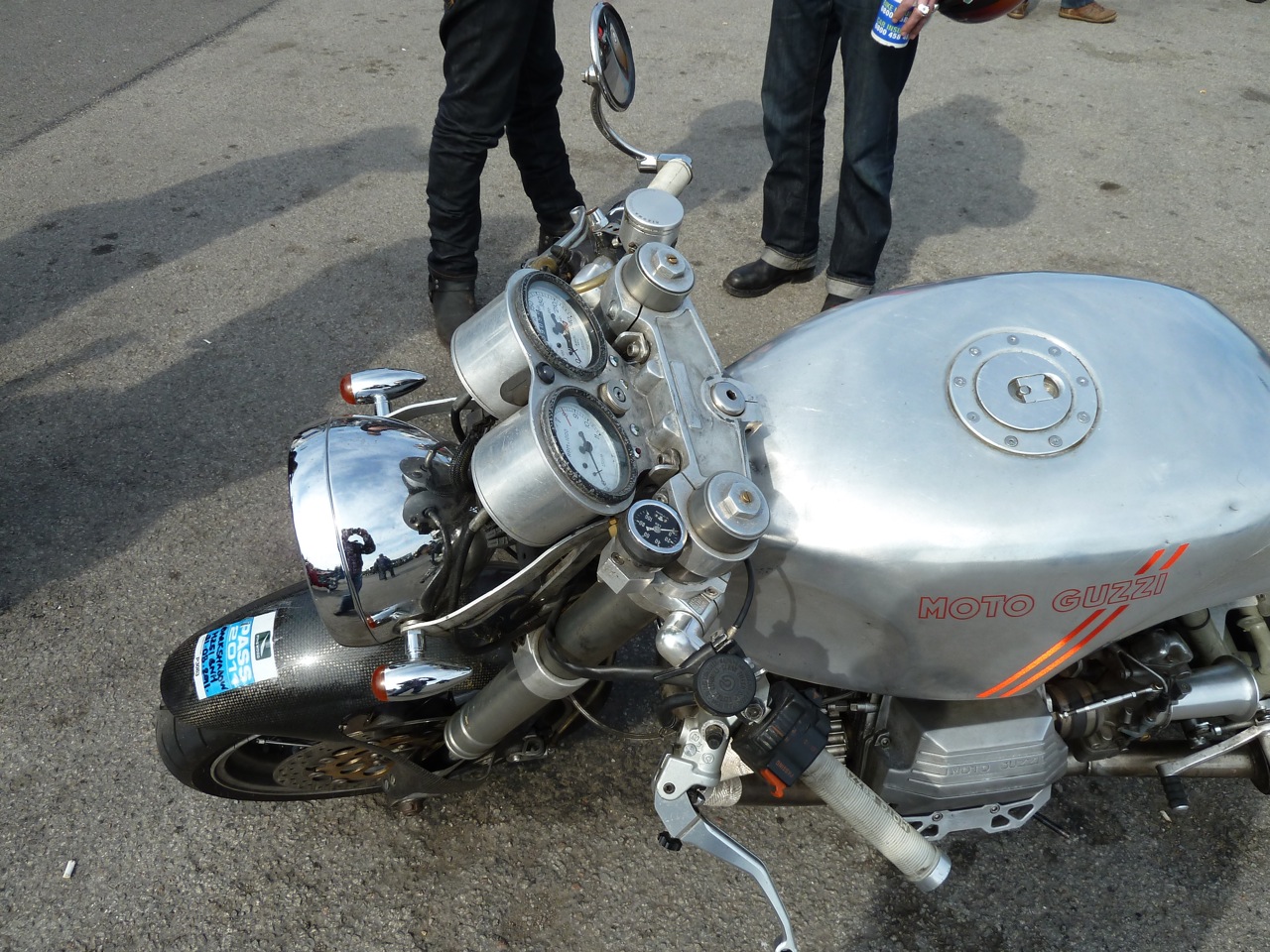
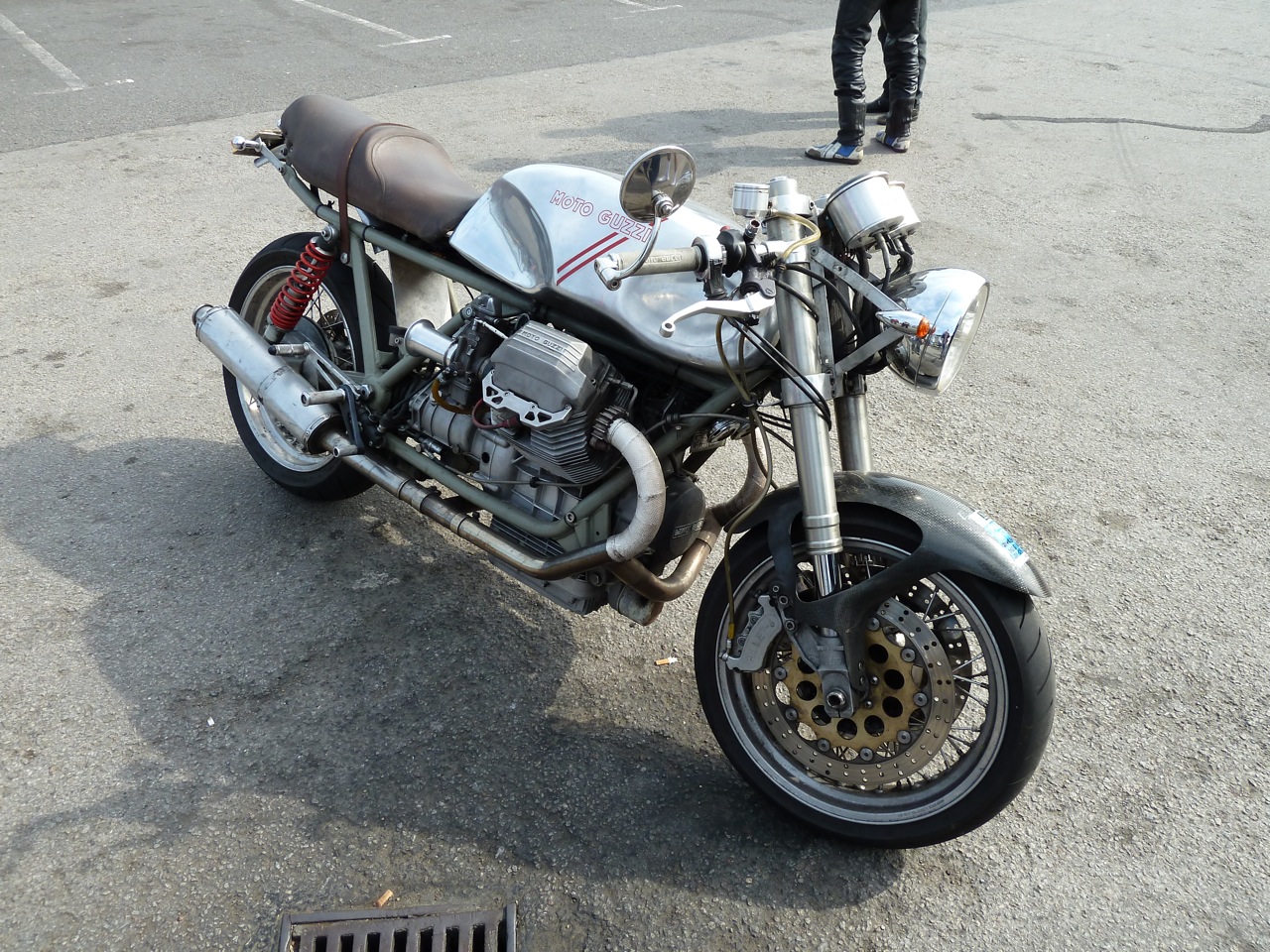
First things first, this is a Moto Guzzi that belongs to a sculptor called Ed who lives in south London. Ed put the bike together himself over a number of years and in my mind you can assuredly say that it was built for a purpose by a man with a vision. I love it. It’s a fantastic combination of old and not so old, all wrapped in a patina that one can virtually smell.

It was initially parked quietly on the edge of the “display area”, not attracting much attention unlike the collection of shiny and immaculately turned out exotica that invariably fill the car park on a day like Sunday. It was only when he wheeled it out to centre stage that peoples attention was alerted and a small group of admirers gathered to fire questions at its happy owner. I wandered over, liked what I saw and reached for the camera. For some reason only known to my subconscious it wasn’t important to know the size of the engine, it was big, nuff said, or where all the various parts had come from. It was just a great bike to look at, a true “bitsa” in the best interpretation of the word and displayed an unashamedly honest approach to its engineering and finish. There was nothing flashy about it but Ed’s sense of, and attention to, detail was a breath of fresh air after nearly an hour of shining Ducati specials armed with expensive aftermarket components, and concours standard Laverdas.

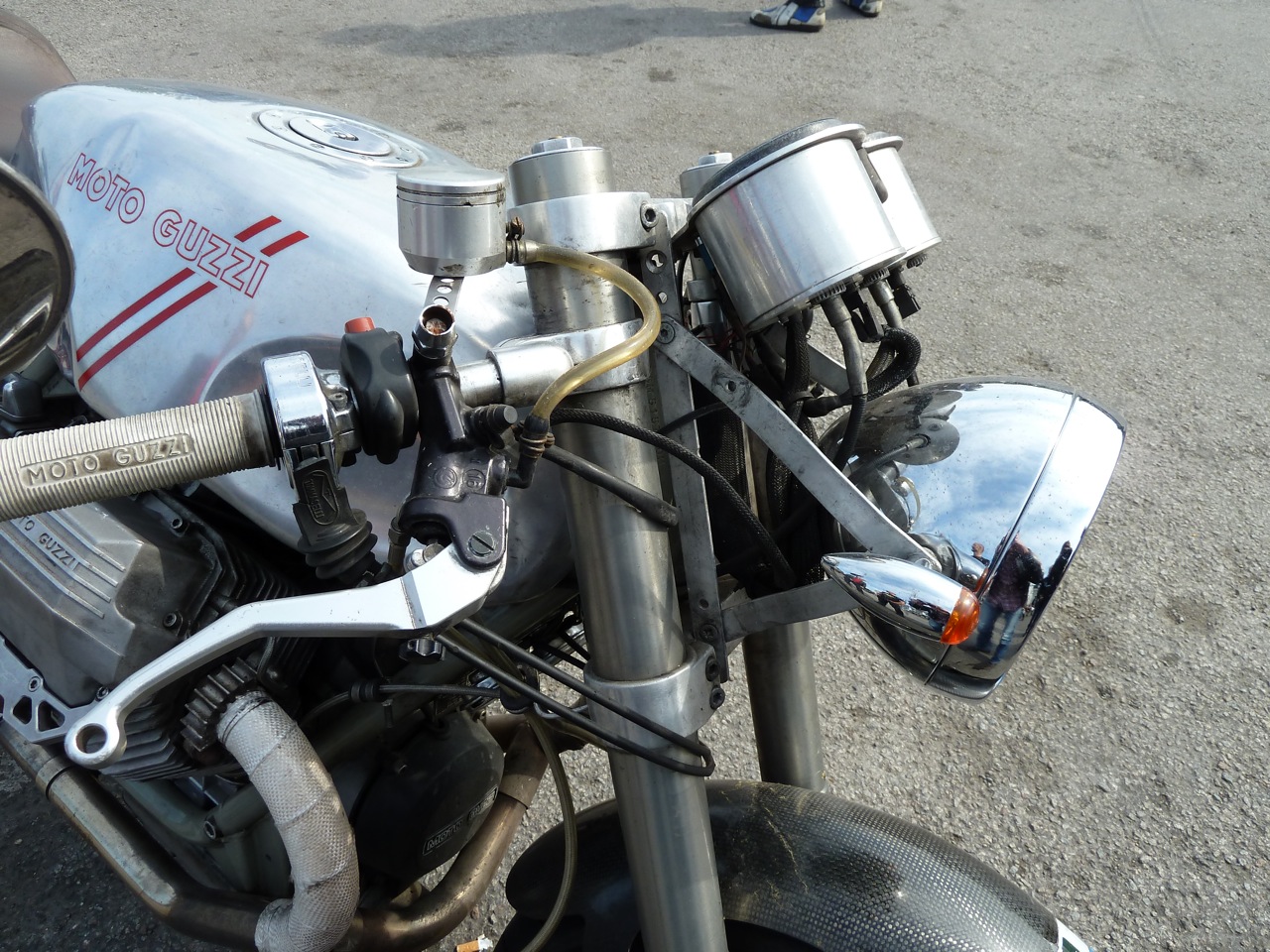
It seemed obvious that this Moto Guzzi was built to do the three main things in a bikes armoury well: go, stop, and carve round corners. As I said, I didn’t ask many questions but from the look of the front end, taken from a Ducati Monster perhaps(?), equipped with two huge discs and a pair of Billet 6 callipers it was a serious tool. The front wheel was capped in a wonderfully curvaceous carbon fibre mudguard, it was virtually the only shiny bit on view, though you could still admire the carbon weave below the lacquered surface. Its high tech origins a fine counterpoint to the headlight mounts fashioned from aluminium angle and the double seat which seemed perched atop the frame rails. The whole bike is covered in lovely touches. From the repeated pattern of cut outs on the cylinder head protectors and the battery support plate under the seat, to the small adjustable tie bars that secure the carb tops to the rocker box covers. I can only assume these are to stop the carbs rattling themselves to death. From the modern radial master cylinders for clutch and front brake to the discrete little oil pressure gauge atop the left clip-on by the tachometer. I liked the fact that the fluid reservoirs didn’t match and that the rear tyre didn’t need to be the size of Sussex to look utterly purposeful.

Time and again my eye returned to the frame. I don’t know the history of it but the colour is what I remember most, a lovely kind of duck egg green. Such an unusual colour and it had something aeronautical about it. It reminded me of trips to the RAF museum at Hendon in north London where peering into open undercarriage and bomb bay doors one gets a eyeful of the inner structure of some of the planes, their very skeletons, and they are invariably covered in a coat of greenish paint. So in a way very apt for a big bike frame.

The whole bike though was dominated by the engine and the enormous polished fuel tank. One doesn’t appreciate how big a big Guzzi engine is until you’re up close and personal like this. It’s a fantastic thing, a true statement of engineering purpose and when equipped with two huge carbs and a pair of the most extreme bell-mouths I’ve ever clapped eyes on, one that intends to make the very earth shake.

I could go on. Needless to say I had to go before hearing the beast fire up but, I’m sure this won’t be the last time I see this bike. I’ll be looking out and listening out for it. It was great to meet Ed and learn a little about his fabulous motorcycle, a true testament to the values of creativity and individualism that many of us admire. He says he’s thinking of another project and if it turns out anything like this one it’ll be a cracker. Good luck with that Ed.

The chain run.

Does it make sense?

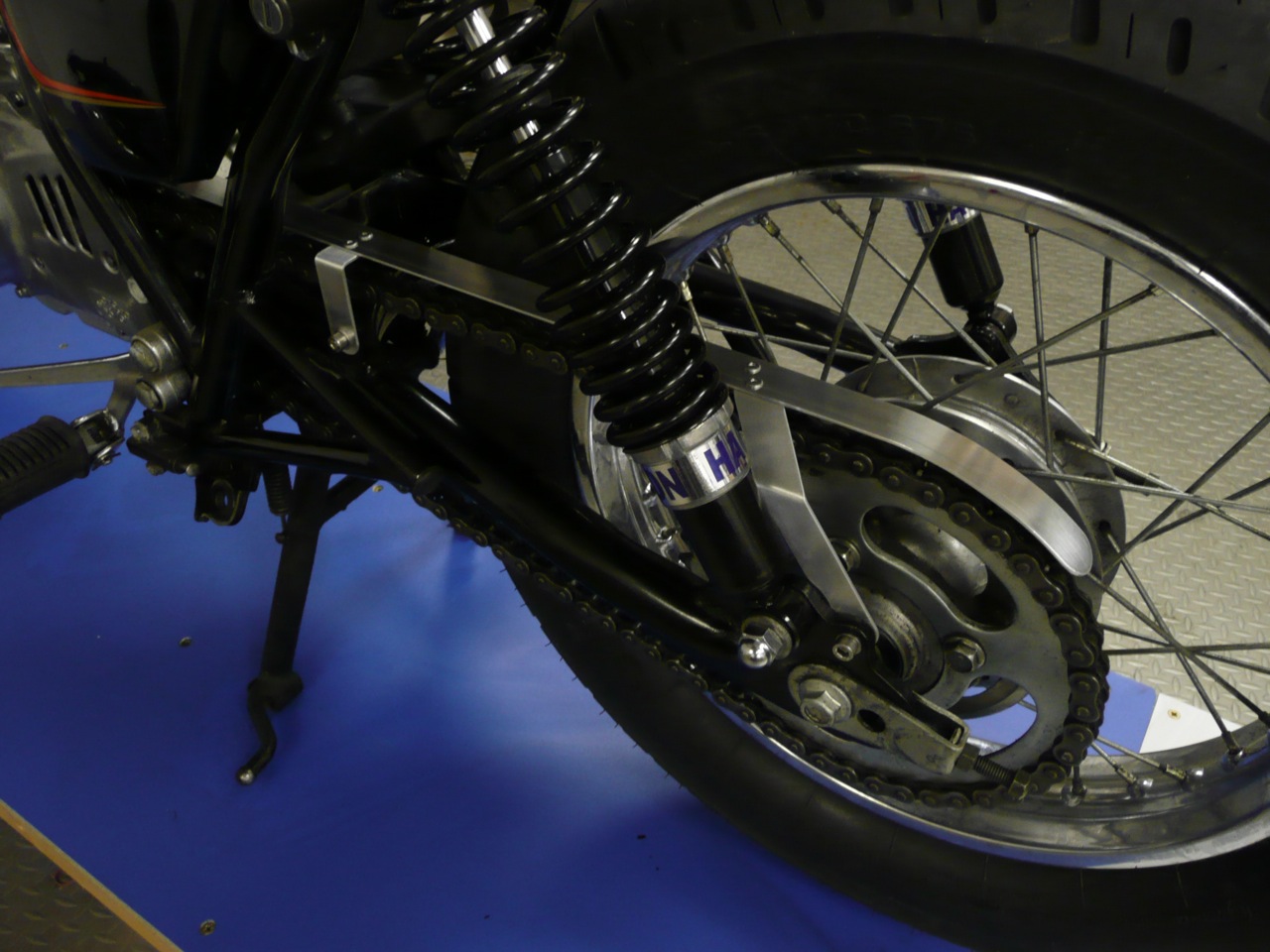
I knew that having made the clock mount and its accompanying surround I should really have got on with some kind of front screen, but I didn’t. I decided to make a chain guard instead. In a funny kind of way I found myself in the situation where I’d tried to plan everything out as much as possible, in a loosely efficient project management kind of way, and then found myself deliberately jumping from one part of the plan to another rather randomly. I’d call it something like organic execution. Having planned everything out systematically, I was free to approach the list of tasks depending on how I felt on the day. That day I was much more in the mood to make a chain guard than to start to get to grips with the next big thing which was the rear mudguard or fender.

At least with this next part I followed very closely one of my guiding principles of the build which was to lose weight. The standard part, as any GN owner will tell you, is a substantial piece of kit. Whilst I understand fully the need to prevent ingress of foreign objects into the chain run, I can’t for the life of me see why said part has to be the depth of a piece of industrial guttering and sturdy enough to shake off an attack of rocket propelled grenades. Whatever, it weighs a ton and made its way swiftly into the ever growing pile of discarded ironwork growing in the corner.

A bit blurry I'm afraid

It would have been much easier I know, to have followed the weight saving creed to its maximum and not fitted anything at all but I wanted something there to stop things like loose rucksack straps getting too close and prevent the back of the bike and ultimately me, getting a good spattering of flung off chain lube.

A quick trip to the DIY store and I’d got myself a very handy length of aluminium ‘L’ section, the angle to give it some rigidity, and a length of flat bar as well for making a couple of brackets. By trimming off part of the angle, to create a flat section, it was easy enough to bend the strip around a quick wooden former to get a radius that would sit nicely above the rear sprocket. I could then trim the length of the whole thing at the end that goes over the front sprocket. Duly done it was just a question of working out how high off the upper chain run I wanted it to sit. As the chain can flap whilst your traveling, too low and each journey would be a rattling affair. To tell the truth I did get it a bit low to start with and modified it very quickly soon after the first test ride. For the rear of the guard I made the bracket at an angle to match the rake of the rear shocks, to kind of blend in, and secured it to a conveniently located hole above the chain adjuster on that side. The front bracket was a simple piece with a single 90 degree bend in it, and I cut it to a length which would allow me to raise or lower the guard at that point should I need to, which I did as you’ve already read. I attached the brackets to the guard using some ‘Pop’ rivets, another godsend to the home builder, and it was complete and ready for a coat of trusty old black paint. Job done. Now I knew I couldn’t put off the rear fender any longer.