A change of scale.

It is most likely true that if you asked any creative person who produces stuff, if they just worked on one thing at a time, in a beautifully seamless procession of sequential order, they would likely say they did not. It seems to be in our nature to have as many things in the pipeline as we can manage, and then more. Our work spaces are doubtless littered with bits and pieces which remain unfinished, partially forgotten and “in development”. Our ability to accumulate projects is often quite astounding, and that’s before you even start talking about what’s in the brain bank, the unseen material hidden in the grey matter.

This is very much the case at Soulcraftcandy Mansions. Both the brain bank and endless pages of notebooks are filled with things that might be, one day. Sketches, doodles and diagrams all waiting patiently to be given life through some creative expression.

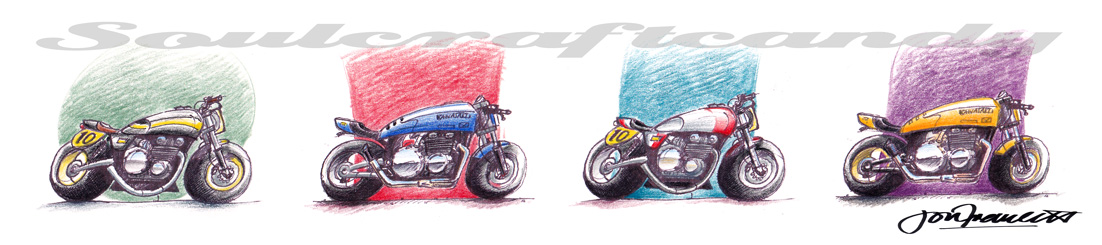
One such idea has been receiving such attention this week, small drawings in series. With the bigger drawings churning away nicely it was time to look at another idea for a while, to give my creativity a rest by way of a change of scale, pace and medium. Small drawings have always held my attention and this goes way back to when to being in a design studio and a winning idea would first appear in the corner of a page as a little thumbnail sketch. Of course the same thing happens these days but I’m now just as interested in the drawing as the idea it expresses.

The former situation would require enlarging the sketch and then investigating its potential as a design. Now the process is kind of reversed, rather than adding detail to the original sketch the process is reductive, what can be left out. The drop in scale really makes you think about what is the minimum required to get what you’re after. How do you compress all the complexity, mechanisms and complicated forms into a small space. Comic artists are consummate masters of this discipline. The hope is that it will refresh an appreciation for the details when returning to a larger format, but that might be hoping for too much.
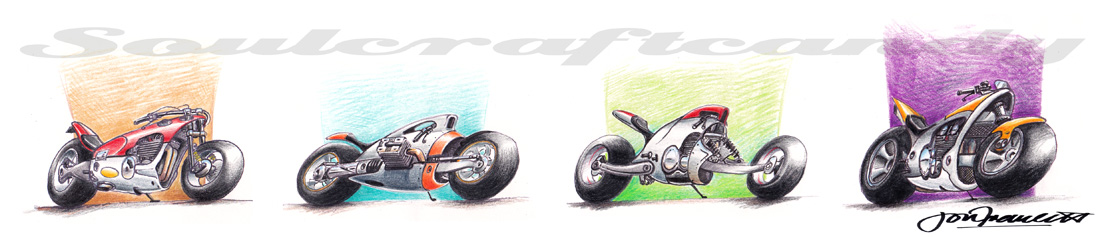
Some might be tempted to sidestep this issue of detail by simply scaling down an already scanned drawing in Photoshop and printing it out, but that only gives you little dense balls of ink and not much else. So the idea was to draw as close to the required scale as possible to start with. Then, in the same way that we used to play with the photocopier all those years ago, it’s a question of cleaning up the image and changing the size until you’ve got something workable. Scanning, cleaning out unwanted lines, knocking back saturation levels and printing until I’m happy. Four of these images get gathered together and printed out in a 2×2 matrix on A4.

The old Epson A3 printer that’s sat here stopped doing beautiful ages ago but has a great ability for handling all manner of different kinds and weights of paper which my newer Canon is not that interested in doing.

This facility means that it’s also easy now to play with differing media on these different papers and, to play around with different colour combinations for the images. Colour crayons, inks and paints will all get a look in. So far it’s the crayons that have held my attention and the results are promising though there is certainly room for improvement. I’m using Derwent Studio crayons by Rexel Cumberland and they have a lovely soft waxiness to them, but they don’t stay sharp for long and laying on deep colour often requires you to labour them a bit. The paper too, is a bit coarse but picks up colour well so it will be a case of finding the right balance between these two attributes in order to get the desired level of intensity.
There are some liquid water colours ( Dr Ph Martin’s)sitting in a box on the shelf here. It will be interesting to see how they work on some fine surfaced water colour paper in the next experiment.

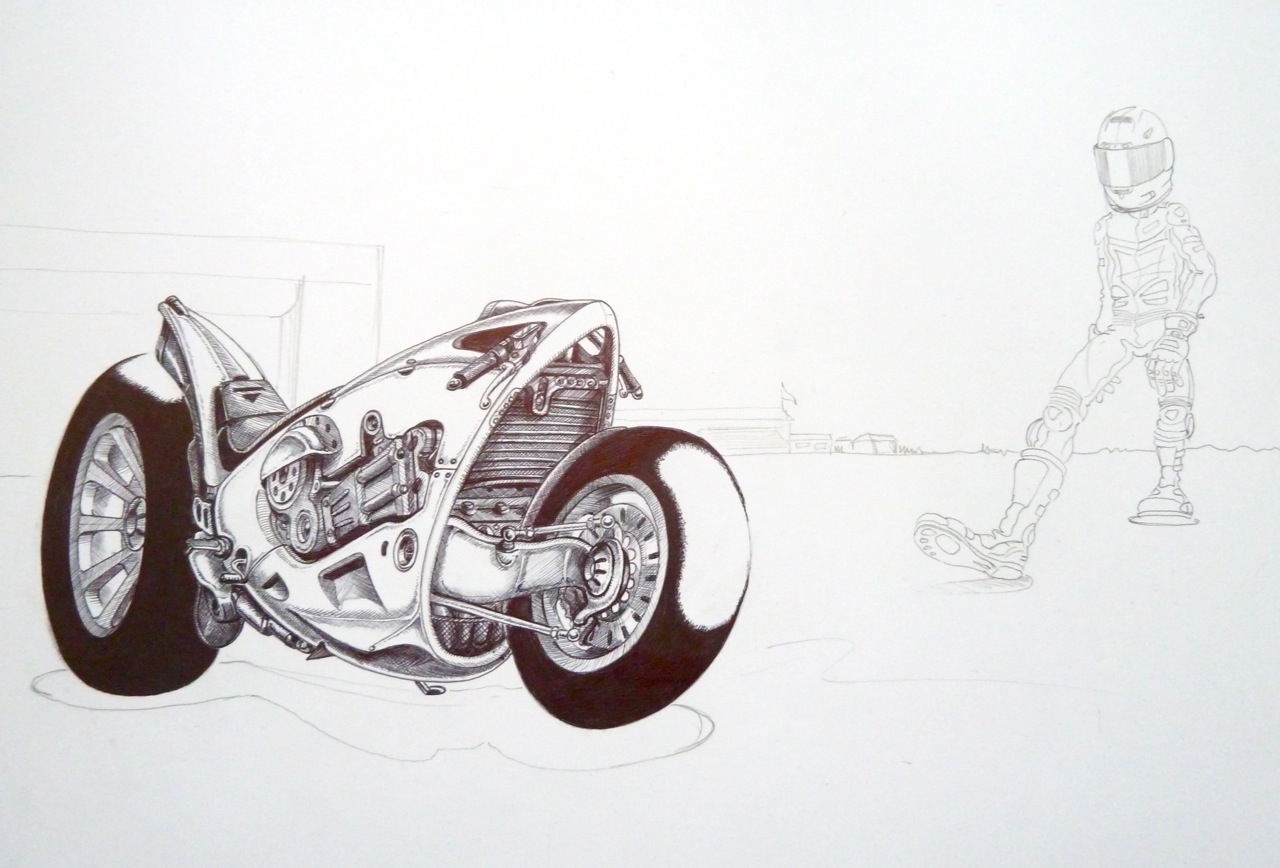
Slow progress is still progress.

It’s been a while since the last post and it is great to say that the time was spent doing something incredible. More about that at the bottom of this post my friends.

Although finding the time to sit and draw of an evening can be a challenge when working, the days are long, it’s really only the pace of things that changes. This drawing above has taken some time as a consequence, at least it feels very much like that. When you’re in the groove, getting these things finished has a most satisfying pace to it. If things are a bit rusty or periods between drawing are lengthy and sporadic it’s very much a different story. An apparently inordinate amount of time seems to be spent staring at the page wondering what to do next. And then, when you’re ready to put pen to paper a wave of unfounded nerves descends as if to ask, “are you sure you want to do it like that?”. Known in my lexicon as “scribblers block”, it is a battle royal sometimes to get out of it and break the cycle. One has to accept it and work through it, though it can be a kind of agony at times.

As mentioned elsewhere on the blog, there are lots of little strategies to get over it. Switching between a number of drawings is one, getting a sketch pad out and going nuts for five minutes or so is another. Getting out of the chair and going for a short walk helps too. Whatever you do it becomes easier as time progresses and can even be used to limber up or refresh the mind even when things are going great.

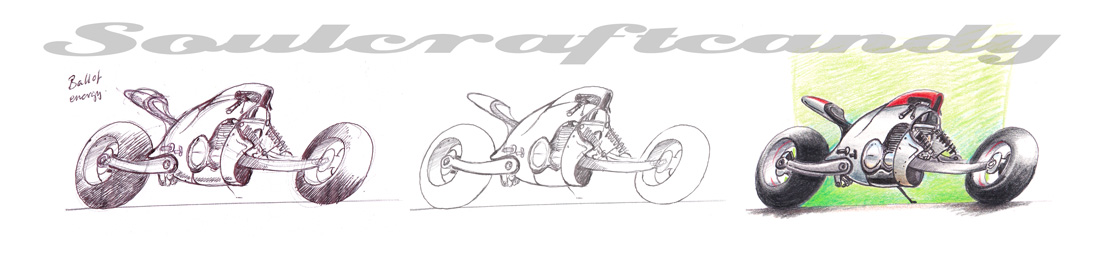
This drawing continues with one of my current themes which is playing with chassis forms which are enclosed or wrapped. Granted it doesn’t allow as much detail to come through from the engine but, this is not an issue frankly. It gives the bikes a cohesive form factor which pleases me greatly. By keeping bodywork shading to a minimum the aim was to get the eye to focus on the stark contrasts that run from right to left. I hope you like it.

You will recognise this other image from the previous post. it’s coming along nicely and work will be continuing apace to finish it soon. It’s a strange thing but this drawing says something different every time one looks at it, particularly as it’s not finished yet. Maybe it will find its voice when done, but then again…….

Now, as promised a quick bit about what work was keeping the author from his doodles. After all this is meant to be a blog as much about making as drawing. Certainly what we’ve been working on fits into the amazing category in my book as it’s been as much a learning experience as just another job. Anyway, my friend Mandy Smith, a modelmaker of considerable skill, and I have been busy making plastic chocolate for an advertising campaign. This strange endeavour has introduced me to the world of resin casting, making silicon moulds and making double castings. At first encounter this process appears quite complex but after initial ignorance is overcome one begins to see that like many things in this field it’s as much about being methodical as much as grasping huge levels of technical knowhow. It was fun and when the time is right there will be something about it featured here on the blog, but currently confidentiality prevents me from showing more. If this tickles your interest and you’d like to learn more about what we do you can visit Mandy’s site here:

 http://cargocollective.com/mandymaker#1656991/About. 

There are some more works in progress to show and tomorrow I want to play with some paint so who knows what the next post will contain.

Two pens are better than one.

Ok, so here’s the final finished version of what’s called Megatwin 1. It took me some time to finish as working on getting all the shaded areas seemed to consume me. Knowing when to stop fiddling with an image can be such a difficult thing to learn, but with practise the end result becomes easier to see earlier, one would hope.


Working on this Bristol Board type of paper provides you with a very smooth surface which is ideal for pen work but its smoothness also seems to encourage the ink to flow with only the merest touch of the pen to the surface. Training your hand to almost hover over the drawing whilst shading, maintaining the lightest of touches consistently is quite difficult, not to say quite tiring at times. Thus getting consistency in some of the shaded areas with my usual weapon of choice, a Bic medium point, can be hard. As a way to get around this, and to create a wider variation of tone I have started to use a fine point pen, Bic again the one with the yellow barrel, in conjunction with the medium point pen. Not only does this give me the variations I’m looking for but also means it’s easier to achieve differences in the density and thickness of the cross-hatching. Ultimately you get greater control everywhere and it really helps in bringing out the forms in certain details like the belly pan underneath the engine.