A Teaser

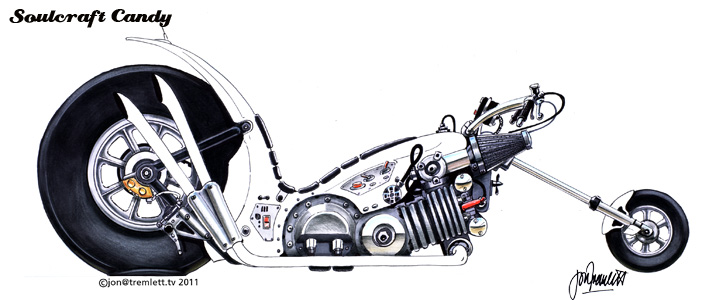
In my last post I mentioned that I wanted to work up those two BMW inspired sketches in ink as a next step before playing around with some colour. Well, things as ever never go according to even the simplest of plans. Not through anything going wrong, far from it, but from being led up another path by my inquisitiveness.

When I’m playing about with colour on an image I’m always fearful of making a mess of it and spoiling a perfectly good drawing through the inappropriate application of paint or crayon. The latter you can sometimes remove with an eraser but, the former is a more tricky medium to shift. It always leaves a stain at the very least. So my thinking was that to avoid such situations I could print the sketch onto another sheet and play about with that. I’ve tried this before and it’s always been onto standard cartridge or stock printer paper. It’s a habit carried over from doing coloured design renderings back in the studio many moons ago, before anyone thought an Apple mac might be useful and anyone had any idea about Photoshop. The copier was my best friend.


My problem, or what I perceived as a problem was that I wanted to use some watercolours and these do not sit well with standard printer paper. The paint goes all streaky and the paper quickly starts to look like an unpressed shirt. I’d never thought to try printing onto watercolour paper as I’d always thought it would be too thick to go through my old Epson. How wrong I was. After a couple of false starts as the paper feeder got to grips with what must have felt like someone feeding it a doormat, it chugged through and the results are pleasing enough to warrant throwing some colour at it. As you can see from the picture above it’s not too shabby a result. I’ve printed out a couple of other scanned pencil sketches in the same way and I’ll pop those up on the blog as they come together and I get to grips with re-familiarising myself with my favourite paint medium.

Here is a bit of a teaser image for you too today. It shows me (though I’m not in the shot obviously) about coming up to half way through inking in a drawing of a massively engined single cylinder cafe racer I sketched out ages ago. I’d left it languishing in the sketch pile while I got on with other drawings but, coming across it the other day I thought I’d do something about it now. Of course I’ll put the finished article up on the blog as soon as it’s done for your delectation.


Also in the shot is one of my favourite tools. It’s a book, a fabulous book by a chap called Daniel Peirce and covers the story of a photographic project he undertook called Up-N-Smoke. It is essentially 140 pages or so of beautifully photographed bike engines. All vintages, all types and all lovingly lit. For me it’s a fantastic reference for shading in all of those apparently similar coloured metal parts, how reflections get cast on surfaces and bags of engineering details to feed the imagination for future drawings. It’s published by Veloce books (ISBN 978-1-84584-174-4 ).


There is art to be found in engines, that’s for sure.


Chasing the thief away.

Welcome back. Having covered the time thieving monster of procrastination on my last post I’m happy to report that I’m now starting to get over it. It is an undoubted truism that it can be laid to rest by the mere act of sitting down and starting something, anything. So today I’ve had a bit of a scribble and come up with a new header for the blog, something which I hope says more about what goes on here than the last one, and the one before that etc. It’s been a lot of fun doing it as I managed to persuade myself that playing with my colour paints would be a very good thing today. The sun is shining and a bit of colour injected into what has been a very dreary few days lifts the mood.

In the previous post I showed one of two sketches I’ve been playing with recently. Here is the second of the pair. It follows along the lines of the theme for the first one and continues with the idea of a frame which is more of a monocoque forming the bodywork of the bike as much as the support for the engine and chassis parts. Again it’s also fun to experiment with some kind of extreme engineered front end, I’m developing a soft spot for these single legged kind of forks, and have another great big engine slung in there to create a fun feeling of speed and power.

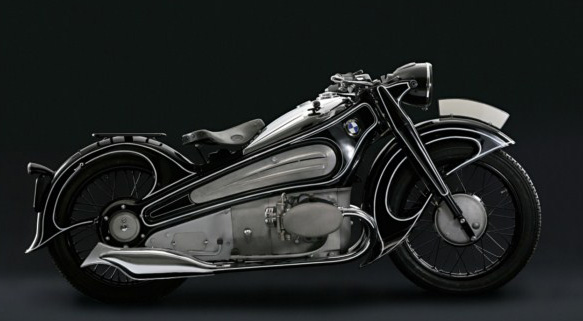
I was trying to work out where the inspiration for these two drawings came from. It’s interesting that often I’ll draw something and have no recollection of where the idea might have come from. I gather images of all kinds of stuff from books, the internet and photographs I take myself. In an attempt to be well organised I file them away on a hard drive somewhere and try to catalogue them so that I can refer to them later. But what often happens is that I rarely look at them at all whilst I’m drawing. As a consequence I often generate an initial sketch without their help but, some part of them must lodge itself in my mind somewhere as I can often find a link between a drawing and a stored image after the event. It’s a strange twist on post-rationalisation I suppose. The BMW R7 shown in the picture is where the main inspiration for these two drawings came from. It’s from the 1930’s as far as I know. I love it. It’s such a fantastic expression of futuristic thinking from that period. There is so much motion in the form language, extenuated by the white pin striping but it is the way that it appears to have no frame that catches my eye first. I’ve got a feeling this bike will influence a few more of my doodles before the effect wears off.

Anyway, this sketch above will get worked up along with the other one in ink to start with. I love it as it is in pencil so I’ll most likely work through onto another sheet with the light box and then revisit this image with more pencil work to get some more detail in there and some deeper tonal areas. I’d like to then scan the inked drawing and print a few out so that I can start to play around with some colour without risking mucking up the original, I’d hate to lose a good drawing through messing about with some paints. I’ll keep you posted on how it goes.

Tmts-The last part.

With the metal parts done I still had no idea what I was going to do about the bodywork colour. I knew that I wanted it to be bright, but I also wanted it to be right. By deciding to apply colour to the wheels and other smaller details I thought I’d be able to postpone making up my mind a bit longer and that the presence of these other pieces of the drawing would give me some indication of which direction I wanted to go in.

The wheels are a big part of any bike drawing. As much as any other part they lead the eye in emphasising any perspective used,can give an image direction and motion, and anchor the drawing to any ground plane. They are also, or can be at least, big blobs of colour. In this case there’s no perspective to worry about so their main function is to complete the drawing and ground it.

We perceive tyres as being bklack but in reality they are anything but, ranging from almost white highlights to virtually black  in the shadows. I like to keep these things simple and so chose to start with black, for shadows etc and then applied white to give gradated greys and lend the tyre some basic form, nothing more.

And now the time for the bodywork.

Orange, definitely orange I’d decided. A bright, fast colour that makes me think of sport, racing and speed. It’s a great colour for bikes, think KTM and Kawasaki. Wanting to build it up slowly I applied it with colour pencil, and quickly realised that Bristol Board requires quite a bit of pressure to build up a good layer. Finally doing the exhaust and inserting a fat ground line finished it off.

I’m quite pleased with the result given that it’s a fairly simple image. I could fuss over it for another hour or so but I’ll leave it as it is for now. The colours worked ok in the end and lend the drawing a bit of that “punch” that lifts it off the page. But it’s what is not there that slightly bothers me. It’s a contextual thing, the lack of a background or other device holding it back. In all my subsequent drawings this is something I’m still figuring out.

I could have, of course, avoided a great deal of this mucking about by simply scanning the black line drawing into Photoshop and just playing around for a while. But I decided not to. There are a number of reasons for this. Firstly I find it’s too easy to create something on screen and then be utterly unable to repeat it on paper,  colour matching being a perfect example of this. Also, the texture of the paper can have a quite strong influence on the colour medium that is applied to it, and I find it utterly laborious trying to replicate this on screen, especially when all I’m doing is having a quick look at how something might look.

Secondly, and this is a process issue more than anything, I find it burns up my time and plonks me squarely in left brain mode when all I want is to be in right brain, creative mode for a bit longer. Left brain is the logical half of the partnership and I find it starts to restrict my thoughts and actions, particularly when I’m working on a drawing. Perhaps I have yet to learn how to be truly creative with a computer program, but I find even the simplest of menu sequences takes me into left brain territory and keeps me there like some kind of hostage. I’m sure this is a subject that I will return to a lot more later on.

In an earlier post I mentioned that I felt like I’d gone too far with full colour and wanted to draw more before getting into all that. So from this point onward I went back to monochrome, pencil or pen, in an effort to get myself drawing more and thinking about colour less.