Pop! And it’s gone.

The bulging pile of paper sheets sitting on various shelves in my small studio room are testament to the hard learned (many years ago I might add) lesson that for every stack of ideas one might have, only a very few ever really make it out into the world in a finished form that we the creators are fully happy with. In the commercial design environment where I used to spend much of my time this is certainly the case and the reason why the search for a new industrial design for a mobile phone, for example, starts with hundreds of design sketches. Only after a protracted process of editing, refinement, lots of trips round an iterative loop and endless testing is the final design isolated.


What’s the point of the above? Well, I suppose it’s a comment on ones ability to accept that no matter what you might think there is still a very strong reason why iterative exercises and endless failures must remain a fundamental part of any personal creative undertaking. Personally, I like it when things don’t go quite right. It makes me refocus on what I’m doing and forces me to analyse why it didn’t work in an effort to learn something new and move forward.


This is what’s happening with this colour sketch above. I knew I had to put some kind of background in. I thought I’d try and keep it simple. I had a funny feeling it wasn’t working before I’d finished but, I carried on, and I think mainly to see if it would turn out as bad as I’d suspected. I think it did. I will probably find ten things wrong with it if I think long and hard about it. But I don’t feel the need to do that as the thing that hits me first is that it kills the drawing. It’s taken any and all of the “pop” away from the core image and drowned it in a sea of mid-toned dullness. ‘Pop’ is the word I use to describe in very simple terms an images ability to jump out of the page at you. The colour drawing in the previous post has it and many of the black and white drawings have it too. For me it’s about contrasts. Tonal contrasts across a drawing and between foreground and background. And intensities, particularly when using colour, again between foreground and background.


In theory I should know better, I’ve been making images for long enough to balance these things instinctively but, it doesn’t always work like that, so moments like this are always useful because they force me to step back from the work and consider carefully what I’m actually doing.


I’m not sure yet what I’m going to do with it. I could use it as the basis for a good fiddle in Photoshop just to play with tonal values quickly or I may take the opportunity to recolour another print and find that missing pop.


Keeping it up.

Strange effects courtesy of the scanner.

Prompted by my lovely niece Rose, who’s currently away in Germany on a working year for her language degree, todays post has some drawings in it. She quite rightly let me know that all the bike building stuff is all very well but, where are all the sketches etc that filled the blog when it started? I suppose I had got a bit engrossed in the bike build so, for Rose and all other fans of them here are a couple of drawings.

You will remember from previous posts that I was having trouble deciding on backgrounds for some of the images, I still am, it’s definitely becoming a work in progress though my inner self wishes I would just get on and resolve it once and for all. The reasons I’m posting this sketch are two-fold. Firstly I wanted to see how one of the drawings would turn out if I employed an old technique that I haven’t used for ages. Namely inking in the sketch with a very fine tipped felt pen and then gently “washing” over selected areas with a damp brush to create the shading I wanted. I was working just on some thin layout paper as this was a bit of an experiment. I had a feeling that the paper would warp with the moisture from the brush, but I ignored it. Then I put it in the scanner and this is the result, a kind of sunburst pattern around the drawing. I understand that it’s the result of how the light from the scanner falls and moves across the paper, but it’s a pleasant surprise that it creates this effect around the drawing but not across it. Interesting. Backgrounds by mistake, perhaps there is something in this, leaving things to a kind of creative serendipity.

This other drawing is one that I did a little while ago. Again, my sharing this one with you is to do with background again. here I tried to follow up on the idea that I create a partial background using a distinct part of the drawing, namely the smoke billowing out around the rear tyre. I’m not sure that it works that well as I don’t think I rendered the smoke particularly competently. It’s an idea I want to try again. I think I overdid the level of detail in the puffiness of the smoke, perhaps a simpler approach would work better. I do like however the way you can leave holes in the smog through which one can see parts of the bike and wheel. The only drawback to this is that it’s a lot of work to create a drawing that in the end doesn’t work. But that’s half the fun is it not, and we have to do these things in order to learn and move things forward.

So if we believe that we should try and learn something new every day, then today I’ve learned not to leave such big gaps between my sketch posts and that my funny old scanner has the capacity for unexpected creativity. Who would have thought it?

The right way to go.

Just when you think you’ve got a strong idea in your mind it has to be admitted by this scribbler that my minds ability to create an image is far more polished than my hand/eye combo. Full of a new found confidence and a belief that I’d finally started to crack a nut that had been bothering me for some time, I leaned back and presumed things would just flow out. No, it was a lot harder than that. Sketch after sketch after sketch. Locked into a kind of one man battle with a pad of layout paper I just went round and round in circles. Over a cup of desperately needed coffee I laid everything out on the floor and had a think about what I was doing. Doing this is such a great way of seeing where you are with a project and a practice ‘d completely neglected to incorporate into my working.

By turning over all of the skamps that I felt weren’t going anywhere I ended up with three or four which showed promise. I rarely throw any drawing away, no matter how crappy, you never know what you might see in them on another day with fresh eyes. So I had a pile of duds and a select few to work on further.

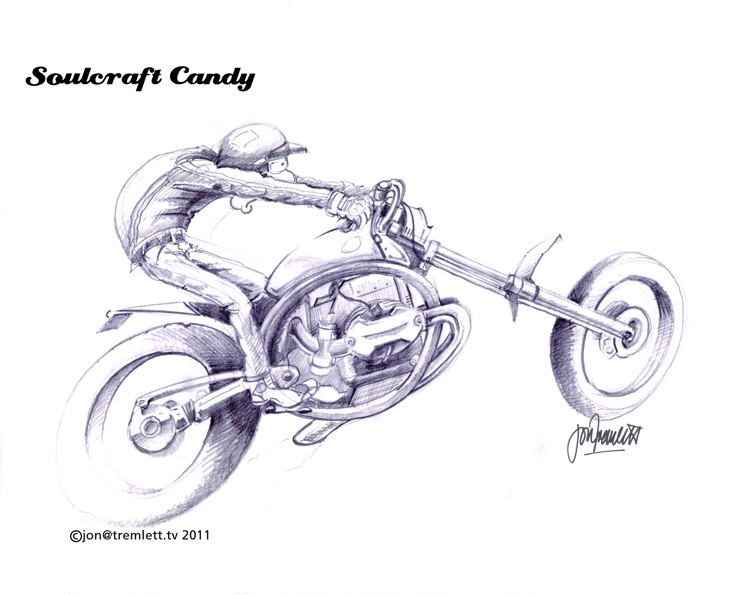
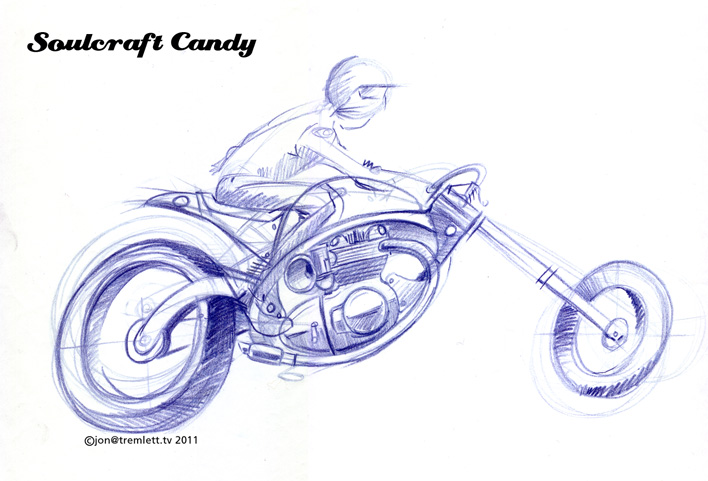
I stuck with pencils and layout paper. One has a beautiful progressive nature to it, in that it allows you to press as softly or hard as you wish and the line quality is a direct reflection of your actions and, the other is opaque enough for a good background but thin enough to allow you to place drawings underneath the top sheet and trace through. The two sketches in this post are preliminary drawings for others that I’ve now done in ink.

Because I’d been thinking about context and how to create it in the drawings I’d decided to always draw a rider on board unless he’s close by doing something to the bike and it’s stationary. I kind of thought that that, and the attitude of the bike in the picture would be enough to keep me going for now and that I’d worry about fuller backgrounds later on. I wanted to master drawing the bikes first. I also wanted to try and find a style of drawing that was comfortable and more importantly, repeatable, in the sense that layout and other elements would come more naturally rather than feeling forced in any way.