A time for ink.

Armed with the blue pencil sketch from the previous post, I used it as an underlay to create the final version of this drawing. Having said before that layout paper provides a good opacity for tracing through it became obvious fairly early on that despite this it was often difficult to pick out the lines that I wanted to follow. As a result I found working slowly and with a medium hardness pencil the best way to go. Basically I could erase things if I didn’t like them, though there is always the danger that you’re going to wreck the paper just at a critical moment as you get a bit enthusiastic with the eraser. I always try to avoid this by stretching my hand across the sheet and working the eraser slowly between my thumb and forefinger. Still, the danger is always not too far away.

I seem to have acquired a two pronged attack to adding detail to the drawings. I insert a certain amount in the pencil stage and then include more as I proceed with the ink pen stage, and so the drawing looks kind of half done at this stage. I also have to say that when I’m unsure about something, like the rider’s expression for example, I’ll leave it half done and continue to work on it in pencil as the inking process moves forward. Something in the way the drawing takes shape seems to help me find the right look further down the line.

Inking on this drawing was straight on top of the pencil on the layout paper. I realised I didn’t have any kind of light box that would allow me to easily transpose the image onto my favoured Bristol Board. This was something I didn’t forsee but was able to solve relatively quickly soon after as I made my own. I’ll cover that in the next post.

As a consequence the process of laying down layers of biro ink onto quite thin paper lead to the paper doing what it always does in these instances and that is to wrinkle quite badly, particularly around the areas where you put in the most effort. I suppose it must be that the constant pressure and side to side action of the pen stretches the paper. I could see myself ironing it in a desperate effort to make it flat enough to stick to a backing board. I know ironing a drawing sounds a bit mad but it does work provided you place it face down before you start and work slowly from the centre outwards and keep the iron dry. Stay away from the steam button. The strange things that my brain is filled with eh? As an aside, I first learned about ironing paper from the father of an old friend who I was best man for at his wedding. He told me to iron all the cash I was due to hand over to the chauffeur and various other folk that day. The reason being that it would give a great impression and that a man in a top hat and tails should be armed with suitably smart money. Whatever.

Fortunately I didn’t need to flatten out the drawing in the end before getting it onto a backing sheet, to protect it as much as anything else. In its current state the paper drawing doesn’t have any ground line or background, I’ve added these in a very scribbly way in photoshop just to see what it looked like. I’ve been mucking about on a multitude of photocopies with all kinds of backgrounds and ground lines. I’ve not found what I’m after yet but will add to the final drawing when I do. Coming up with ideas which both convey speed, and sit naturally with the style of the drawing is proving a lot harder than I thought it would. Perseverance will win out in the end though. I for one will certainly be happier when it does. The last thing I want to do at this point is f**k up a decent drawing with a failed background experiment.

The inspiration for this image is definitely from my love of racing machines and a burgeoning liking for big twins and singles. There’s something about these engines that’s kind of pure and simple, though having said that many are certainly not so. I also have tried to convey in the rider the sense of barely controlled power and the kind of expression that I’m sure many of us make when we feel we’re really opening the taps. There’s still much more work to do and progress to be made but at this point I feel the drawings gaining a definite look of their own.
 

Too much too soon-Part2

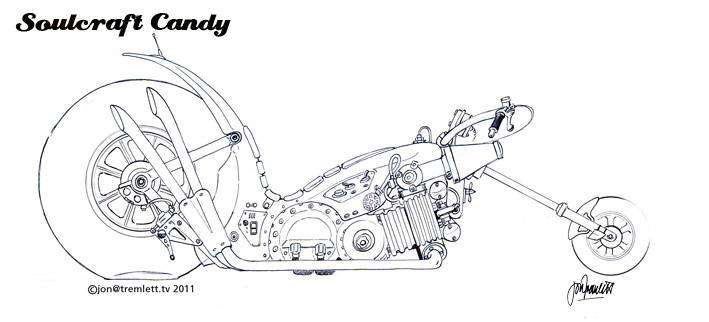
When I’m finished fiddling with the original sketch it’s time for ink. This one was done in black medium point biro.


I’m sure everyone has their own opinion about inking in a drawing. Should it be the last thing to be done? Should it be the first step after sketching something out? I don’t think there is a right way or a wrong way, a right time or a wrong time for it to be done. For me it very much depends on what I’m going to be doing with the rest of the drawing. For example, if I’m going to be using a lot of colour pencil, and the drawing is on a particularly rough piece of paper then I may very well ink in at the end as the colour often ends up obscuring any lines that you’ve made previously. The same goes for certain paint media too, gouache in particular. Sometimes this timing depends on what I’m using to create the outlines in the first place, for instance is the ink waterproof or not, or is some of the line work so fine that it will be all too easy to obscure with what comes next. If I’m thinking of using any magic markers or similar spirit based media I’ll ink up first in a water based ink as spirit markers can make a lovely mess of a biro line and you end up with black smudging all over the finished piece. Similarly, if I’m of a mind to use a light watercolour or colour ink wash then I may very well ink up last as again the liquids can dissolve the outline and leave a messy result which you can’t fix later.

I’ll often use this stage of the process to add little extra details. This is again a result of coming back to an image after a break and seeing things differently. As with many aspects of drawing and creating images like this, the secret, if there is one to learn, is knowing when to stop. This is also sometimes a good time for filling any areas which you know are going to be solid black in the final piece, though having said that, if the drawing is going to be in full colour quite often black is never truly black. Again it’s a choice to be made before moving on to the next stage.

Old habits die hard.

When I made the decision to share some of my output with the world and start this blog I had very little idea how difficult it would sometimes be to distill thoughts and processes into meaningful words. I suppose rather naively I didn’t realise that I would need to learn to cast a more critical eye over my work. What I mean is that normally when one is making an image you make judgements about what you’re doing all the time but, you don’t have to express them, the conversation happens in your head. Alterations and changes that you want to make are decided silently before proceeding.

Now, up until now I’d been drawing away to my hearts content and was pretty happy with how things seemed to be going. I’d realised that bikes were quite difficult things to draw, they are actually quite complicated things really, but had satisfied myself that I could stick with plain elevational views for the time being, while I learned more about them from a form perspective. Getting a drawing to look right in terms of shape and proportion was quite a challenge to start with. It was surprising that so many of the elements had to come and work together just so the thing looked like, well, a motorbike. There was a lot more involved than I first reckoned. So achieving a drawing which hung together and looked ok  just in line form turned out to be quite hard work to start with.

Fine, and then for some mad reason that even I can’t fathom I started colouring them in.

Great, but what was I thinking? I’m sure I had told myself to stay away from all the myriad colour pencils and pens that litter my workroom. I’m pretty sure I’d had a word with myself about reaching into the drawer for a circle guide or French Curve as well. But no, I couldn’t resist it.

I mentioned in the previous post that something reared it’s head and this was it. Big deal you might think but, it actually created more problems for me than I wanted, and influenced a number of things. For I start I began to think constantly about how I would render the drawing and this influenced the way I drew things at the outset. It also meant that I was covering the drawing in a kind of cloak of realism which I had initially intended to leave out until I’d built up a bit more confidence and competence. I was sat there thinking, “what colour should this bit be?” and “how many spokes should this wheel have?” If I wasn’t careful I’d be diving headlong into the realms of reflections and then there would be no end to it.


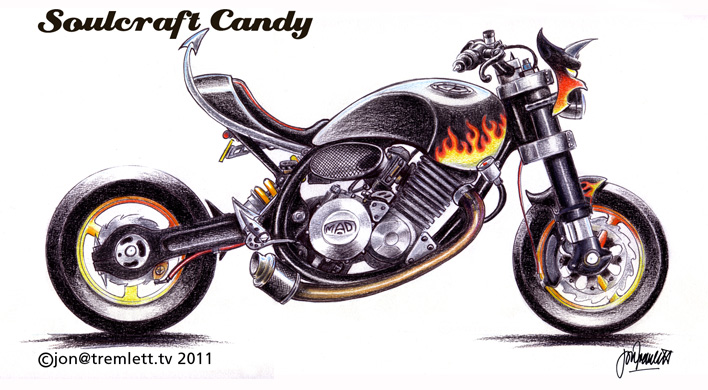
I’d done a few line drawings and suddenly found myself staring at a pile of colouring in. I got myself truly stuck in. I’d started with colour pencils as they are my kind of default medium, I’ve always been very comfortable with them, and started piling on the pigment. Here’s another one that got the treatment.

In isolation these aren’t bad drawings, even though I say that myself, but they were lacking something which had been very evident in the first drag bike cartoon. They were a bit dry and lacked a certain something, a dynamism? And there weren’t any people in them.

I was reminded of an old tutor I had when studying at the Central School of Art in London back in the early eighties. In his spare time he would sit at home and paint pictures of vintage cars in gouache and ink. They were impressive technically but, as dry as a bone visually. I looked at my drawings and got a feeling that I was headed, albeit slowly, down some road toward a similar end, spending days painstakingly recreating every last detail in perfect likeness. That was not what I wanted and so had to rein myself in somehow. I knew that there would be a time for lots of colour but it wasn’t now and it wasn’t like this either.

The learnings from this experience were interesting though. Quite unwittingly I’d found myself charging off down a path I had not readied myself to pursue. This is what I think happened. They say that old habits die hard and perhaps this is the case here. Over years of making images to illustrate design ideas one gets into a groove. Not only does each designer develop their own unique style, but I think they also embed within themselves certain ways of doing things. These are like creative habits. If I look back at some of my work from studio days I can clearly see that I went about things in a very particular way. In a sense that’s what I found myself doing now, doing it in a certain way. I was going from sketch to line drawing and then to colour etc etc. For things to be finished they had to be in colour, properly shaded and kind of looking “real”. Despite the fact that the images were not of real things I’d started to try and make them look as real as possible and had found myself “designing” them, which in it’s own way effected the lines I drew. I was sat there worrying about whether they looked real enough, when the whole idea in the first place had been for them not to be real at all. Most importantly the process had started to be less fun. I hadn’t got the mix of ingredients right. Time for a rethink.